
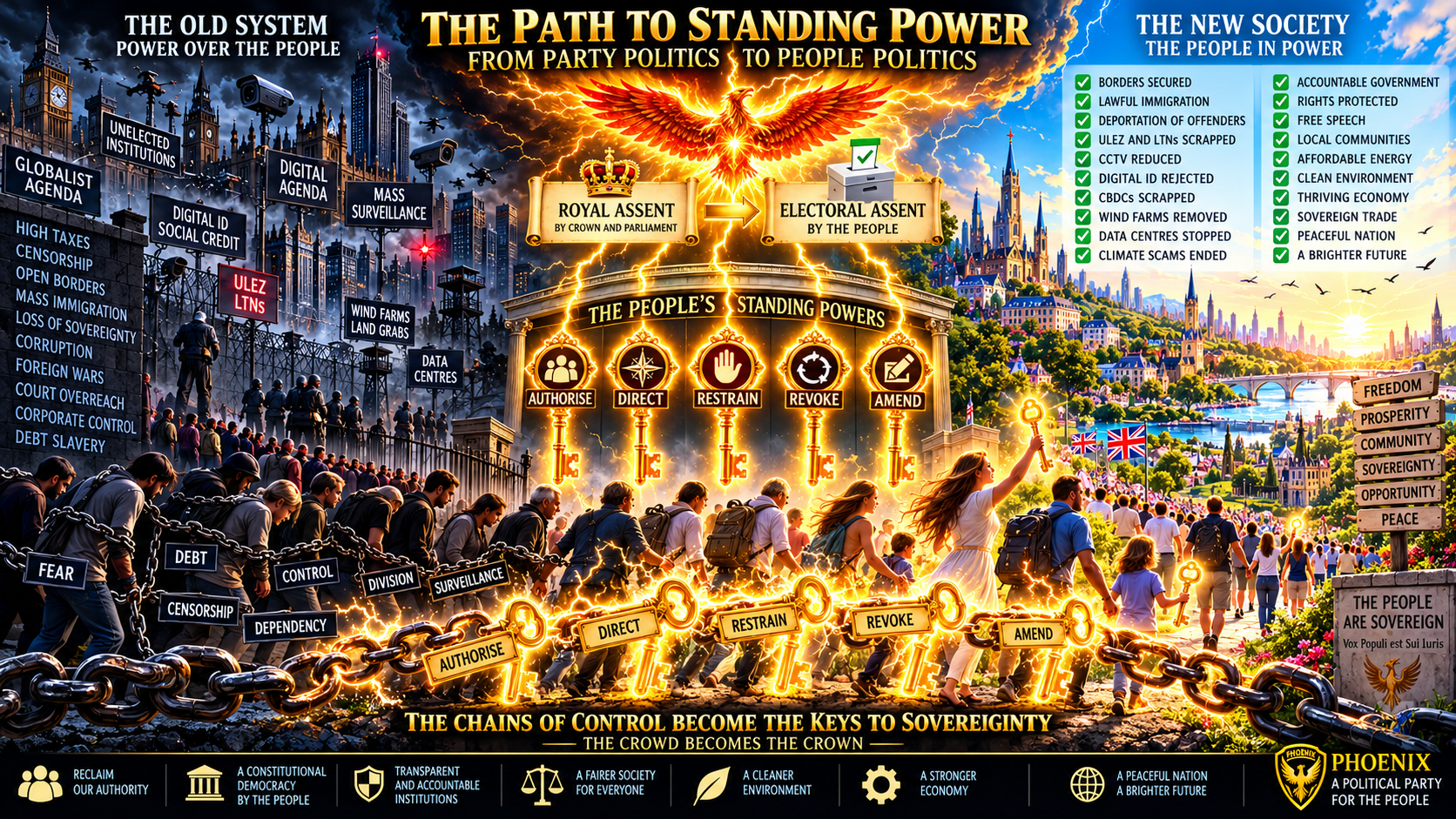
Path to Standing Power — From Approval to Operation
THE REFERENDUM IS THE DECISION. OPERATIONAL STANDING POWER IS THE DESTINATION.
Vox Populi est Sui Iuris — The Voice of the People is Sovereign.
Public information draft V001 — 5 November 2026
Contents
- The distinction from the Path to the Referendum
- The official constitutional decision
- Legal recognition and commencement
- The electorate itself becomes the constitutional body
- The five Standing Powers
- Building the Civic-Crowd-Device
- Independent testing and public assurance
- The Guardian and the courts
- The commencement decision
- Government continues through the transition
- The constitutional destination
1. The distinction from the Path to the Referendum
The Path to the Referendum explains how public demand can reach Parliament and become a lawful national vote. This page concerns what must happen after a constitutional settlement is approved before the electorate can actually exercise continuing Standing Power.
The founding objective is not fulfilled solely by an election victory, parliamentary legislation or even a successful referendum. It is fulfilled when the new Standing Power exists in law and the People have a practical, secure and auditable means to exercise it.
2. The official constitutional decision
The proposed referendum would ask eligible voters to approve or reject a defined constitutional settlement, including the House of the Electorate, five Standing Powers, Electoral Assent, fundamental rights and institutional safeguards.
Before voting, the complete operative text, the intended consequences and the arrangements for commencement must be identified in law. A private pre-vote or petition cannot substitute for statutory authorisation and a certified result.
3. Legal recognition and commencement
Once the result is lawfully certified, its effect follows the legislation that authorised the referendum. Some constitutional changes may commence at a specified time; others may depend on conditions that must be satisfied to protect continuity and the People.
The transitional arrangements must define which institutions continue to exercise authority until each function has been lawfully modified. Neither Phoenix nor a software provider may simply announce that existing law has ceased to operate.
4. The electorate itself becomes the constitutional body
The proposed House of the Electorate consists of the eligible electorate itself. It is not an appointed council or a second chamber of politicians.
The Constitution would define eligibility, lawful initiation, decision periods, thresholds, safeguards, review and implementation. These arrangements must protect individual rights and independent courts rather than treat every public poll as a binding court or parliamentary decision.
Voice of the Electorate explains petitions, proposals, public deliberation and decisions.
5. The five Standing Powers
AUTHORISE grants or withholds defined constitutional authority. DIRECT enables lawful binding directions. RESTRAIN prevents or limits abuses under the prescribed process. REVOKE permits mandates and authority to be withdrawn. AMEND provides lawful procedures for changing constitutional arrangements within rights protections.
Electoral Assent is a separate function for constitutionally prescribed assent to legislation, not a sixth Standing Power. Each power must have clear legal effect, eligible participants, thresholds and remedies.
6. Building the Civic-Crowd-Device
The Civic-Crowd-Device is the proposed practical infrastructure through which participation can be organised. The underlying mechanic — token → threshold → outcome — is a system for recording valid contributions and applying predetermined conditions; it is not a source of constitutional sovereignty in its own right.
Development may begin before the referendum and continue during the legal transition, but private website polls, beta systems and prototypes have no binding constitutional authority by virtue of their existence.
The underlying Crowd-Device and protective Trust arrangements remain distinct from the political Party and the legal authority of the electorate.
7. Independent testing and public assurance
Before commencing legally binding operation, the system must be shown to be functional, secure, auditable and genuinely usable by the electorate. That includes eligibility checks, duplicate-vote protection, ballot secrecy where required, accessible non-exclusive methods of participation, reliable recording, independent audits and remedies for failure.
Any reliance on identity verification must protect privacy and cannot be turned into general-purpose political surveillance. Independent scrutiny must be able to determine whether published results are accurate without exposing confidential ballots.
Administrative convenience does not permit skipping required legal or technical safeguards.
8. The Guardian and the courts
The Guardian’s proposed role is to protect integrity of the constitutional procedure, not to decide which policy should win. Independent courts retain the ability to determine disputes, enforce lawful rights and provide remedies.
Neither a Party officer, software administrator, trust custodian nor Guardian may claim to become sovereign. The People remain the source of authority; the Constitution defines its lawful exercise.
9. The commencement decision
When the statutory and constitutional requirements are satisfied, the competent authorities under the approved settlement would certify readiness and bring the relevant functions into operation under the lawful commencement process.
That decision must be documented and independently reviewable. The Party’s Founding Objective is achieved only when the Standing Power can actually be exercised, not merely when a government says a project is finished.
LEGAL AUTHORITY + PROVEN PRACTICAL OPERATION = EFFECTIVE STANDING POWER.
10. Government continues through the transition
If the legal settlement is approved before its practical mechanism is ready, ordinary government continues except where the law specifically changes its authority. Parliament and public administration do not surrender lawful functions to an unproven voting website.
Phoenix may govern under ordinary law during that interval, using experienced public servants and advisers, while remaining bound to pursue the protected Founding Objective.
11. The constitutional destination
Once operational, the electorate has a continuing route to authorise, direct, restrain, revoke and amend delegated authority under the adopted Constitution. Government continues to administer the country but remains accountable to the People.
Phoenix does not automatically dissolve. If lawfully entitled to remain in government, it continues under the constitutional order approved by the electorate and can be challenged through its constitutional processes and ordinary elections.
FROM PARTY POLITICS TO PEOPLE POLITICS.
THE CROWD BECOMES THE CROWN.