
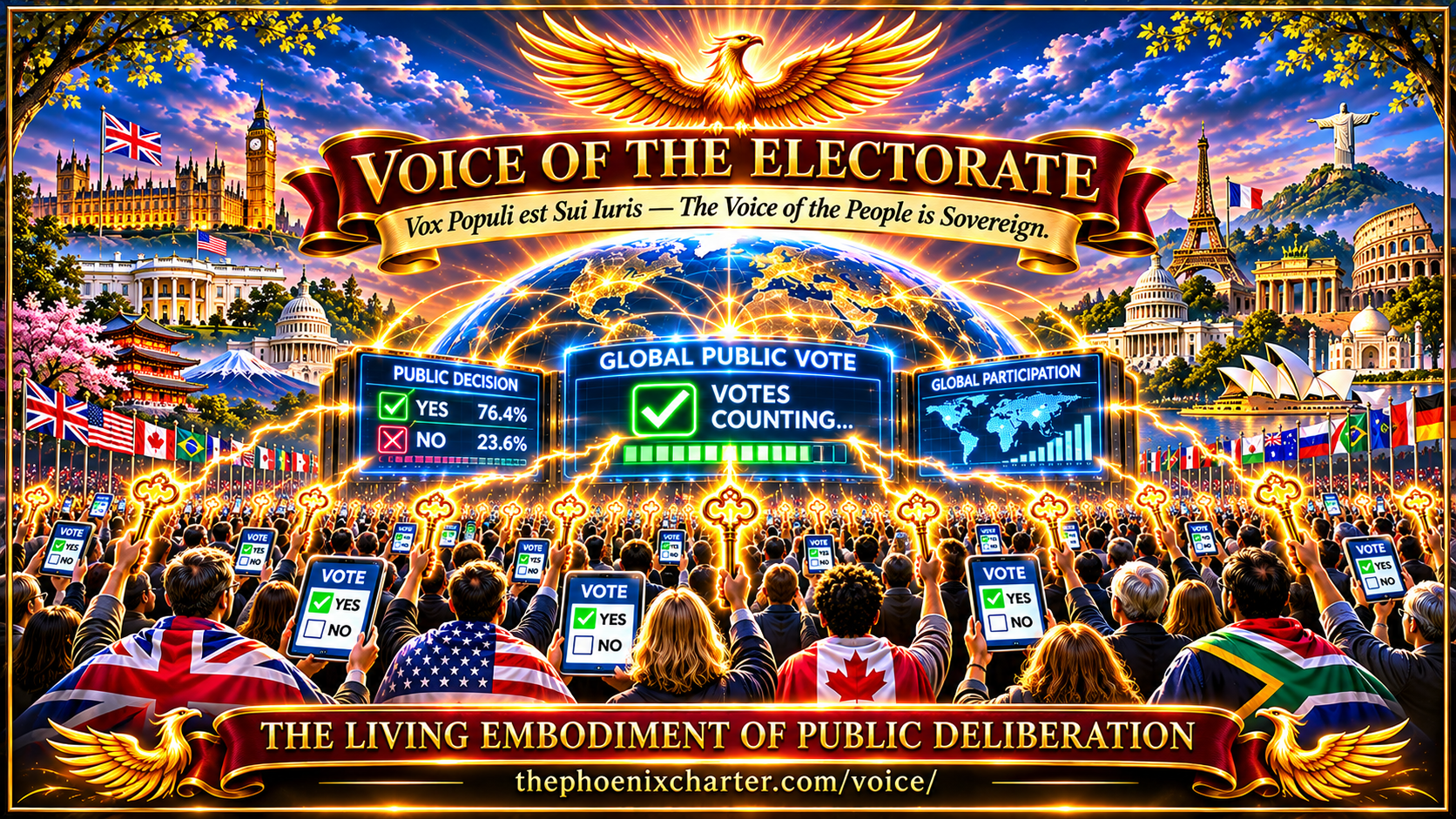
Voice of the Electorate — From Proposal to Public Decision
FROM PARTY POLITICS TO PEOPLE POLITICS
Vox Populi est Sui Iuris — The Voice of the People is Sovereign.
For generations, the People have been asked to make their political choice at an election and then leave the business of government to those who won it. Their views may be expressed through petitions, public meetings, protests, letters and consultations, but those expressions do not ordinarily give them a continuing constitutional power to direct or withdraw the authority exercised in their name.
The Phoenix Charter proposes a different relationship. Elections would remain, Parliament would continue and government would still administer public affairs. The change would be that the electorate itself would possess a continuing means of raising issues, examining the facts, deliberating with one another, expressing a collective judgement and, where the Constitution authorises it, making binding decisions.
The Voice of the Electorate is the bridge between having a right to speak and having an effective constitutional means to be heard.
It is not the name of another political party, a privately appointed committee or a new class of representatives. It describes the process through which the electorate, acting as the House of the Electorate, would form and express its views. The Civic-Crowd-Device would support that process; the Guardian would protect its lawful administration; and government would remain accountable for the action required of it.
Contents
- Why the People Need a Continuing Voice
- The House of the Electorate
- Petitions & Polls — Where Public Participation Begins
- Deliberation Before Decision
- From Proposal to Accountable Outcome
- When Public Opinion Becomes Constitutional Authority
- How Government Must Respond
- Integrity, Access and Protection
- The Civic-Crowd-Device and the Guardian
- What People Can Do Today
1. Why the People Need a Continuing Voice
Ordinary elections answer an important question: who should exercise public office for the next term? They do not necessarily answer what the electorate thinks about a policy introduced years later, how public concerns should be resolved between elections, or how a government should be held to account when it acts outside the purpose for which it was elected.
Public consultation often asks people for opinions after a proposal has already taken shape. A petition may bring an issue to public attention without compelling a decision. A demonstration can expose anger without creating an accepted procedure for turning that anger into an effective instruction. Phoenix does not reject these democratic activities. It seeks to connect them to a coherent process in which the electorate’s judgement can be examined, recorded and, when constitutionally authorised, acted upon.
The intended difference is not that everyone must vote on everything. Most people need to work, care for families and live their lives without performing the duties of government every day. What matters is that a lawful means of intervention remains available when the People need it.
A government should not be able to claim that silence is consent when the electorate has been denied an effective way to speak.
2. The House of the Electorate — The People Themselves
The proposed House of the Electorate is not another chamber occupied by politicians or delegates. It is constituted by the relevant electorate itself, acting through the procedures established by the Constitution. No private operator, party executive or appointed body would become sovereign merely because it helped organise the process.
Through the House, eligible people would be able to submit initiatives, inspect proposals, raise objections, deliberate, participate in polls and, under the adopted constitutional rules, exercise the Standing Powers belonging to them collectively.
The Voice is the means by which this collective body communicates and reaches decisions. The House identifies whose authority it is; the Voice describes how that authority is expressed. Neither depends upon pretending that a private website is already a constitutional institution.
Explore the House of the Electorate.
3. Petitions & Polls — The People Guiding Government
Petitions & Polls provides the everyday public doorway into the Voice of the Electorate. A person should be able to raise a problem that those in authority have ignored, propose a remedy, seek support, ask a public question and discover whether others share the concern. The system should make it possible for an idea to grow from an individual’s proposal into a subject of informed collective consideration.
A petition demonstrates that people want an issue addressed. It may ask an institution to investigate, explain, change or reconsider a decision. A poll helps reveal the range and strength of public opinion, including disagreement and competing alternatives. Neither requires the People to surrender ownership of their views to the person who started the question.
For government, the difference is substantial. Instead of relying only upon party manifestos, occasional elections or selectively commissioned consultations, elected representatives could see an ongoing public record of the issues people regard as important, the alternatives they favour and the arguments they find persuasive.
Government would no longer have to guess what the electorate wants — nor could it so easily claim to speak for the People while refusing to hear them.
Not every petition will become a binding constitutional instruction. An ordinary poll measures expressed opinion under its published participation rules. A public petition asks for attention or action. Only a decision made under the procedures and authority of an adopted Constitution could exercise a binding Standing Power.
This distinction protects the credibility of participation. The total displayed on a website must never be mistaken for an official electoral verdict merely because it looks impressive.
Visit Petitions & Polls to see current petitions, polls and participation opportunities.
4. Deliberation — The Part That Comes Before a Verdict
A petition can identify a problem, but public support alone does not always reveal the best solution. People may agree that an outcome is unacceptable while disagreeing sharply about what should replace it. The Voice must therefore make room for evidence, objections, competing explanations and alternatives before a final decision is taken.
Deliberation begins by clearly stating the issue. Those presenting a proposal should identify what change they seek, which authority could carry it out, why it is needed and what consequences it might have. Others should be able to challenge that account, present additional information and argue for a different remedy.
A proposal may improve through that exchange. It may be amended, divided into clearer questions, combined with a better alternative or withdrawn if its assumptions fail. The purpose is not to force agreement. It is to ensure that people know what they are deciding and can see that contrary views have been considered.
The process must not allow whoever controls a website to suppress legitimate criticism, quietly alter a question after support has been recorded, or manufacture the appearance of consensus. A fair process records the relevant question, the evidence and arguments, the applicable time window and the outcome.
Deliberation is not a delay imposed upon the People. It is the protection that allows their collective decisions to be informed rather than manipulated.
5. From Proposal to Accountable Outcome
5.1 A Person Raises a Proposal
Someone identifies a public problem or proposes a change. The submission makes clear what is requested, which community or institution is affected and whether the matter is an ordinary public petition, a consultation or a potential constitutional initiative.
5.2 Others Examine and Support It
The proposal becomes available for examination. Interested people can lend support, request clarification, identify errors or submit alternatives. Early support demonstrates interest; it does not automatically determine the final outcome.
5.3 The Question Is Deliberated and Refined
Relevant arguments, evidence, objections and practical consequences are considered during the published deliberation period. Where necessary, the wording is refined so that participants can distinguish the problem from the remedy being proposed.
5.4 A Defined Poll or Ballot Takes Place
When a poll is appropriate, participants are given a clear question, available responses and published rules explaining who may participate and how the outcome will be counted. A constitutionally binding decision would require the separate eligibility, notice, voting and threshold rules prescribed by the Constitution.
5.5 The Result Is Recorded and Published
The public should be able to discover what was decided, how many eligible responses were recorded, which version of the question was used and what the result actually means. Auditability and transparency must not require the disclosure of how named individuals voted.
5.6 Government Responds and the Outcome Is Followed Through
For ordinary petitions and consultations, the public record should show the relevant authority’s response and reasons. Where a valid constitutional instruction has been issued, the responsible institution would have the duty established by the Constitution to comply, subject to lawful review and rights protections. The process is not complete merely because a result appears on a screen.
PROPOSE → EXAMINE → DELIBERATE → DECIDE → RECORD → IMPLEMENT → ACCOUNT.
6. From Public Opinion to the Five Standing Powers
Under existing arrangements, a public poll remains an expression of opinion unless the law provides otherwise. The Phoenix proposal is to create circumstances in which a decision made by the electorate under prescribed constitutional conditions carries legal authority. The difference lies in the Constitution, not in the voting software.
AUTHORISE concerns the grant of delegated public authority. DIRECT permits the electorate to issue lawful binding instructions. RESTRAIN provides a constitutional means to stop abuses of authority. REVOKE permits the withdrawal of mandates or delegated authority under prescribed procedures. AMEND preserves the electorate’s power to alter constitutional arrangements by the protected constitutional process.
Different powers may require different initiation rules, deliberation periods, thresholds, voting windows and legal safeguards. Those rules must be established in the adopted Constitution, not invented retrospectively because a platform has displayed a popular outcome.
Electoral Assent is a further, separate constitutional function. It is not another name for an opinion poll and not a sixth Standing Power. The Constitution would define when and how assent by the electorate is required.
Read the Five Standing Powers and explore Electoral Assent.
7. Government Must Remain Accountable Between Elections
The Voice is intended to change what happens after the electorate speaks. A government can receive a petition and explain why it will or will not act. It can engage with public objections, amend a proposal and publish the reasons for its decision. Where the Constitution grants the electorate binding authority, government must recognise that its own mandate remains delegated and act in accordance with a lawful decision.
This does not mean placing ministers under an endless sequence of informal internet votes. Government would continue to make the ordinary administrative decisions required to provide services and fulfil its statutory duties. The electorate’s continuing powers would operate through defined constitutional processes, with the safeguards needed to protect the rights of individuals and the continuity of lawful government.
The intended transformation is deeper than an improved suggestion box. The People would retain a recognised route from public concern to public judgement and, where authorised, from public judgement to an enforceable constitutional outcome.
From Party Politics to People Politics means that elections remain, but accountability does not end when the ballot boxes close.
8. A Voice That Cannot Be Captured
Any system claiming to represent the People must be able to show that those participating were entitled to do so under its published rules, that the same person was not counted unlawfully more than once, that the question was not changed secretly and that the recorded totals are accurate. A process that can be altered by an administrator without scrutiny would merely recreate the danger that Phoenix seeks to prevent.
Eligibility must be appropriate to the type of decision. A public consultation may welcome broad participation; a local matter may concern residents of a defined area; and the future exercise of a Standing Power must follow the electorate and procedures established by the Constitution. These are distinct activities and their results must not be mixed together.
Accessibility is equally important. Participation must not depend exclusively upon a particular commercial smartphone, biometric product or privately controlled account. People must have practical means of participating regardless of disability, technical confidence or access to expensive equipment. Privacy and ballot secrecy must be protected where appropriate, and rights must not be made conditional upon taking part.
The record of a decision should be open to lawful independent scrutiny while protecting personal information. Individuals must be able to challenge procedural wrongdoing and seek independent remedies. No software provider or Guardian should be empowered to decide which political outcome the People are permitted to reach.
9. The Civic-Crowd-Device and the Guardian
The proposed Civic-Crowd-Device is intended to provide the practical infrastructure for verified participation, petitions, structured proposals, deliberation, voting and transparent records. It applies the underlying Crowd-Device mechanism — token → threshold → outcome — to civic participation under constitutional rules. The mechanism organises participation; it does not manufacture sovereignty.
The Civic-Crowd-Device would administer the procedures that the Constitution authorises. The Guardian would protect the integrity of those procedures, rather than choose political outcomes. Independent courts would continue to determine legal disputes and protect fundamental rights.
The relationships must remain distinct: the People are the source of authority; the House of the Electorate is the People collectively; the Voice is the means of expression and deliberation; the Civic-Crowd-Device supports the process; and the Guardian protects its integrity.
No invention, party, Trust, administrator or commercial operator should acquire control of the electorate merely because it helps maintain the machinery of participation.
10. The Voice Today — What Is Already Available and What Is Proposed
The Phoenix website already has a Petitions & Polls facility for public participation, separate from the Petitioner signing system used for affirmations on the Sign page. The existing poll facility demonstrates the intended approach to public questions and visible results; it does not itself exercise a constitutional Standing Power.
Further facilities for structured deliberation, electorate verification, safeguarded constitutional voting and accountable implementation are part of the proposed system. They must be developed and tested before being described as operational constitutional machinery.
The preliminary referendum poll, when opened, will belong in the Petitions & Polls area. It can record and display public opinion about the proposed constitutional settlement, but it cannot replace an official referendum authorised by Parliament.
Open Petitions & Polls to see participation opportunities.
Read what the proposed constitutional referendum would decide and examine the parliamentary Referendum Bill.
11. The People Must Never Be Reduced to Spectators
The Voice of the Electorate is not an attempt to abolish representative government. It is the means by which representative government would remain in a living relationship with the People who authorise it. Citizens would be able to raise issues, test claims, propose remedies, see disagreement openly examined, register their judgement and follow what happens next.
Where the Constitution permits only consultation, the outcome must be described honestly as consultation. Where it authorises a binding decision, the authority responsible for implementing that decision must be identifiable and accountable. The People should never be offered the appearance of participation while the actual power to decide remains hidden elsewhere.
THE PEOPLE ARE NOT AN AUDIENCE FOR GOVERNMENT. GOVERNMENT IS ACCOUNTABLE TO THE PEOPLE.
FROM PARTY POLITICS TO PEOPLE POLITICS.