
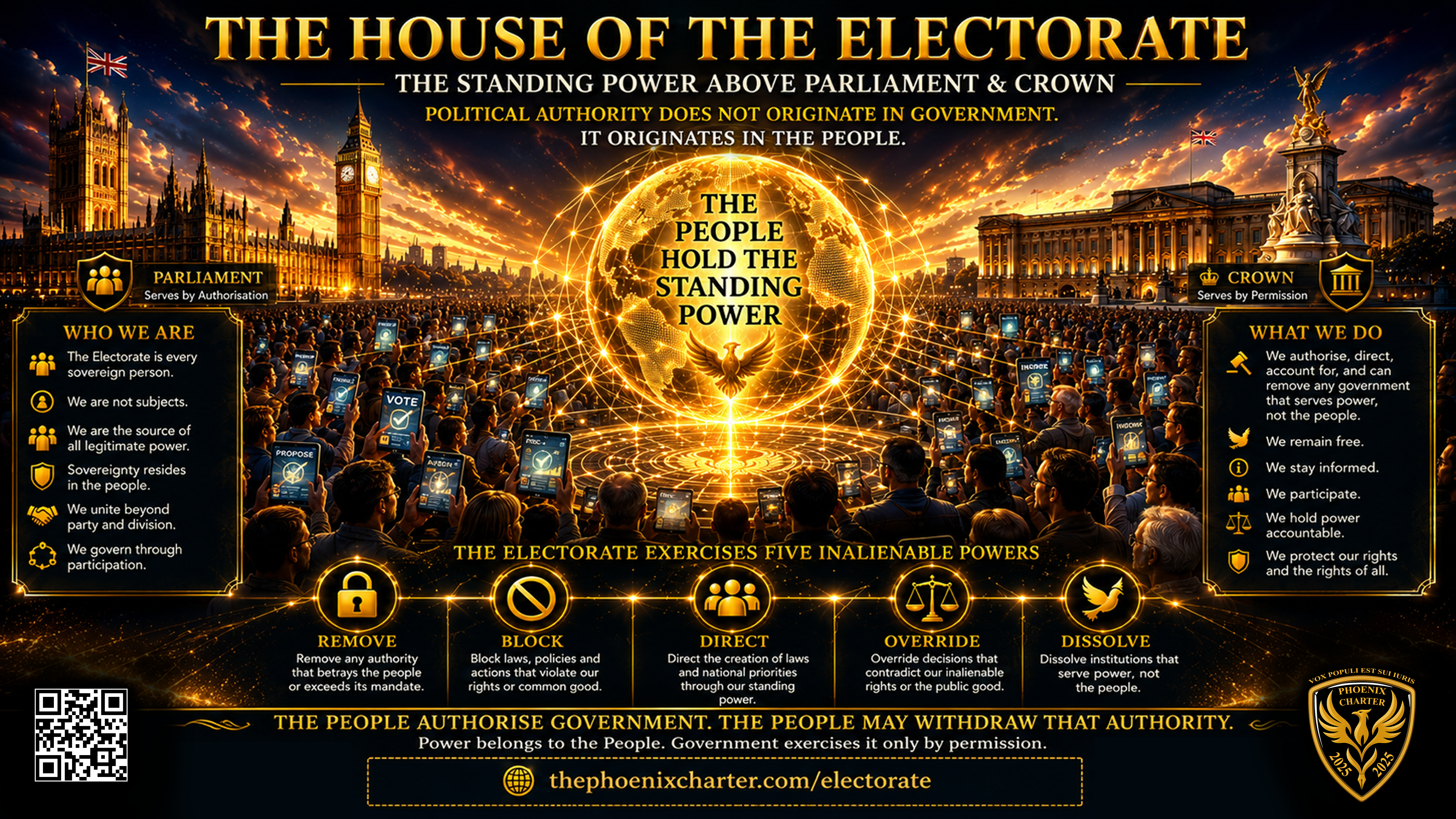
The House of the Electorate
Holding a standing power of the people, above Parliament and Crown
The House of the Electorate is the whole body of the electorate, holding the standing power the people authorise. It is the political sovereignty of the people — which the constitutional writer A. V. Dicey identified as residing always in the electorate, behind and above the legal sovereignty of Parliament — made operative, for the first time, as a working authority.
It is not a new chamber of politicians, and not a new layer of representatives who hold power on the people’s behalf. It is the people, whole and entire, holding a standing authority directly, above Parliament and Crown. Override, not bypass: it does not abolish the institutions of government, it places them, at last, beneath the people they serve.
How the House of the Electorate takes force
The House of the Electorate does not exist yet, and this page does not claim that it does. It is the settled destination of a lawful, peaceful route: a petition that demands it; a party raised to carry that demand into law, a purpose it can never be turned from. What becomes of it once that demand is carried is a matter for its own members and the electorate to settle; a single binding referendum in which the people establish it in constitutional law; and the standing power that referendum brings into being. It takes its force from the day the people vote it into being — not by automatic operation of law, and never by force. The road to it is set out in How We Reclaim Sovereignty.
To Stop and to Direct
Sovereignty, rightly understood, has two hands. A free people must be able to stop what is done in their name, and to direct what is done on their behalf. A power that can only object is a power of complaint; a power that can only command is a power without restraint. The House of the Electorate makes both operative: a settled authority to halt, and a settled authority to require — held by the people themselves, not lent to anyone.
The Four Powers — the Phoenix Kill Switch
Through the House of the Electorate, the people hold four standing powers:
- Refuse — to withhold consent from a law, mandate, or act done in their name, so that it does not stand.
- Repeal — to undo measures already in force that break the terms of legitimate authority — what should never have been done.
- Direct — to require what ought to be: not only to block, but to instruct — to adopt or to abandon a course, through a settled and deliberate process. The power to say “do this,” not only “stop.”
- Dissolve — to bring to an end a government that breaks the mandate it was elected on, and to return the question to the people.
Together these are the Phoenix Kill Switch — not a means to switch off government, but to stop a government that has forgotten whose power it holds. It is held in reserve, used by deliberate verdict, and never by any hand but the people’s.
What the People Could Reach
As things stand, when power breaks the terms on which it is held, the breach simply stands. The people may protest, vote in new officials, or wait for the next election — but they hold no instrument that can name the act for what it is and undo it. Today, illegitimacy is a word without teeth.
Under the standing power, that changes. An act that breaks the terms of legitimate authority is no longer merely wrong in principle: it is illegitimate in fact, and the people have the means to strike it down. Through their verdict, the people could:
- refuse or repeal laws, mandates, and regulations that break the terms of legitimate authority;
- mandate that any treaty or international commitment seeking to bind the nation must first answer to the people’s consent;
- strike down fines, penalties, licences, or conditions imposed by power acting outside its bounds;
- set limits on the use of state force, so that compulsion rests on lawful authority and the people’s consent;
- and restore in fact the rights that today can be set aside without remedy.
These laws are illegitimate in their origin. That does not, by itself, make them void or end your obligations — illegitimacy is not automatic nullity. They stand in force until the people withdraw their consent and reverse them through the standing power. Nothing here is undone by argument alone; it is undone only by the people acting.
Supreme but Never Unchecked
The standing power is bounded from its very first day by a floor of rights that even the people’s own vote may not cross. It may not be used to strip the innocent of protection, to punish belief, or to breach the liberties the Charter secures for everyone. Within that floor the power is supreme; the floor itself is beyond its reach.
Once held directly, the standing power can be laid down only by the people themselves — it cannot be repealed by a government, dissolved by a court, or signed away by treaty. Entrenched, supreme, but never unchecked. That floor of rights is the Bill of Rights.
The One New Office: The Guardian
Only one new office is created, and it holds no power of its own. The Guardian of the Electorate is an intermediary, not a representative — a faithful keeper of the process, never a voice that speaks for the people. The people form their own will directly, through the Civic-Crowd-Device; the Guardian’s task is only to make sure that will travels intact, is placed before government, is not buried, and that what government does in answer is carried faithfully back.
The Guardian certifies that a verdict is genuine, properly conducted, and within the rights floor; places it before Parliament as a binding instrument and ensures it is entered, recorded, and answered rather than quietly dropped; watches whether government acts on, stalls, or drifts from the instruction; and compiles Parliament’s responses and actions faithfully, relaying them back to the electorate so the people can see what was done and pass their next verdict. It transmits; it does not translate. The public record of that loop is the Phoenix Ledger.
Because it interprets nothing and decides nothing, the Guardian is not a chamber standing between the people and their power. It is the integrity check on the channel — and, like any office, it can be removed by the people it serves.
The Guardian of the Electorate
The Institutions Reordered
What follows is not a blank page or a power vacuum. The same institutions continue — reordered, with the people restored to the apex of their own constitution, holding a standing power the rest must answer to:
- Parliament — continues, now answerable to a standing power it cannot override.
- The Crown — continues, held to the same standard.
- The courts — continue, upholding the people’s codified constitution and identifying breaches of it, with the final verdict on any breach resting with the electorate’s own standing power.
Nothing is torn down. The structure of government remains familiar; what changes is who sits at its apex.
The Tool It Votes Through
Authority, Power, and the Device
There are three things here, and they must never be run together. The first is authority — and the authority is already the people’s; it always has been. The electorate has never lacked the right to govern itself; that is where sovereignty resides. What it has lacked is the second thing: the power to act on that authority — the standing means to intervene, to refuse, to direct. That power is not something the people already hold; it is what the single referendum brings into being, and what they vote through.
The Civic-Crowd-Device is the third thing, and it is neither of the first two. It is one proposed instrument — among others the people might choose — through which they could exercise the power once they hold it: a transparent, auditable mechanism by which the whole electorate could deliberate and cast its verdict directly, drawn from the same participation engine held in perpetual public custody by the Phoenix Trust, and applied here to self-governance.
So the order is plain: the authority is theirs already; the power is what they claim; the device is only a means to wield it. The means must never be mistaken for the power it serves, nor the power for the authority beneath it.
Where This Sits
The House of the Electorate is the destination. The rest of the Charter is how the people lawfully reach it, and what bounds it once held:
- The petition is step one — the demand for the binding referendum that establishes it.
- The Phoenix Party is the vehicle raised to carry that demand into law. What becomes of it once that demand is carried is theirs to settle — its own members and the electorate, not a rule fixed within it.
- The Phoenix Charter is the covenant the settlement rests on; the Declaration and the Bill of Rights are its codified constitution, which people affirm by signing.
- The Bill of Rights is the floor the standing power may never cross.
Signing the Charter (the Declaration and Bill of Rights) is a distinct act from signing the petition: the petition demands the referendum; signing the Charter affirms the settlement itself.