
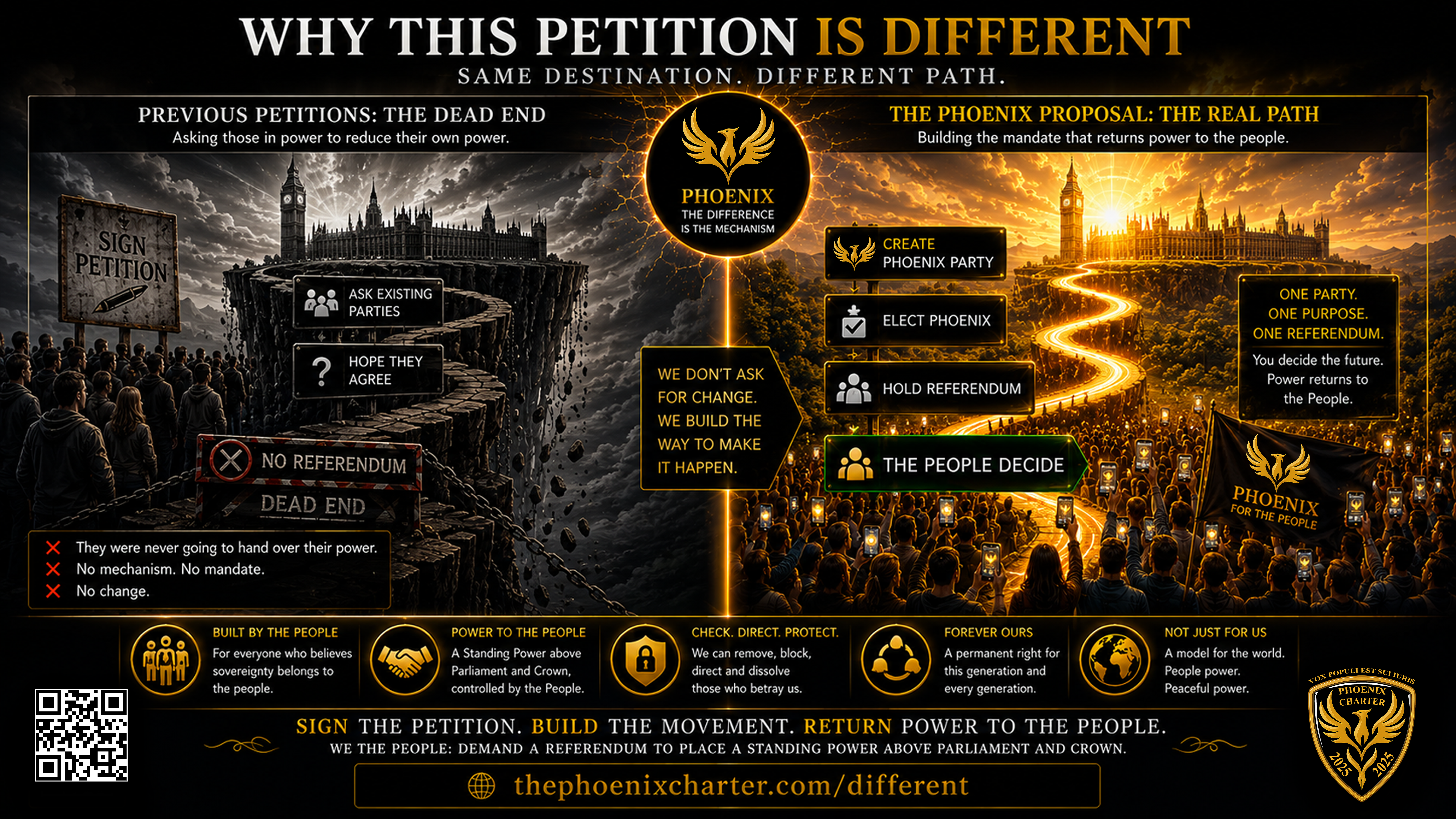
Why This Petition Is Different
At first glance, this petition may appear to pursue the same objective as many others before it: restoring constitutional accountability and returning power to the people.
In reality, its approach is fundamentally different.
For decades, citizens have signed petitions calling for constitutional reform, electoral reform, direct democracy, binding referendums and greater government accountability. Those petitions reflected genuine public concern, but they all relied upon the same assumption—that those already holding political power would voluntarily agree to reduce or surrender that power.
That assumption has repeatedly proved unsuccessful.
The problem was never the destination.
The problem was the mechanism.
The Missing Step
A petition can demonstrate public support for an idea.
It cannot, by itself, create the constitutional authority needed to implement that idea.
Previous campaigns therefore reached the same point repeatedly: they identified the problem, gathered signatures, and asked existing political institutions to change themselves. Without a lawful mechanism capable of carrying that demand into constitutional law, the process simply stopped.
The Phoenix proposal introduces that missing step.
Rather than relying upon petitions alone, it seeks a democratic electoral mandate to bring a defined constitutional proposal through Parliament and put the final decision directly to the electorate.
Building The Vehicle
The Phoenix Party exists for one protected Founding Objective.
Its role is not to secure permanent political power for itself, nor to replace one group of career politicians with another.
Its purpose is to obtain the electoral mandate necessary to pursue a lawful, binding constitutional referendum, give effect to the electorate’s decision and establish the House of the Electorate with a practical, proven means of exercising its Standing Power.
That objective is fulfilled only when the constitutional authority has been lawfully established and its practical mechanism has been demonstrated operational. Phoenix does not automatically dissolve at that point. What becomes of the Party itself is for its members and the electorate to decide under the constitutional and legal arrangements then in force.
The destination has never been the Party.
The destination is always the permanent constitutional settlement.
Letting The People Decide
Unlike petitions that simply request reform, the Phoenix proposal seeks the parliamentary legislation needed to place a defined constitutional choice before the people themselves.
Parliament is part of the lawful route to the referendum. The electorate makes the constitutional choice.
The referendum is not intended to determine who governs.
It is intended to determine how authority is permanently structured.
If approved and lawfully implemented, the settlement would establish the House of the Electorate, through which the People could exercise five Standing Powers: AUTHORISE, DIRECT, RESTRAIN, REVOKE and AMEND. The proposed Electoral Assent would be a separate constitutional function, transferring the relevant assent responsibility presently exercised through Royal Assent.
These powers would become binding only under the approved constitutional procedures and after the practical means of exercising them had been proven operational.
A Peaceful Constitutional Path
The Phoenix Charter is built upon lawful, peaceful constitutional change.
It does not seek conflict, revolution or the removal of democratic institutions.
Instead, it seeks to strengthen democracy by ensuring that constitutional sovereignty remains permanently with the electorate, while governments continue to administer the country under powers delegated by the people.
The objective is accountability—not instability.
The mechanism is democratic—not revolutionary.
The authority comes from the people themselves.
One Destination. A Different Path.
Many movements have identified the destination.
The Phoenix Charter seeks to provide the vehicle that reaches it.
It is not simply another petition asking for change.
It is the beginning of a constitutional process through which the people themselves decide whether to establish a permanent, operational Standing Power above Parliament and Crown.