
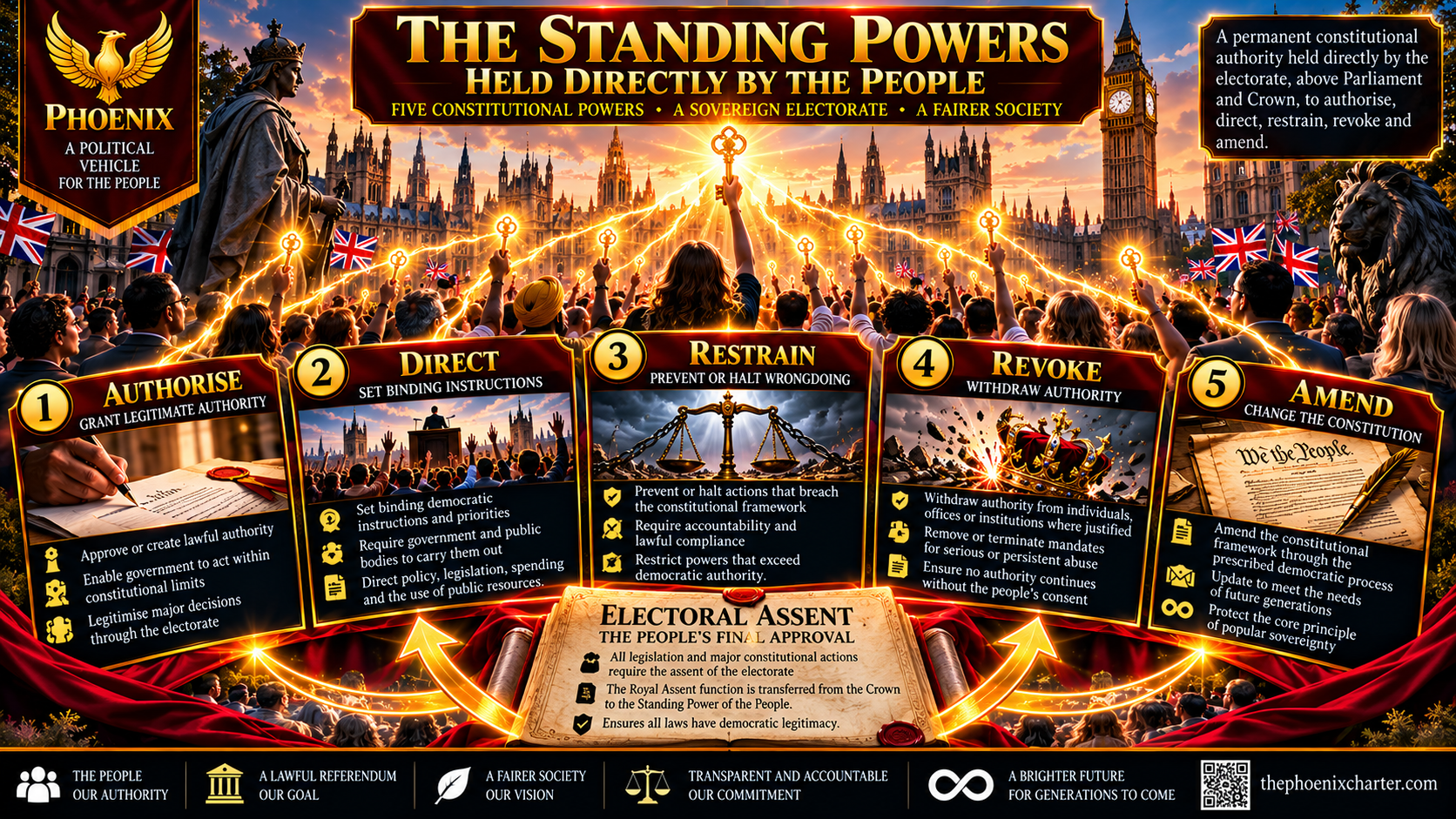
The Five Standing Powers of the Electorate
FROM PARTY POLITICS TO PEOPLE POLITICS
Vox Populi est Sui Iuris — The Voice of the People is Sovereign.
THE PEOPLE MUST NEVER LOSE THE POWER TO CONTROL THOSE ENTRUSTED TO GOVERN THEM.
At a General Election, the electorate chooses representatives to exercise public authority. But choosing representatives is not the same as retaining effective constitutional control over the powers those representatives exercise.
Once elected, a government can introduce legislation, direct public administration and make decisions affecting the population throughout its term of office. The electorate may protest, petition, challenge decisions through the courts and eventually vote in another election. Yet it has no general constitutional mechanism allowing it to issue binding directions, revoke a parliamentary government’s mandate or directly restrain the exercise of public power whenever the electorate considers intervention necessary.
The Phoenix Charter proposes to change that relationship.
Its central constitutional reform is the establishment of five permanent Standing Powers, held collectively by the electorate and exercised through the House of the Electorate.
These powers would allow the People to authorise delegated authority, direct its lawful exercise, restrain its misuse, revoke mandates and amend the constitutional arrangements through which public authority operates.
The five Standing Powers are AUTHORISE, DIRECT, RESTRAIN, REVOKE and AMEND.
These are proposed constitutional powers. They do not presently operate under UK law. Their precise legal procedures, thresholds and safeguards must be established in the constitutional settlement submitted for democratic approval.
The objective is not to prevent government from governing. It is to prevent government from becoming permanently unanswerable to the People who entrusted it with authority.
Contents
- Why Standing Power Is Necessary
- AUTHORISE — The Power to Grant Authority
- DIRECT — The Power to Give Binding Direction
- RESTRAIN — The Power to Prevent or Halt Abuse
- REVOKE — The Power to Withdraw Authority
- AMEND — The Power to Change Constitutional Arrangements
- How the Five Powers Work Together
- Electoral Assent — A Separate Constitutional Function
- From Public Proposal to Constitutional Decision
- Safeguards Against Manipulation and Abuse
- The Bill of Rights and Independent Justice
- Government Continues Under the People’s Authority
- How the Standing Powers Would Be Established
- The Crowd Becomes the Crown
1. Why Standing Power Is Necessary
A constitutional right becomes vulnerable when the institution accused of violating it also controls the practical means through which it may be challenged.
Governments can change without fundamentally changing the relationship between the electorate and those exercising public authority. A new party may occupy the same offices, inherit the same powers and operate through the same institutions.
Election promises may be abandoned. Policies may be introduced that were never placed before the electorate. Public objections may be acknowledged and then disregarded. Political decisions may create obligations lasting for generations beyond the mandate of those who made them.
Democratic elections remain essential, but Phoenix argues that elections alone do not provide sufficient continuing constitutional accountability.
The People must retain a lawful means of intervening before the next scheduled election when public authority is being exercised against their rights or expressed constitutional decisions.
The five Standing Powers are intended to supply that missing constitutional relationship.
They would not operate as five unrestricted powers to interfere with every government decision. Their jurisdiction, initiation procedures, thresholds, safeguards and legal effects would be defined by the Constitution.
They would belong to the electorate collectively, not to Phoenix, its founder, the Guardian, a political party or the operators of the voting system.
The People are the source of authority. Government exercises delegated powers. The Constitution establishes the limits and procedures through which the electorate may intervene.
2. AUTHORISE — The Power to Grant Authority

AUTHORISE establishes that public authority is delegated by the People, not owned by those who exercise it.
Under the proposed constitutional settlement, the electorate would possess a continuing constitutional means of granting or withholding authorisation wherever the Constitution requires its approval.
The election of representatives would remain one important way in which authority is conferred. But an election victory would not automatically provide unrestricted permission to exercise every conceivable power throughout the parliamentary term.
The Constitution would identify those decisions, powers or changes requiring the electorate’s specific authorisation.
2.1 The Purpose of AUTHORISE
AUTHORISE would make the distinction between delegated government and sovereign constitutional authority explicit.
Parliament and government would continue to perform their respective functions, but they could not treat powers reserved to the electorate as their own property.
Where the Constitution requires public authorisation, the relevant institution would need to obtain it through the prescribed process before the proposed action acquired the required legal authority.
This could apply to defined constitutional decisions involving the grant, enlargement or reallocation of public powers. The final Constitution must specify the matters covered rather than leave the scope to administrative discretion.
2.2 How AUTHORISE Would Operate
A proposal requiring constitutional authorisation would be presented to the relevant electorate with sufficient information to explain what authority was being requested, who would exercise it, for what purpose and within which limits.
The prescribed deliberation and voting process would then determine whether authorisation had been granted.
If the required authorisation were not obtained, the proposed action could not lawfully proceed on the assumption that silence amounted to consent.
2.3 The Limits of Authorisation
AUTHORISE would not remove the protection of individual rights or replace the lawful operation of independent courts.
Nor would it require the electorate to vote separately on every routine administrative decision. Ordinary authority already delegated to government would remain exercisable within its constitutional limits.
THE PEOPLE GRANT AUTHORITY. GOVERNMENT DOES NOT GRANT SOVEREIGNTY TO ITSELF.
3. DIRECT — The Power to Give Binding Direction

DIRECT would allow the electorate to instruct public authorities through a constitutionally authorised decision.
At present, people can express opinions, sign petitions, organise campaigns and ask representatives to act. Such activities can influence decisions, but they do not ordinarily create a binding instruction from the electorate to government.
The DIRECT Standing Power is intended to establish the circumstances in which the electorate’s collective decision becomes an enforceable constitutional instruction.
3.1 From Public Opinion to Public Instruction
A petition may identify a problem. Public deliberation may reveal its causes and competing remedies. A poll may demonstrate the level of support for different responses.
Where the subject falls within the electorate’s constitutional competence, the proposal could proceed through the formal decision process established for DIRECT.
If the required constitutional conditions were satisfied, the resulting instruction would bind the responsible public institution to the extent prescribed by the Constitution.
The institution would then have to act in accordance with its lawful duty, rather than simply acknowledge the electorate’s wishes and disregard them.
3.2 The Scope of a Direction
A valid direction would have to identify the action required, the public authority responsible and the constitutional power under which the instruction was issued.
The Constitution would determine which matters can be directed, how conflicting obligations are resolved and which forms of judicial review or other independent remedy remain available.
Directions must also respect the Bill of Rights and the lawful rights of individuals affected by their implementation.
3.3 Government Must Account for Its Response
Where a binding direction is issued, the responsible authority would be required to demonstrate compliance with its constitutional obligations.
The implementation process should identify the required action, the responsible institution, any lawful implementation period and the means through which compliance can be independently examined.
If a direction cannot lawfully be implemented as originally expressed because it conflicts with protected rights or another constitutional obligation, that conflict must be resolved through the prescribed legal process, not concealed or unilaterally exploited as an excuse to ignore the electorate.
THE PEOPLE MUST BE ABLE TO DO MORE THAN REQUEST. WHERE THE CONSTITUTION AUTHORISES IT, THEY MUST BE ABLE TO DIRECT.
4. RESTRAIN — The Power to Prevent or Halt Abuse
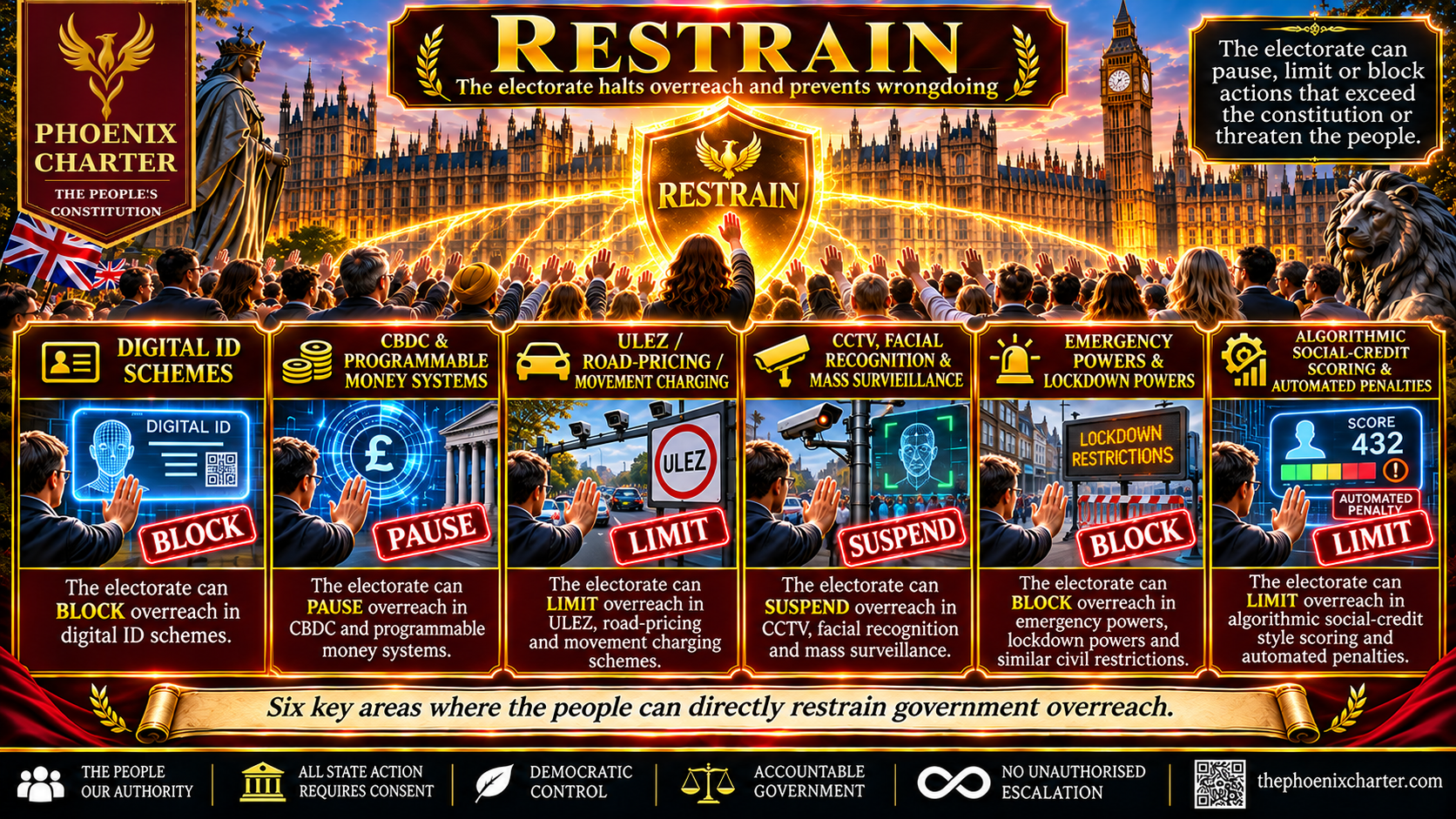
RESTRAIN would provide a constitutional means of preventing, limiting or halting the misuse of delegated public authority.
Government power can cause serious consequences before the next election arrives. An action may affect rights, public assets, national resources or the ability of individuals to live freely.
If the electorate possesses a constitutional right to intervene only after the action has been completed, that protection may come too late.
The RESTRAIN Standing Power is intended to address that problem.
4.1 Preventing Irreversible Harm
RESTRAIN would allow the electorate, through the prescribed constitutional process, to challenge and limit the exercise of public powers that fall within its jurisdiction.
The Constitution would determine when a measure may be suspended, prohibited or otherwise restrained, what evidence is required and which legal consequences follow.
Particular care would be necessary where the subject involves urgent public safety, contractual obligations, ongoing judicial proceedings or the rights of individuals.
4.2 Urgent Protection and Independent Courts
Some threatened violations require immediate judicial intervention rather than waiting for a collective vote.
The Phoenix Bill of Rights and Constitution are intended to preserve independent judicial remedies capable of restraining unlawful conduct, including where the electorate has not yet completed a Standing Power process.
The judiciary’s responsibility to enforce rights must therefore remain distinct from the electorate’s collective RESTRAIN power.
The Constitution must establish how urgent judicial protection and collective constitutional restraint interact, without allowing either to defeat fundamental rights.
4.3 Restraint Must Not Become Arbitrary Power
RESTRAIN must not be a mechanism through which a temporary majority can punish an unpopular person, prevent lawful disagreement or extinguish the rights of political opponents.
The measure challenged, the legal grounds, the evidence, the applicable thresholds and the remedies must all be governed by defined constitutional procedures.
Government must be answerable for abuses of public authority, but decisions restricting public power must themselves remain subject to the Constitution.
THE PEOPLE MUST HAVE THE POWER TO STOP ABUSE BEFORE IT BECOMES IRREVERSIBLE.
5. REVOKE — The Power to Withdraw Authority

REVOKE would provide the constitutional means to withdraw a mandate, authorisation or delegated authority under prescribed conditions.
A political mandate cannot reasonably be treated as an unrestricted possession of those who receive it. Phoenix proposes that the electorate should retain a continuing lawful means of withdrawing authority when the constitutional conditions for revocation are met.
The precise legal effects must be established before the Standing Power is adopted.
5.1 A Mandate Is Delegated, Not Surrendered
Representatives are entrusted to exercise public responsibilities. The proposed constitutional settlement would recognise that such authority remains conditional upon the rules under which it was granted.
REVOKE would prevent a mandate from becoming a permanent shield against constitutional accountability.
Depending upon the matters assigned to this power by the Constitution, revocation could concern a defined public authorisation, a delegated mandate or the termination of an authority otherwise due to continue.
5.2 The Power to Require a General Election
Phoenix also proposes that the electorate should be able to initiate a General Election without requiring the agreement of the Prime Minister or Crown, through a constitutionally prescribed process.
That process would need to define the initiating conditions, electorate, thresholds and legal consequences of the decision.
A valid decision requiring an election would have to operate through the constitutional arrangements governing dissolution, election administration and the continuity of government.
The objective is to ensure that a government cannot indefinitely retain a mandate that the electorate has lawfully withdrawn.
5.3 Revocation and Individual Public Officers
The Constitution may also provide procedures governing the recall or removal of public officers where appropriate.
Those procedures must distinguish between political accountability, statutory officeholding, criminal responsibility and judicial independence.
A public vote cannot substitute for a criminal trial or lawfully establish individual guilt without due process.
Nor would Phoenix’s internal withdrawal of endorsement automatically remove a sitting MP from Parliament. Any such legal consequence would require authority under the applicable law.
5.4 Continuity Following Revocation
When constitutional authority is revoked, lawful public administration must not collapse into an uncontrolled vacuum.
The Constitution must establish who exercises necessary functions during the transition, which existing legal obligations remain in force and how replacements are selected.
Transitional arrangements must prevent those who have lost authority from using temporary arrangements to restore it without lawful approval.
THE PEOPLE WHO GRANT A MANDATE MUST RETAIN A LAWFUL MEANS TO WITHDRAW IT.
6. AMEND — The Power to Change Constitutional Arrangements
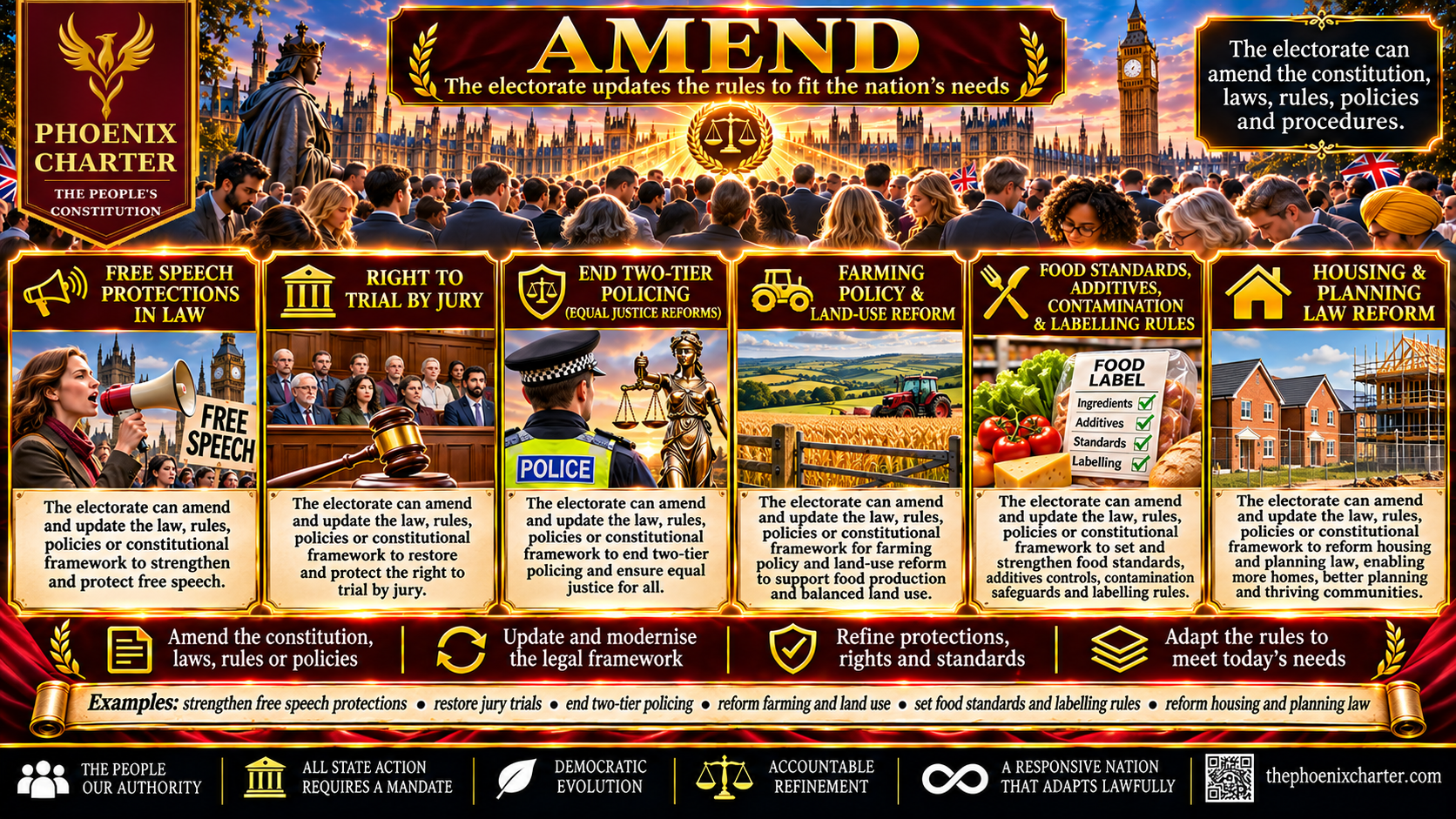
AMEND would preserve the electorate’s continuing constitutional authority to change the arrangements through which public power is exercised.
Constitutions must provide stability, but they must also remain capable of lawful improvement.
Future generations will face circumstances, technologies and public questions that cannot all be predicted by those establishing the original settlement.
AMEND is intended to provide the constitutional means through which eligible provisions can be reconsidered and altered without surrendering the fundamental protections upon which the constitutional order depends.
6.1 A Constitution That Can Be Improved
The proposed Constitution would establish a protected process for submitting, examining and approving constitutional amendments.
An amendment must be identifiable in advance, with its intended legal effects explained before voting.
The electorate should be able to compare the existing provision with the proposed replacement and understand what would change if it were approved.
The final constitutional arrangements must distinguish ordinary public-policy decisions from changes to constitutional provisions.
6.2 Protected Rights and Constitutional Foundations
AMEND cannot be treated as unrestricted permission to extinguish fundamental rights or remove the effective constitutional protection of the electorate itself.
The Phoenix proposal includes entrenched rights and safeguards intended to prevent a temporary majority or an institution from dismantling the constitutional protections upon which future generations depend.
The final Constitution must identify which provisions are amendable, which protections are entrenched and which procedures apply to any permitted change.
Those safeguards must be defined in the settlement approved by the electorate, not introduced after the result.
6.3 Deliberation and Lawful Amendment
Constitutional amendments should undergo a clear process involving publication, scrutiny, deliberation and voting under the applicable constitutional rules.
Different categories of constitutional change may require different thresholds or additional protections, as established by the adopted Constitution.
Once validly approved, an amendment must be officially recorded, incorporated into the authoritative constitutional text and given effect through the lawful commencement process.
No government, software administrator or private institution should be able to change the operative Constitution secretly.
THE CONSTITUTION MUST SERVE THE PEOPLE THROUGH GENERATIONS — WITHOUT ALLOWING ITS FUNDAMENTAL PROTECTIONS TO BE DESTROYED.
7. How the Five Standing Powers Work Together
Each Standing Power has a distinct constitutional purpose.
AUTHORISE concerns whether authority may be granted or exercised where the Constitution reserves the decision to the electorate.
DIRECT concerns what an institution must lawfully do when the electorate issues a valid binding instruction.
RESTRAIN concerns preventing or limiting the misuse of public authority.
REVOKE concerns withdrawing authority or mandates under constitutional procedures.
AMEND concerns changing the constitutional arrangements through which authority is defined and controlled.
These powers are intended to complement one another rather than operate as unrelated public voting exercises.
AUTHORISE determines whether authority has the required consent. DIRECT governs its lawful use. RESTRAIN prevents its misuse. REVOKE allows it to be withdrawn. AMEND provides a protected means to change the underlying constitutional rules.
All five must operate within the same constitutional framework, protecting fundamental rights, preserving independent justice and preventing conflicting or arbitrary decisions.
TOGETHER, THEY PLACE A CONTINUING CONSTITUTIONAL CONTROL UPON DELEGATED PUBLIC POWER.
8. Electoral Assent — A Separate Constitutional Function
Electoral Assent is an important part of the Phoenix constitutional settlement, but it is not a sixth Standing Power.
Under the present UK constitutional arrangements, Royal Assent is the final formal stage by which a Bill passed by Parliament becomes law.
Phoenix proposes transferring the constitutional assent function to the electorate under a defined system of Electoral Assent.
Where the proposed Constitution requires Electoral Assent, the electorate would possess the legal authority to grant or withhold assent according to the prescribed procedures.
This is distinct from AUTHORISE. AUTHORISE concerns the wider grant and exercise of delegated authority. Electoral Assent concerns the specific constitutional function of assent to legislation.
The Constitution must state which legislation requires Electoral Assent, how it is submitted to the electorate, what thresholds apply, how refusal operates and how the process interacts with Parliament and the protection of individual rights.
Until the new settlement has been lawfully established, Royal Assent and the existing legislative arrangements continue to operate.
Read more about the proposed transition from Royal Assent to Electoral Assent.
9. From Public Proposal to Constitutional Decision
The electorate cannot exercise meaningful constitutional authority without a practical means of raising issues, examining proposals and making informed decisions.
The proposed Voice of the Electorate provides the relationship between public participation and constitutional decision-making.
9.1 The Proposal
An individual or group identifies an issue and submits a proposal through the appropriate public participation process.
The proposal should identify the problem, the change being requested, the relevant authority and the constitutional basis for any proposed binding action.
9.2 Public Examination and Deliberation
Others examine the proposal, present evidence, raise objections and suggest alternatives.
The issue may be clarified, refined or amended before a formal decision is sought.
The objective is to establish a clear question and informed public choice, not merely to accumulate support for an undeveloped idea.
9.3 Constitutional Qualification
Where a proposal seeks to exercise a Standing Power, it must satisfy the constitutional requirements applicable to that power.
Those requirements may concern the subject matter, eligible electorate, initiating threshold, notice, deliberation period and protection of fundamental rights.
An ordinary petition or opinion poll does not automatically qualify as a constitutional decision.
9.4 The Formal Decision
Where the requirements have been satisfied, the eligible electorate would participate through the prescribed voting process.
The applicable thresholds and rules must be established before the decision takes place.
The outcome must be counted, independently verifiable and subject to the remedies required by the Constitution.
9.5 Legal Effect and Implementation
Where a valid decision exercises a binding Standing Power, the relevant public institution must comply with the constitutional obligations arising from it.
The decision, its legal effect, any lawful implementation period and the responsible authority must be identifiable.
The result should not disappear into an administrative system without explanation, accountability or the means of confirming whether it has been implemented.
PROPOSE → EXAMINE → DELIBERATE → QUALIFY → DECIDE → IMPLEMENT → ACCOUNT.
Explore the Voice of the Electorate and Petitions & Polls.
10. Safeguards Against Manipulation and Abuse
Constitutional authority must never depend upon the integrity of a voting total that nobody can independently verify.
The proposed Standing Powers therefore require safeguards covering eligibility, ballot integrity, public information, privacy, secrecy where applicable, independent scrutiny and lawful remedies.
10.1 A Defined Electorate
Each binding decision must identify who is entitled to participate and how that entitlement is established.
The rules must protect eligible people from exclusion while preventing invalid or duplicate participation from altering the result.
10.2 Defined Thresholds and Voting Windows
Initiation requirements, deliberation periods, approval thresholds and voting windows must be known in advance.
They must not be altered retrospectively to favour a government, political party, platform operator or particular outcome.
10.3 Verifiable Records
The voting system must provide sufficient records to allow lawful scrutiny of the process and verification of the declared result.
Record integrity must not come at the expense of exposing private political choices.
10.4 Accessible Participation
The exercise of constitutional authority must not depend exclusively upon ownership of a particular commercial device, platform account or unnecessary biometric product.
Reasonable arrangements must accommodate eligible people with disabilities, limited digital access or other participation barriers.
10.5 Independent Remedies
Participants must have lawful means of challenging substantial procedural wrongdoing.
The Constitution must define how irregularities are investigated, how disputed results are reviewed and when a vote may require correction, recounting or repetition.
THE SYSTEM MUST RECORD THE WILL OF THE ELECTORATE — NOT MANUFACTURE IT.
11. The Bill of Rights and Independent Justice
The Phoenix Charter does not propose replacing arbitrary government with arbitrary majority rule.
The five Standing Powers must operate within the Constitution and the protections established by the Bill of Rights.
Fundamental rights cannot be treated as privileges to be withdrawn merely because an opinion poll or even a formal constitutional vote has produced a numerical majority.
Independent courts must remain capable of protecting individuals, determining legal disputes and providing remedies for unlawful conduct.
Collective constitutional authority must not be used to bypass due process, punish unpopular individuals or determine criminal guilt through public voting.
The House of the Electorate would be the electorate acting collectively. It would not be a new political executive authorised to override the rights of those who disagree with it.
The Guardian would protect the integrity of constitutional procedures within its lawful responsibilities. It would not own sovereignty or determine which political choices the People are permitted to make.
CONSTITUTIONAL POWER MUST BE STRONG ENOUGH TO RESTRAIN GOVERNMENT, BUT NEVER SO UNRESTRICTED THAT IT CAN DESTROY THE RIGHTS IT WAS ESTABLISHED TO PROTECT.
Read the Phoenix Bill of Rights and the Guardian’s proposed role.
12. Government Continues Under the People’s Authority
The Standing Powers are not intended to replace every ordinary decision of government with a national ballot.
Parliament would continue to legislate. Government would continue to administer public affairs. Public servants would continue to perform their lawful duties. Independent courts would remain responsible for interpreting and applying the law.
The constitutional change would be that delegated authority could no longer be regarded as permanently beyond the electorate’s effective control.
Government would operate within the limits established by the Constitution and remain answerable to valid decisions made through the Standing Powers.
Where the Constitution assigns a decision to government, government remains responsible for making it. Where it reserves authority to the electorate, that reservation must be respected.
Where the electorate issues a lawful binding instruction, government must respond according to its constitutional obligations.
This distinction is essential to an effective constitutional settlement.
THE PEOPLE DO NOT NEED TO BECOME THE GOVERNMENT IN ORDER TO REMAIN SOVEREIGN OVER IT.
13. How the Five Standing Powers Would Be Established
These powers cannot be brought into force through a declaration on the Phoenix website, a private petition, an experimental poll or the unilateral decision of a political party.
Phoenix proposes to pursue their establishment through the lawful electoral and parliamentary process, followed by a national referendum on a defined constitutional settlement.
The proposed Constitution must explain the legal scope of each power, how it is initiated, the relevant electorate, the required thresholds, the protections applying to each decision and the legal effect of its outcome.
The referendum legislation must establish what the electorate is being asked to approve and the lawful arrangements for implementing an affirmative result.
A successful referendum would not necessarily mean every participation mechanism becomes operational immediately.
The necessary constitutional and technical arrangements must be established, tested and brought into force under the approved legal process.
During any transitional period, ordinary government continues except where lawfully changed. A prototype Civic-Crowd-Device or temporary public voting platform does not acquire sovereign authority merely because it has been deployed.
THE STANDING POWERS ARE OPERATIONAL ONLY WHEN THEY HAVE LAWFUL AUTHORITY AND A PRACTICAL, SECURE, AUDITABLE MEANS OF GENUINE ELECTORATE USE.
Follow the Path to the Referendum, read about the proposed Referendum and explore the House of the Electorate.
14. The Crowd Becomes the Crown
The five Standing Powers express the central constitutional change proposed by Phoenix.
Under the proposed settlement, the electorate would not simply choose who governs and then surrender the practical means of intervention until another General Election.
It would retain continuing constitutional authority to authorise public power, direct its lawful use, restrain abuses, revoke mandates and amend the arrangements through which government exercises delegated authority.
Electoral Assent would operate alongside these five powers as a separate constitutional function.
Government would continue to govern, but the People would possess a recognised means of holding it to account throughout its term.
AUTHORISE — DIRECT — RESTRAIN — REVOKE — AMEND.
FROM PARTY POLITICS TO PEOPLE POLITICS.
THE CROWD BECOMES THE CROWN.
Vox Populi est Sui Iuris — The Voice of the People is Sovereign.