The Phoenix Trust
A Perpetual Public Custodial Trust for the Crowd-Device
The Phoenix Trust exists for one purpose: to ensure that the Crowd-Device — the world’s first universal public-participation mechanism, developed by Paul A. Sparrow — can never again be suppressed, inverted, stolen, or weaponised. After three decades of obstruction, gatekeeping, and structural sabotage, the inventor’s goal is simple: to place the entire system into perpetual public custodianship, where no government, corporation, or private entity can control it.
This Trust is intended as a non-charitable protective custodial arrangement, not a company, political party, or operating platform. It is a public safeguard, designed to protect a civic mechanism intended for all people, in all nations, for all generations. It does not hold sovereignty over the People or exercise the constitutional powers that Phoenix proposes for the electorate.
The Phoenix Trust Deed, executed on 5 December 2025, sets out the intended perpetual custodianship of the Crowd-Device Protocol. Under its terms, the Trust is charged with protecting:
- the four-domain architecture of the Crowd-Device,
- its documentation, historical lineage, and developmental evidence entrusted to the Trust,
- its ethical boundaries and intended purpose,
- authorised derivatives, adaptations, and implementations to the extent covered by the Protocol and the rights entrusted to the Trust,
- and ethical future public-benefit uses worldwide.
The Deed does not itself create a statutory monopoly. Phoenix’s policy is that any future restoration of statutory exclusivity must be lawfully authorised by the People through the proposed House of the Electorate and enacted through the applicable legal process. Custodial protection does not wait for that: the Trust may pursue the rights and remedies available to it under the Deed and existing law.
Why the Phoenix Trust Exists
Three decades of lived experience proved a single truth: if a public empowerment mechanism is not protected from institutional abuse, it can be inverted into a system of control.
Sparrow argues that governments have mirrored structural features of the Crowd-Device and repurposed similar mechanisms in behavioural-scoring identity systems. His evidence and claims of derivation are set out in his separate case records. The Trust is designed to prevent any such coercive inversion from being authorised under its custody. Its purpose is to:
- prevent weaponisation,
- prevent monopolisation,
- prevent ideological or political distortion,
- prevent suppression or blocking by gatekeepers,
- preserve the ethical purpose of the invention,
- and ensure perpetual public access to authorised, non-coercive uses.
The Crowd-Device was created to empower people — not to monitor them, rank them, or condition their freedoms. The Phoenix Trust is designed to ensure it remains a tool for unity, collaboration, and public capability — for good.
What the Trust Guarantees
The Deed establishes these protections for the Protocol and rights entrusted to the Trust:
- no government or other body may receive the Trust’s authority to weaponise the Crowd-Device,
- no trustee may sell, assign, transfer, mortgage, or otherwise dispose of the entrusted Protocol contrary to the Deed,
- no private interest may acquire control through an unauthorised disposal by the Trust,
- no coercive or suppressive implementation may be licensed or authorised by the Trust,
- all Trust-authorised implementations must comply with its protective conditions,
- ethical, non-commercial, non-coercive use remains royalty-free under the Deed’s open-source licensing provision,
- the inventor’s reserved commercial licensing, royalty, damages and authorship rights remain separate from the Trust’s custodial function,
- the invention and the evidence establishing authorship and lineage are to be safeguarded for future generations.
The Trust is the protective lockbox for the mechanism. Its Deed binds those subject to it and provides a foundation for lawful enforcement; it does not, by itself, create worldwide statutory powers over independently developed systems. It binds the entrusted invention to its protective public purpose.
How the Trust Will Operate
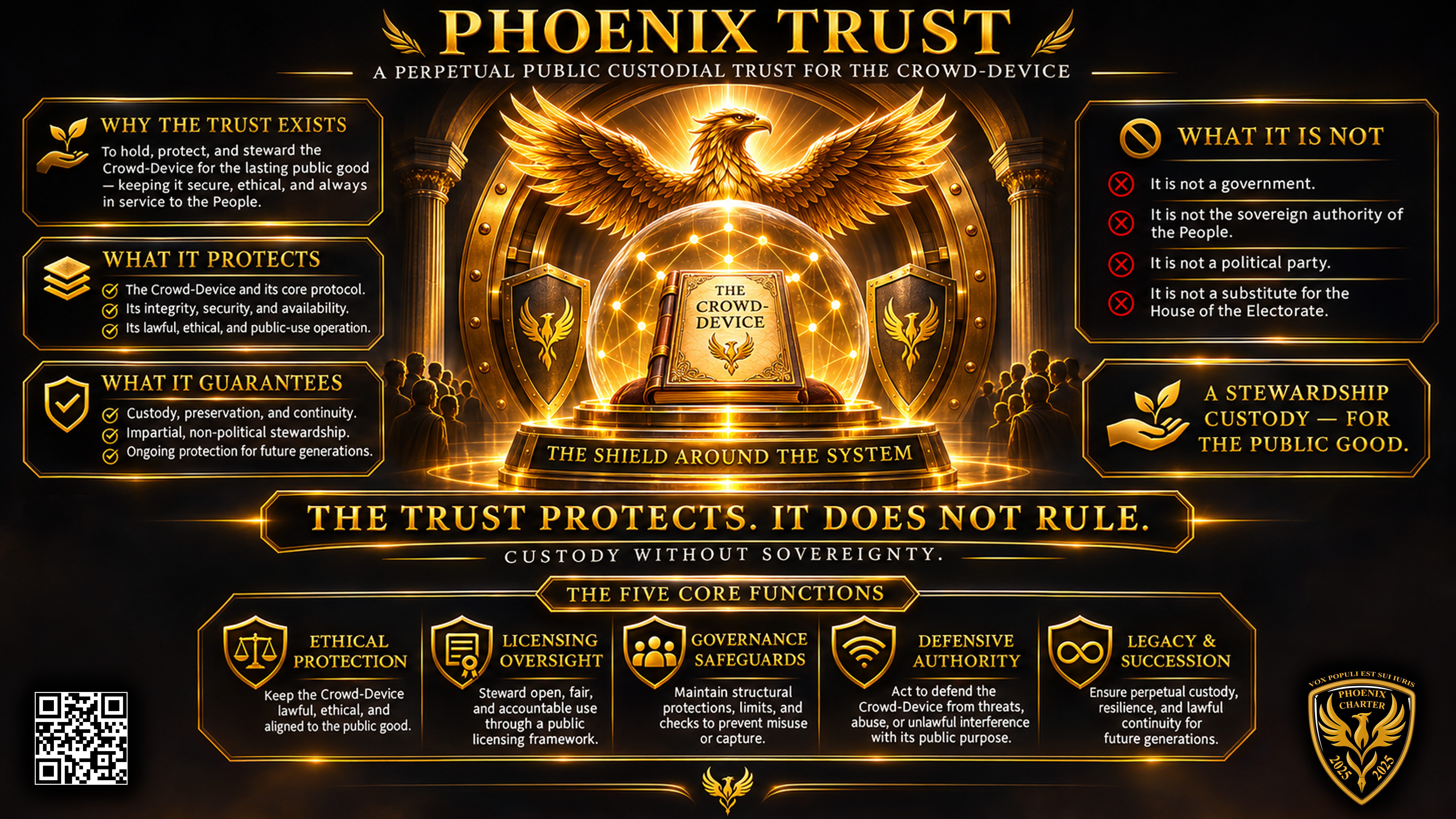
The Phoenix Trust is designed to operate as a perpetual custodial entity with five core functions:
- Ethical Protection — it preserves the correct purpose of the invention, refuses to authorise harmful, inverted, or oppressive uses, and pursues lawful remedies where rights can be enforced.
- Licensing Oversight — it safeguards conditions applying to authorised implementations while preserving the inventor’s separately retained commercial licence and availability payments, usage royalties, damages and authorship rights. These are separate from the Platform Fund’s variable operating-service fees.
- Governance Safeguards — it ensures transparency, prevents corruption, and enforces the Trust’s protective standards within the authority conferred by the Deed.
- Defensive Authority — it can issue public notices and evidential challenges, contest misuse and seek injunctions or other remedies where the law permits.
- Legacy and Succession — it secures all documentation, authorship records, evidence files, and historical lineage entrusted to it in perpetuity.
The Trust’s protective work is distinct from the future constitutional Standing Power of the People. Its actual authority and remedies depend on the Deed and applicable law, and its trustees must be properly constituted and able to carry out their responsibilities. A new statutory monopoly cannot arise merely from the Deed or the Trust’s creation.
Why This Trust Matters
The Crowd-Device is not simply an invention. It is the foundation of a new civic era — the Crowd-Era — a model in which communities can decide, people can act, results can be delivered, and governance can be returned to those who live under it.
A mechanism this powerful requires protection equal to its purpose. The Phoenix Trust is that protection: the shield around the system, and the bridge between the old world of gatekeeping and the intended new world of people-led governance.