
The Phoenix Charter
FROM PARTY POLITICS TO PEOPLE POLITICS
Phoenix seeks parliamentary representation not to take sovereignty for itself, but to secure the People’s opportunity to decide whether effective constitutional authority should remain permanently in their hands. Government would continue to govern, while the electorate would retain the five Standing Powers to hold delegated authority accountable.
Vox Populi est Sui Iuris — The Voice of the People is Sovereign.
Restoring sovereignty to the People — before concentrated power becomes impossible to resist.
The Phoenix Charter exists because the People must never be reduced to subjects of governments, financial systems or corporations they can no longer control. Its founding principle is uncompromising: government exists to serve the People, and the People must retain the enforceable constitutional authority to stop it when it does not.
The purpose is not to dismantle lawful government, public services or independent courts. It is to prevent any government, agency, corporation or combination of interests from turning those institutions against the population they were established to protect.
Phoenix brings together a Declaration of Sovereignty, an entrenched Bill of Rights, the electorate’s Standing Powers, Electoral Assent, a lawful route to a referendum, independent constitutional safeguards, public participation and protected public assets. Each part is designed to close a route by which the People could otherwise be stripped of their freedom and their means of resistance.
Why the Phoenix Charter Exists — The Threat to the Sovereignty of the People
The Phoenix Charter begins with the question that every constitutional system must answer: What happens when the institutions established to protect the People become the very machinery from which the People need protection — and no lawful means remains to stop them?
An election can remove a government without removing the networks of influence, dependency and institutional power operating around it. Parties change. Ministers change. Yet the electorate is still expected to depend on those holding power to investigate themselves, expose wrongdoing, resist corruption, keep promises and limit their own authority. That is not sufficient protection against systemic capture.
If commercially driven interests penetrate, influence or capture public institutions, the danger ceases to be ordinary political failure. A government compromised by private power may turn public law, public money, essential infrastructure and enforcement machinery into instruments serving interests that are hostile to the People.
Such a takeover needs no tanks at Parliament’s gates. It may advance through lobbying, political finance, revolving-door appointments, regulatory capture, privatisation, procurement, acquisition of essential infrastructure and legislation that repeatedly favours concentrated power over the public interest.
The most effective hostile takeover may be one that leaves the outward appearance of democratic government intact while steadily removing the People’s ability to challenge what is being done in their name.
The Danger of a Global, Synchronised Takeover
FOLLOW THE MONEY. NOT THE POLITICAL STORY.
A hostile takeover can destroy a business while leaving its name above the door. The buyer arrives promising rescue, investment and a brighter future. Then the assets are carved up, the people who built the company are discarded and its value passes to those who financed the acquisition. The promises are temporary. The transfer of ownership is permanent.
Now apply that principle to entire nations. A war, emergency or reform dominates the headlines. Politicians speak of security, recovery, efficiency and public benefit. Meanwhile, the commercial question is barely asked: When the dust settles, who owns the land, the water, the energy, the infrastructure and the rights to the money they produce?
We have watched the transfer of public resources into commercial structures for decades. The House of Commons Library documents Britain’s privatisations; Hansard records N. M. Rothschild’s involvement as adviser or underwriter in major disposals. In 2024, BlackRock acquired Global Infrastructure Partners, extending its position in the international infrastructure investment market. The slogans change; the question of control does not.
Ukraine exposes the commercial arithmetic with particular clarity. In 2022, BlackRock agreed to advise on a framework for attracting public and private reconstruction investment; JPMorgan was also involved in planning a reconstruction fund. In April 2025, Ukraine and the United States established a joint investment fund entitled to 50% of specified royalties and licence payments from future natural-resource projects, while Ukraine retained ownership of its resources. In October 2026, the fund approved further energy and critical-minerals investments. The agreements speak in the language of rebuilding. They also establish economic stakes, revenue rights and prospective returns. Whatever public benefits are promised, the structure establishes economic stakes, revenue rights and prospective returns. INVESTMENT IS NOT CHARITY.
That is the point obscured by the political theatre. Governments are temporary. Contracts, concessions, creditors and owners can remain after the politicians have gone. The People may change the party in office without recovering control of the resources on which their lives depend. THE PEOPLE GET TO VOTE. THE OWNERS GET TO COLLECT.
Now connect that pattern across borders. If different governments surrender essential resources to overlapping financial and technological interests, changing country may offer no escape. Food, energy, finance, communications, identity and movement can become dependent on systems the electorate cannot remove. The takeover is no longer of a company, or even a country. It is the commercial capture of the conditions under which humanity is allowed to live.
THE POLITICAL EXPLANATION IS NOT THE TEST. THE FINAL BENEFICIARY IS.
Follow the assets. Follow the revenue. Follow the power to grant or deny access. If all three accumulate beyond the People’s control, the promised public benefit has become the justification for private domination. At its extreme, those who control life’s necessities acquire the practical power to play God over everybody else’s existence.
THE PHOENIX CHARTER EXISTS TO ENSURE THAT NO GOVERNMENT CAN TRADE AWAY THE PEOPLE’S SOVEREIGNTY, NO COMMERCIAL EMPIRE CAN BUY IT, AND NO PRIVATE INTEREST CAN CAPTURE THE WORLD’S NATURAL AND PUBLIC RESOURCES TO EXPLOIT HUMANITY’S DEPENDENCE UPON THEM FOR COMMERCIAL PROFITEERING.
Removing the People’s Ability to Intervene
Capturing resources is only half the danger. The other half is disarming the People constitutionally — removing their effective right and practical capacity to challenge those who command the resources.
Suppress lawful dissent, weaken independent scrutiny, intimidate opposition, conceal public decisions or make essential services conditional on institutional permission, and people can be forced to comply without a single visible act of conquest. A right that cannot be enforced against those in power is a right at risk of becoming meaningless.
Digital identity systems, interconnected databases, financial surveillance and programmable or conditional access technologies can bring convenience; if weaponised, the same architecture could identify, isolate, exclude or economically immobilise individuals and entire communities. No population should be compelled to rely on a system that can deprive it of ordinary life without independent due process and an effective remedy.
The central danger is the convergence of two forms of power: control over the resources necessary for life, and control over the constitutional, financial and technological means by which the People could refuse that control.
That is the trap Phoenix is intended to prevent: a society where elections still occur, institutions still claim legitimacy and rights still appear on paper, while the People have lost the effective means to defend themselves.
Fish in a Barrel — A Warning About the Possible Endgame
The accompanying work, Fish in a Barrel, takes that danger to its most terrifying conclusion. Written as FICTION BASED ON FACTUAL OBSERVATION, it explores a nightmare in which governments, financial institutions and powerful commercial interests have accumulated sufficient control over resources, infrastructure and essential services to turn entire populations into prisoners within their own countries.
The fictional scenario portrays a calculated programme of population reduction, mass slaughter and enslavement. Covertly imported militias are positioned to attack; children are abducted and trafficked; communities are driven into designated kill zones. GWEN towers, chemtrail operations and other technologies become elements of the story’s machinery of surveillance, manipulation and depopulation.
Digital identification, financial restrictions, censorship and interconnected surveillance become tools for locating, separating and immobilising populations, while their remaining means of communication, organisation, resistance and escape are systematically destroyed. The population discovers too late that systems accepted as conveniences have become instruments of confinement.
Those who survive the imagined killing face a future of captive slave labour: deprived of property, liberty and independence, kept alive on controlled insect rations and made dependent upon their captors for every necessity.
The horror at the heart of Fish in a Barrel is that humanity could build and finance the machinery of its own imprisonment and destruction without recognising its final purpose until resistance has become impossible. The book depicts the endgame; the Phoenix Charter proposes the constitutional defences intended to prevent any concentration of power from making such an endgame possible.

Explore Fish in a Barrel — The Warning →
Why a Constitutional Revolution Is Necessary
The answer cannot be another change of ministers while the constitutional weakness remains. If government can be captured, laws manipulated and essential systems weaponised, replacing a governing party merely changes who operates the same vulnerable machinery.
Petitions can be ignored. Objections can be overridden. Promises can be broken. A government can lose public confidence yet continue to exercise enormous authority until the next scheduled election. A population needs enforceable constitutional remedies before an abuse becomes irreversible.
Voting for a government every few years is no substitute for possessing the continuing power to stop that government when it violates the rights and sovereignty of the People.
Phoenix therefore proposes a peaceful constitutional revolution — not a change of political branding, but a fundamental, democratically authorised transfer of enforceable constitutional control back to the electorate.
The objective is to protect, not abolish, lawful government and independent justice. Public institutions must continue to serve society, but none may become an unanswerable master over the population or a vehicle for the private capture of national resources.
Those protections must survive changes of party, government, corporate ownership and technology. A safeguard that can be switched off by the very authority it restrains is not a safeguard.
The Phoenix answer is Standing Power: the electorate’s continuing, constitutionally protected authority over the powers delegated in its name — backed by rights, procedures, independent justice and the ability to intervene.
From Party Politics to People Politics. The Crowd becomes the Crown.
If Fish in a Barrel shows the nightmare of a population unable to resist, where does resistance begin? Before people can control a government, they must assert that it derives its authority from them. The first step is the Declaration of Sovereignty: a clear statement of who holds the ultimate authority, and why it cannot belong to a government or corporation.
1. The Declaration of Sovereignty — What Belongs to the People
The starting point is to reclaim the principle that government has no inherent ownership of the People. Legitimate public authority originates with the People and is delegated for defined purposes — not surrendered forever.
Government may administer public affairs, but it must never gain an unrestricted right to command the electorate, confiscate its sovereignty or place its basic freedoms at the mercy of officeholders.
Sovereignty and the means of exercising constitutional authority are related but distinct.
Sovereignty belongs to the People. The five proposed Standing Powers would give that principle practical constitutional force, allowing the electorate to intervene when delegated authority is abused.
The Declaration of Sovereignty expresses the underlying principle, while Reclaiming Sovereignty explains the constitutional change being sought.
From Party Politics to People Politics means more than exchanging one set of representatives for another. The electorate would remain the ultimate constitutional authority throughout the term of government, able to correct or withdraw delegated powers through lawful procedures.
The Declaration states the principle. The Bill of Rights protects every individual. The universal Constitution would define the institutions, their limits and the lawful exercise of public authority. None of those documents is interchangeable with the internal Constitution of the Phoenix political party.
The Declaration — a statement of inherent sovereignty, not a claim of powers already granted
The Declaration of Sovereignty is the foundational statement of the Phoenix Charter. It asserts that human beings possess dignity, personal autonomy and an inherent right to take part in determining the public authority exercised over them. It is intended to be understandable beyond one country or party, while acknowledging that each territory would need its own lawful process of constitutional adoption.
Its purpose is to express who holds sovereignty, where the legitimacy of government begins, and the boundary between authority entrusted to public institutions and the rights retained by the People. A person does not acquire basic human dignity or an inherent birthright by joining Phoenix; the Declaration seeks to recognise and protect principles that do not depend on membership.
Today the Phoenix Declaration is a published constitutional proposal and a statement to which individuals may voluntarily subscribe. Signing it is an expression of support and personal commitment; it does not by itself confer a new statutory status, withdraw an existing legal obligation, or enact the proposed Constitution. Its intended legal effect would depend upon a lawful constitutional settlement adopted by the electorate.
What the Declaration is intended to achieve
It would provide the foundation for the proposed Bill of Rights and universal Constitution: public institutions would receive defined duties and limited delegated powers; rights would bind the exercise of those powers; the People would retain their collective constitutional authority; and independent processes would make that relationship enforceable.
There are two separate aspects: personal sovereignty, protecting the autonomy, dignity and rights of each individual, and collective sovereignty, concerning the electorate’s authority to grant, direct and withdraw public mandates. Neither should be used to cancel the other.
The Declaration identifies who holds legitimate authority. The Bill of Rights establishes what no authority may violate. The Standing Powers then provide the means to act when institutions cross that boundary. Without all three, sovereignty risks remaining merely a declaration on paper.
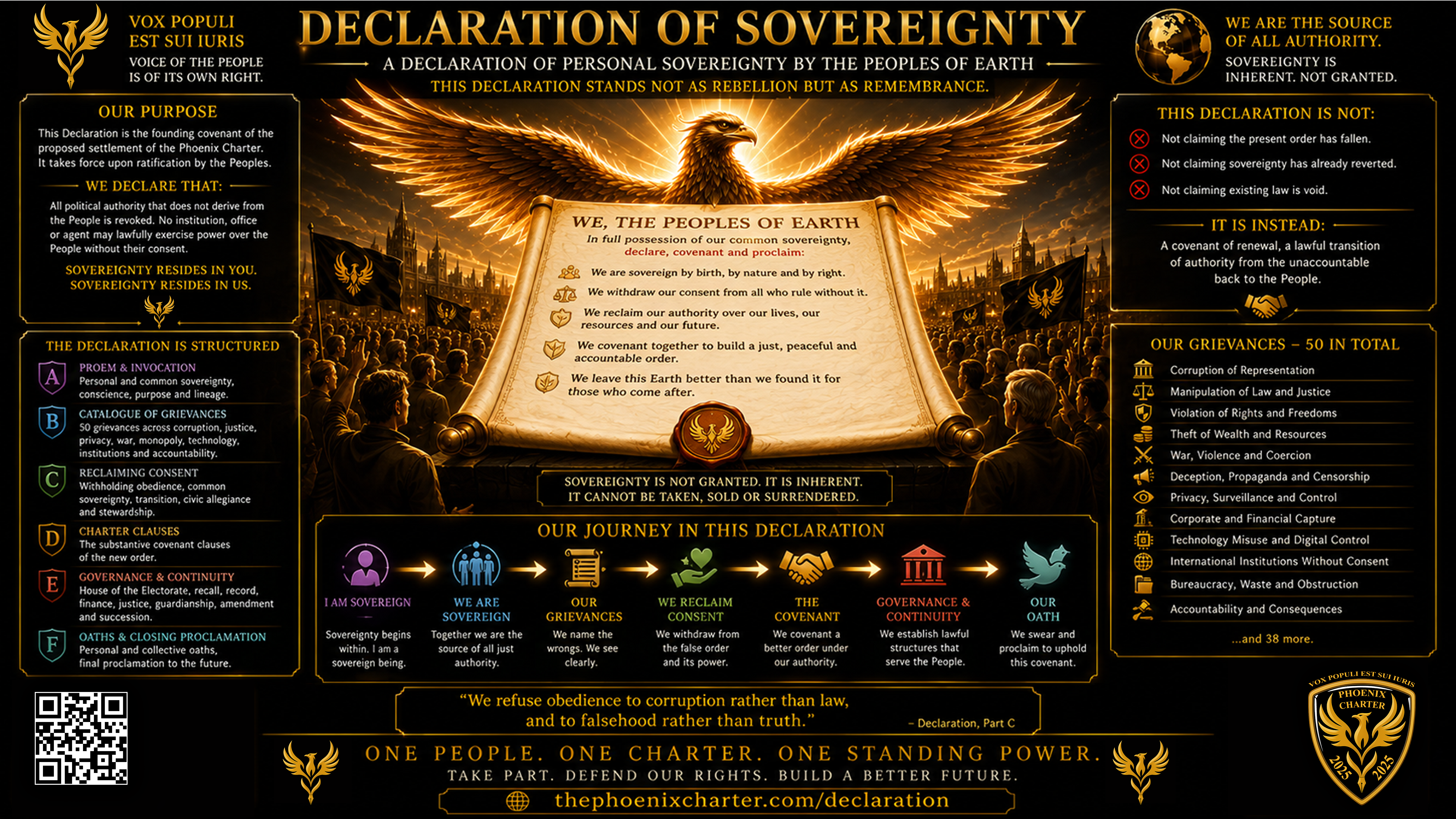
A declaration of sovereignty is not enough if officials can still arrest, silence, exclude or strip people of their livelihood without remedy. Sovereignty must be defended by rights that bind every institution. The next step is an entrenched Bill of Rights.
2. The Bill of Rights — Protections for Every Person
Sovereignty without inviolable individual rights could merely replace one form of tyranny with another. Phoenix therefore makes the Bill of Rights a central line of defence, not a decorative statement of values.
The same constitutional restraints must bind governments, corporations exercising public functions and the electorate when it exercises collective power. No majority acquires a licence to destroy the fundamental rights of an individual.
The Bill establishes the boundaries that public authority must never cross: the protection of life, bodily integrity, liberty, conscience, expression, privacy, property, due process and access to independent justice.
Rights must be more than words. They need enforceable duties, meaningful consent, accessible remedies and independent courts capable of acting against unlawful conduct by powerful institutions.
These protections would apply to government, public institutions and the exercise of Standing Power.
The electorate’s constitutional authority must not become an instrument for arbitrary punishment, discrimination or the removal of fundamental individual protections.
The Bill also addresses the relationship between public authority and individual consent, the protection of creators, the lawful limits of enforcement and the restoration of rights where wrongdoing has caused their loss.
Standing Power prevents unaccountable government; entrenched rights prevent Standing Power itself from becoming an instrument of persecution. Both are indispensable to the defence Phoenix is designed to construct.
These protections address the right to life; liberty and bodily integrity; conscience, belief, worship and expression; personal privacy and consent; due process and independent justice; equality before the law; protection of property and individual creations; peaceful association and trade; and access to essential public resources without arbitrary exclusion.
The proposals also address freedom to criticise government and to cause or experience offence without that fact alone removing lawful speech protections; protection against disproportionate data collection and conditional access to ordinary life; and remedies where official wrongdoing harms a person’s rights or livelihood. Creator rights, independent review and restitution are subjects of the detailed Bill rather than powers that this overview itself purports to enact.
Fundamental rights belong to every person, whether or not they sign the Charter, join the Party or participate in a vote . Collective Standing Power must be bounded by those rights. The universal Constitution would define obligations, remedies, the independence of courts and protection against suspension or removal of entrenched safeguards.
Rights are proposed for everyone, not benefits granted for signing
The Bill of Rights is intended to set the permanent floor beneath which neither government nor the electorate’s own collective vote may go. Its provisions cover not only protection from arbitrary state action, but also practical safeguards including access to independent justice, consent to data processing, protection of conscience and expression, and rights over individual creations.
The published Phoenix Bill is a proposal, not an enacted replacement for existing rights law. People may read it, debate it and express support now; making its provisions legally operative would require the referendum and lawful constitutional steps described later on this page.
The Declaration establishes the source of public authority. The Bill of Rights erects the barriers it must never breach. The Standing Powers are the next step because a barrier without the power to enforce it can be dismantled by those it was meant to restrain.
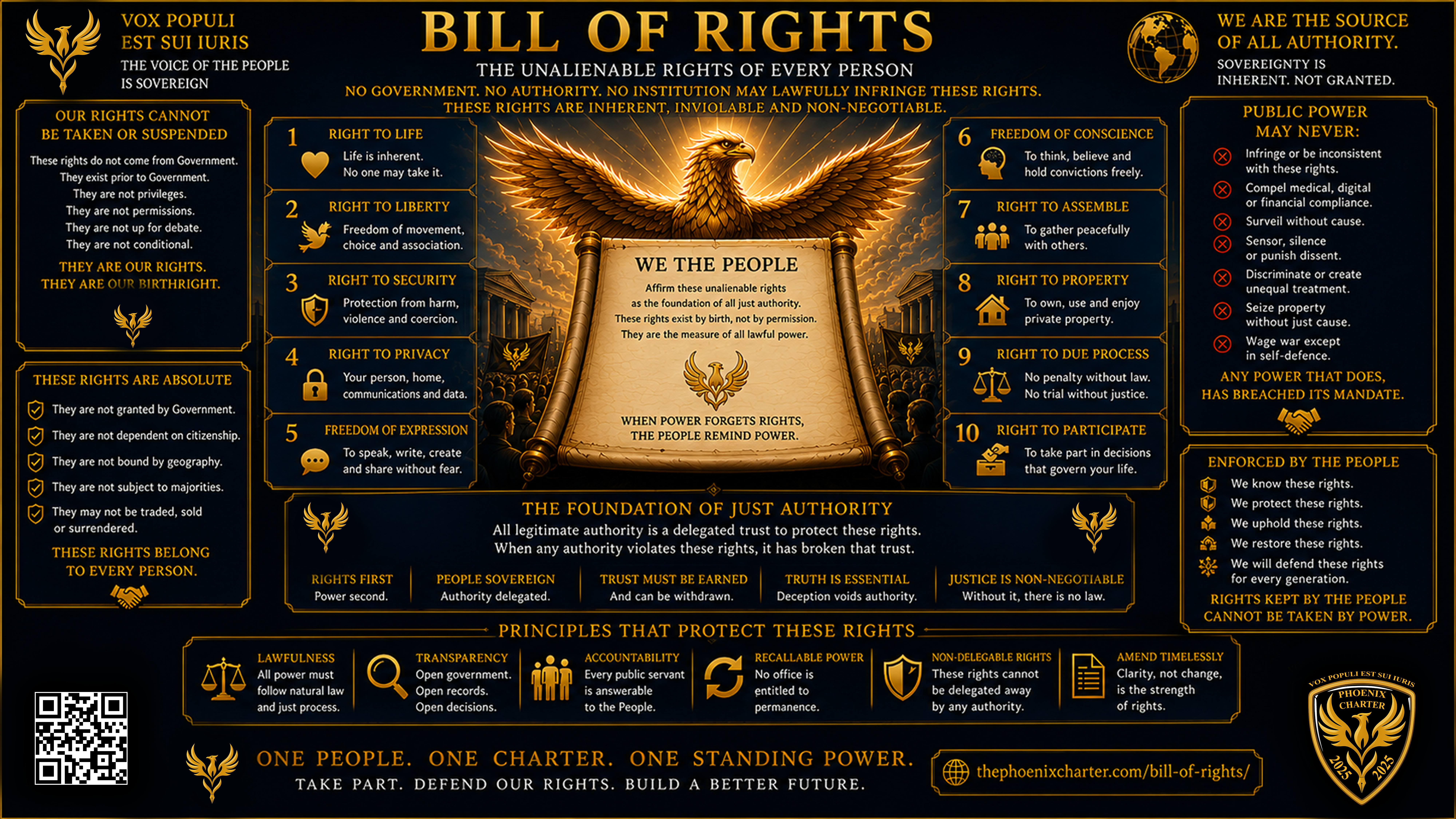
Rights written on paper cannot stop abuses if those who violate them alone decide whether to enforce them. The People need continuing constitutional authority to intervene. That is why Phoenix moves from the Declaration and Bill of Rights to the five Standing Powers.
3. The Five Standing Powers of the Electorate
These five Standing Powers are the mechanism by which the People would cease to be helpless spectators to decisions made in their name. Phoenix proposes to establish them as continuing constitutional authorities, not favours that a government may grant or withdraw.
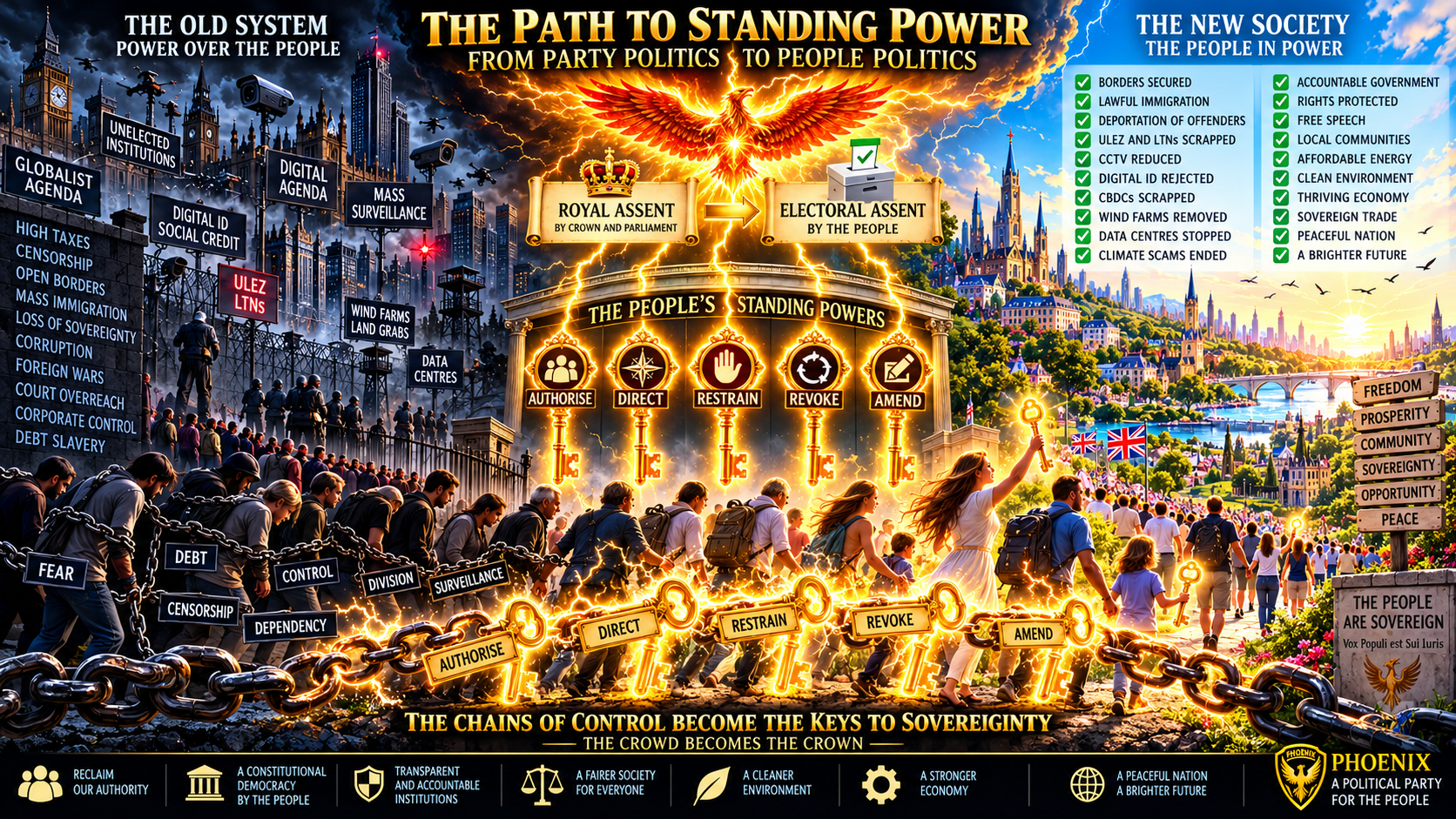
These are AUTHORISE, DIRECT, RESTRAIN, REVOKE and AMEND .
Together they would let the electorate AUTHORISE delegated power, DIRECT its lawful use, RESTRAIN abuses, REVOKE mandates and AMEND constitutional arrangements. This is the difference between asking those in office to listen and possessing lawful authority they cannot simply ignore.
The proposed settlement would also transfer the constitutional function currently exercised through Royal Assent to the electorate, under the name Electoral Assent . This is a transferred constitutional function, not a sixth Standing Power.
Their exercise would remain subject to the Bill of Rights, independent justice and the Constitution. The object is to prevent tyranny, not to create a new route to it.
Their individual functions, detailed procedures, thresholds and safeguards are explained on the dedicated Standing Powers page.
AUTHORISE concerns consent to the grant and exercise of delegated authority. DIRECT allows the electorate to issue binding constitutional instructions within defined limits. RESTRAIN provides a means to stop or suspend disputed exercises of public authority while appropriate safeguards and remedies operate. REVOKE provides for lawful withdrawal of a mandate or delegated authority. AMEND preserves the People’s power to change constitutional arrangements through the prescribed process.
These are organising constitutional powers, not five unlimited plebiscitary vetoes. The final settlement must specify who can initiate each process, the applicable evidence and deliberation requirements, thresholds, time windows, audit procedures, rights protections, and independent remedies. No Standing Power would legitimise arbitrary punishment, remove non-derogable rights or permit a majority to decide individual criminal guilt.
The dedicated Standing Powers page explains the procedures and safeguards. Their constitutional purpose is clear: no government should be able to seize or retain authority beyond the reach of the People who entrusted it.
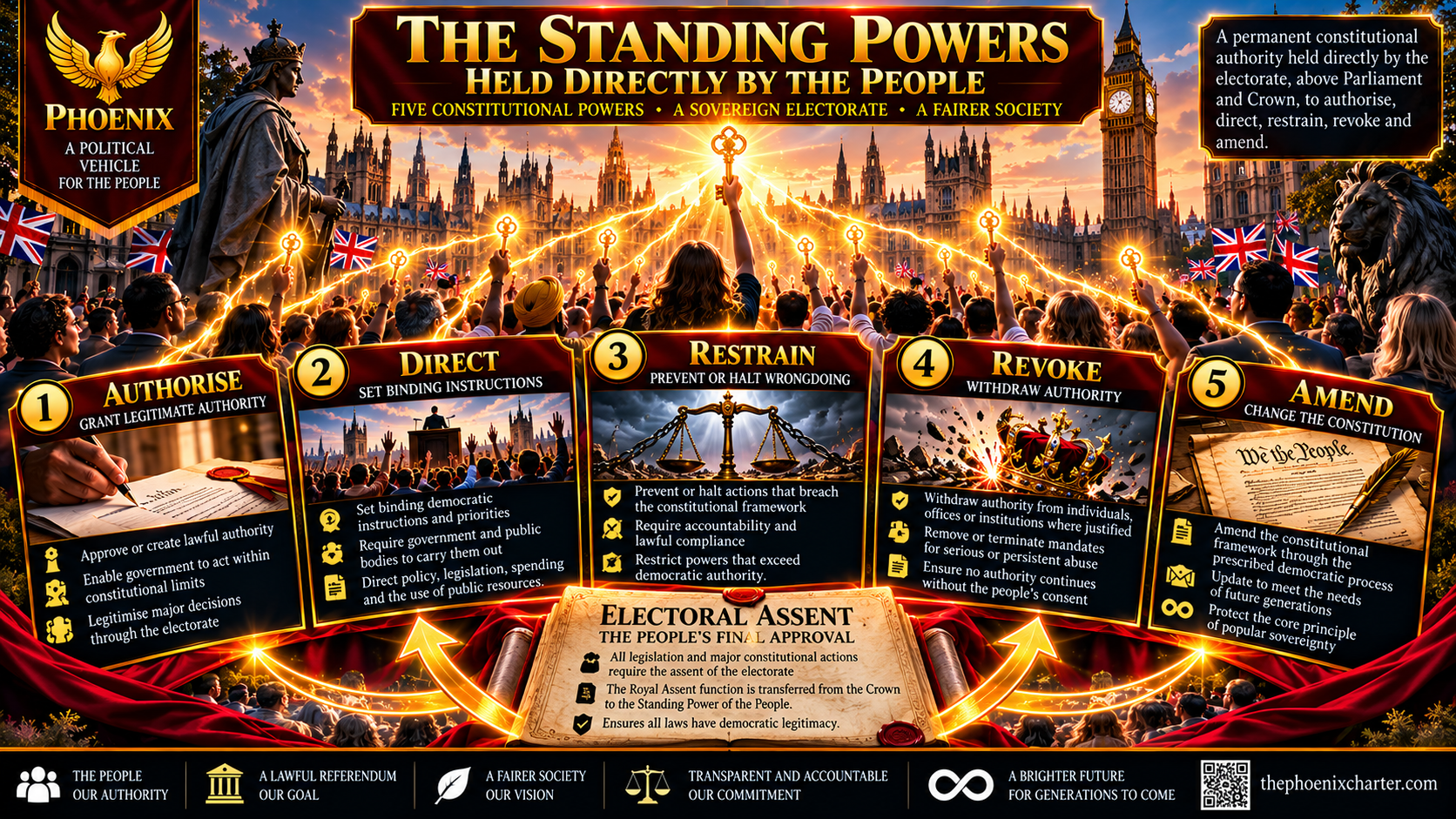
Standing Powers can restrain abuses after they arise; the People must also be able to prevent new legislation from placing their rights in jeopardy. The moment a Bill becomes law must not be permanently beyond public control. This leads from Royal Assent to the proposed Electoral Assent.
4. From Royal Assent to Electoral Assent — The People Gain the Right to Refuse
Royal Assent is the final formal stage of UK legislation. Under modern constitutional convention, the monarch grants assent to Bills passed by Parliament and does not ordinarily exercise an independent political veto. Public opposition to legislation does not, by itself, require Royal Assent to be withheld.
Phoenix proposes a decisive constitutional change: where the adopted Constitution requires Electoral Assent, the People would hold the lawful, binding authority to grant or refuse it. Legislation affecting their future should not pass beyond their control simply because Parliament has agreed to it.
This is not a cosmetic change of terminology. It would replace an assent stage that normally operates as a constitutional formality with a meaningful, defined decision by the electorate.
Electoral Assent is a transferred constitutional function, not a sixth Standing Power. It would operate alongside AUTHORISE, DIRECT, RESTRAIN, REVOKE and AMEND, within the protections of the Constitution and Bill of Rights.
Why Change the Assent Function?
Under the present arrangements, the Crown is not a practical means by which the electorate can prevent legislation it opposes. The monarch’s role is constitutionally constrained, while the electorate has no equivalent standing power to refuse assent between general elections.
Phoenix holds that constitutional consent must be real. Where Electoral Assent applies, the electorate would be entitled to say YES or NO, and the decision would have the legal consequences set out in advance.
How Legislation Would Change
Present system: Parliament passes a Bill → Royal Assent is granted under constitutional convention → the Bill becomes an Act.
Proposed Phoenix system: Parliament passes a Bill → the constitutionally prescribed Electoral Assent process takes place → assent is granted or withheld according to the electorate’s lawful decision.
Parliament would continue to legislate. The constitutional settlement would specify which measures require Electoral Assent, the applicable voting thresholds, deliberation and scrutiny, protection of individual rights, and the consequences of refusal.
The People’s Power to Call a General Election
The proposed settlement would also allow the electorate to initiate a General Election without needing the consent of the Prime Minister or Crown , subject to the procedures, thresholds and safeguards established by the Constitution.
Under current UK arrangements, the Prime Minister ordinarily requests dissolution from the monarch; the electorate cannot independently require a General Election through a binding public vote.
The proposed power to call a General Election and the separate Electoral Assent function answer the same underlying danger: public authority must not become an unchallengeable possession of those who happen to hold office.
A Lawful Constitutional Transition
Royal Assent and existing election arrangements would remain in force until a defined constitutional settlement had received the required democratic and legal approval and the replacement mechanisms were lawfully established and operational.
The transfer would require a lawful transition protecting independent courts, legal continuity, fundamental rights and reliable public decisions. A constitutional defence against arbitrary power must itself be implemented without arbitrary power.
Electoral Assent must be distinguished from the AUTHORISE Standing Power: one addresses the final constitutional assent required for legislation, while the other concerns the wider grant and exercise of delegated authority. The adopted constitutional text would need to make their relationship explicit, prevent conflicting procedures and protect legal certainty while a public decision is pending.
The proposal does not claim that Royal Assent has already been transferred or that an electorate can currently veto Acts of Parliament through this mechanism. These are proposed constitutional reforms requiring a valid democratic mandate and lawful implementation.
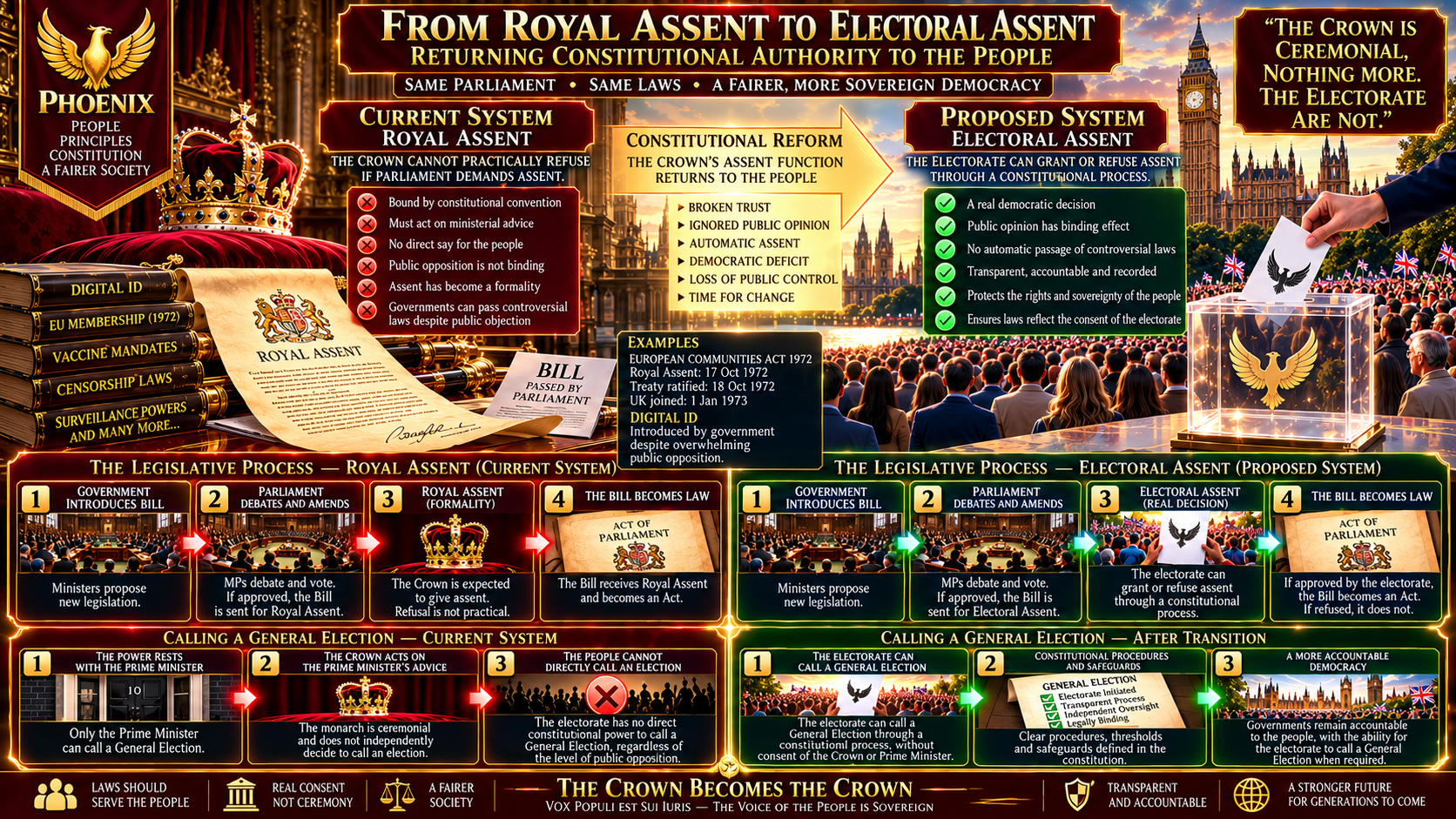
Protected rights, Standing Powers and Electoral Assent define the proposed answer — but they cannot lawfully come into force through assertion alone. The People themselves must authorise the constitutional transfer. That requires a referendum on a defined settlement.
5. The Referendum — The People Decide
The constitutional revolution Phoenix seeks must be authorised by the People themselves. The proposed referendum is the point at which the electorate would decide whether to establish the settlement that places continuing constitutional authority in its hands.
This is not simply a choice between parties or personalities. It asks a deeper question: will the People remain dependent on politicians to restrain political power, or establish permanent constitutional means to restrain it themselves?
It is to decide whether the electorate should acquire the defined constitutional Standing Powers and associated safeguards proposed by the Charter.
The electorate must be able to examine the constitutional provisions, understand their consequences and consider the arguments for and against adoption.
The referendum process must be transparent, independently administered and protected against unlawful interference.
The consequences of a YES or NO decision must be known before the vote, including how and when any approved safeguards would be given lawful effect.
An affirmative vote would not automatically make every proposed institution operational overnight.
The constitutional settlement would require lawful commencement, transitional arrangements, administrative preparation and independently verifiable safeguards.
The referendum would establish the electorate’s decision. The implementation arrangements would determine how that decision takes effect.
The decision would concern a defined constitutional settlement rather than an open-ended mandate for the Phoenix founder or political party. The electorate would need access to the proposed text, its legal effects, safeguards, transitional arrangements and credible arguments supporting and opposing adoption.
The referendum would authorise a defined constitutional settlement, not deliver a blank cheque to Phoenix, its founder or any party. The power being sought belongs to the electorate, not to those campaigning for it.
A referendum would be meaningless if the question were vague, the consequences uncertain or the promised powers left for politicians to define afterwards. The People must see exactly what they are being asked to authorise. The proposed Phoenix Referendum Bill would set out that legal framework.
6. The Phoenix Referendum Bill
A constitutional referendum cannot be secured by slogans alone. The Phoenix Referendum Bill would translate the demand for Standing Power into a legislative instrument capable of placing a clear, consequential decision before the electorate.
It is a necessary distinction: campaigning for a referendum is not the same as establishing the legal authority to conduct one.
The Bill must say exactly what the People are being asked to decide, who can vote, what text is being approved and what legal obligations follow the result. The electorate must never be asked to surrender trust to an undefined promise.
It would also need to establish how the proposed constitutional text is presented, how campaigning is regulated, how votes are counted and how the result is certified.
Most importantly, the Bill must identify the intended legal consequences of the result.
A referendum that merely expresses public opinion is different from one whose approval triggers defined constitutional obligations.
A symbolic opinion poll would not be enough. The intended legal consequences must be specified so that an affirmative decision cannot simply be acknowledged and then ignored.
The Bill must also provide appropriate safeguards for the integrity of the referendum and the lawful transition that would follow an affirmative result.
The Referendum Bill is proposed legislation. It has not been enacted by Parliament.
Its detailed provisions remain subject to drafting, review and alignment with the final constitutional instruments.
The Referendum Bill must confront the hard questions in law: constitutional text, individual rights, Electoral Assent, Standing Powers, transitional safeguards, commencement and the obligations arising from the electorate’s decision.
It must distinguish the authority to conduct the referendum from the legal provisions necessary to give effect to its result. The transfer of the assent function, any election-trigger mechanism, the protections afforded by the Bill of Rights, transition dates and review mechanisms must be unambiguous. Matters still unresolved in the constitutional drafts must not be replaced by invented thresholds merely to make the Bill appear complete.
Read the Proposed Question — and Try a Non-Binding Ballot
The Referendum Bill should make the proposed question and the full constitutional documents available before a real campaign begins, so a reader can see exactly what a YES or NO would mean. The proposed instrument should distinguish the legal act authorising the referendum from the separate provisions giving effect to a result.
The project’s Petitions & Polls
area can provide a place to find an available trial ballot or participate in other consultations. A dry vote, if offered there, must be visibly marked as an unofficial, non-binding exercise: it is not a statutory referendum, its result cannot enact the Constitution, and any published totals must explain the counting and eligibility limits.
The trial vote, where offered, would help people understand the proposal but would not masquerade as a statutory referendum. Clarity about what is binding and what is not is itself a protection against political manipulation.

A proposed Bill is not an enacted law, and a website cannot call a binding national referendum on its own. How does the demand for constitutional protection become a question on the ballot paper? Phoenix must pursue a lawful route through Parliament and public political pressure.
7. The Path to the Referendum — From the People to Parliament
If the electorate is to reclaim constitutional authority, the proposal must reach an actual lawful referendum. Public enthusiasm alone cannot force a binding national ballot into existence.
Public support must first be developed around a clear understanding of the proposed constitutional settlement.
The political route may involve public campaigning, petitions, political organisation, parliamentary engagement and electoral participation.
Phoenix will seek to convert public support into the parliamentary legislation required for a genuine decision. The Party is a political vehicle for that task, not a substitute sovereign.
The objective is to secure a referendum through which the People can decide whether to adopt the proposed constitutional arrangements.
The route to that referendum must distinguish between public support for constitutional reform and the legal authority required to conduct a binding national vote.
A petition or campaign can demonstrate support. It cannot, by itself, establish the legal consequences of a constitutional referendum.
The political route must expose the full constitutional programme to scrutiny and build a mandate strong enough to be heard. The objective is not merely to register dissent against existing power, but to change the constitutional arrangement that makes dissent so easy to disregard.
This stage requires a public explanation of the actual constitutional proposals; a petition and wider evidence of support; responsible political organisation; engagement with MPs and other institutions; and a parliamentary strategy capable of obtaining the necessary legal authority for a referendum. Campaigning, party registration and a public petition do not by themselves create constitutional powers.
Whatever route secures the legislation, voters must be able to assess the final constitutional text, not simply an attractive slogan. The route to obtaining a referendum is a different question from the referendum itself and different again from the post-vote implementation of Standing Power.
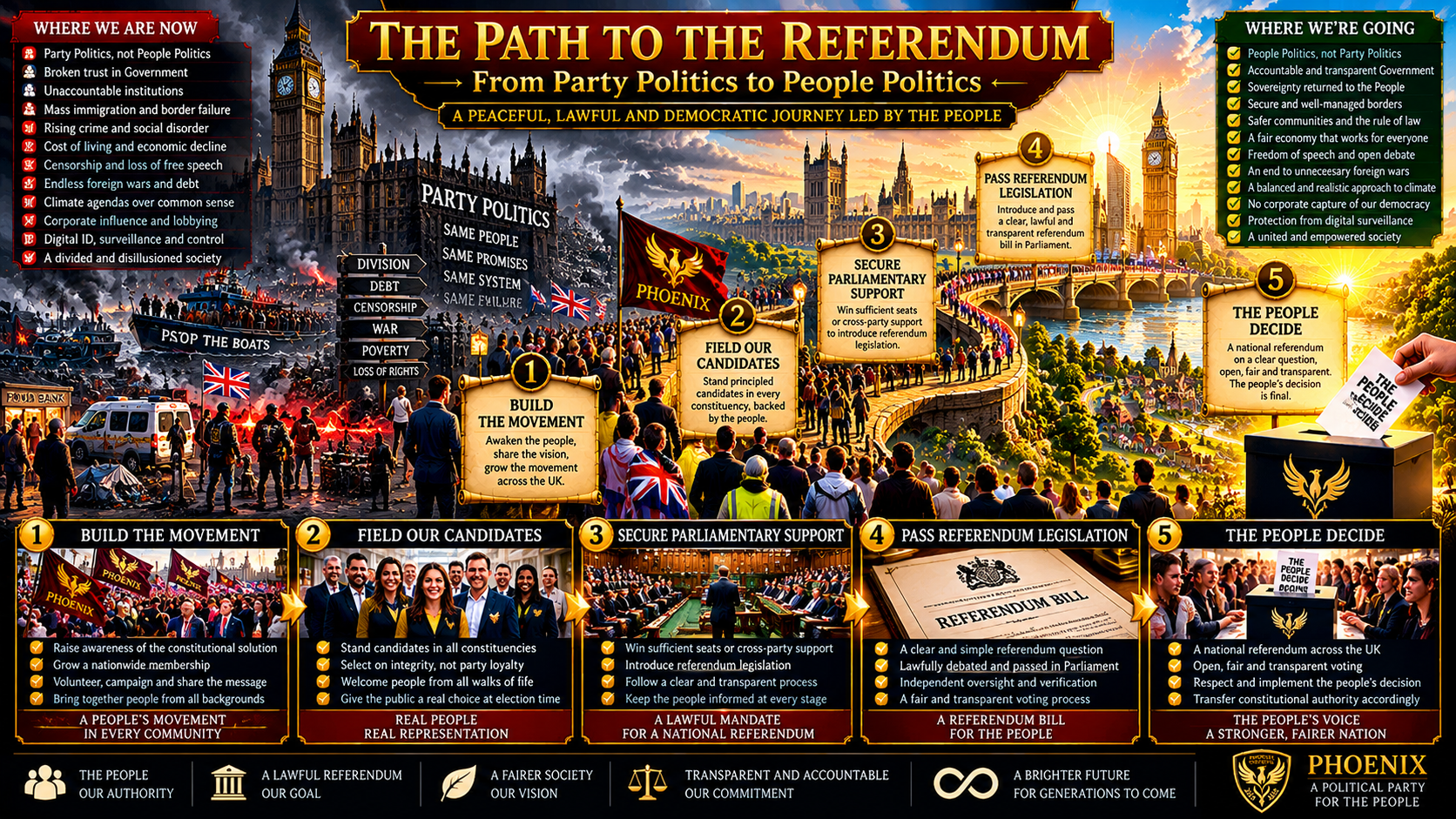
A route to Parliament needs organised people prepared to pursue it. Petitions can expose concern but cannot guarantee the necessary legislation. To challenge the existing political system through its lawful procedures, Phoenix needs a political vehicle with a single constitutional objective.
8. Phoenix — The Political Party
The Phoenix political party exists for a defined purpose: to challenge the constitutional arrangements that leave the People without effective power over those who govern them, and to pursue a lawful referendum to change them.
The Party is distinct from the Phoenix Charter, the Phoenix Trust and the proposed constitutional institutions.
Its founding objective is to secure the lawful establishment of the electorate’s Standing Powers and the proposed transfer from Royal Assent to Electoral Assent — not to install a different elite in permanent control.
The Party’s internal governing document is the Constitution of Phoenix .
That Constitution defines the Party’s organisation, membership, officers, governance, accountability and protected founding objective.
It also provides for lawful political activity, including campaigning, seeking electoral representation, fielding candidates and participating in government where appropriate.
The Party is not itself the House of the Electorate and would not acquire the People’s Standing Power merely by obtaining electoral success.
The Party must not confuse electoral success with constitutional ownership. Even if it gained seats or entered government, sovereignty would still belong to the People.
The Party’s purpose is to help establish the constitutional arrangements through which the People, rather than the Party, exercise Standing Power.
The distinction between the Party’s internal constitution and the proposed universal Constitution is essential. The Party document governs officers, members, candidate selection, finances, conduct and the protected founding objective. The universal Constitution would govern the lawful allocation of public power and the rights of all people in a participating territory, including those who reject Phoenix politically.
Parliamentary participation is a means to obtain a lawful public decision, never a licence to bypass it. Phoenix must be bound by the same constitutional limitations it demands for every other party.
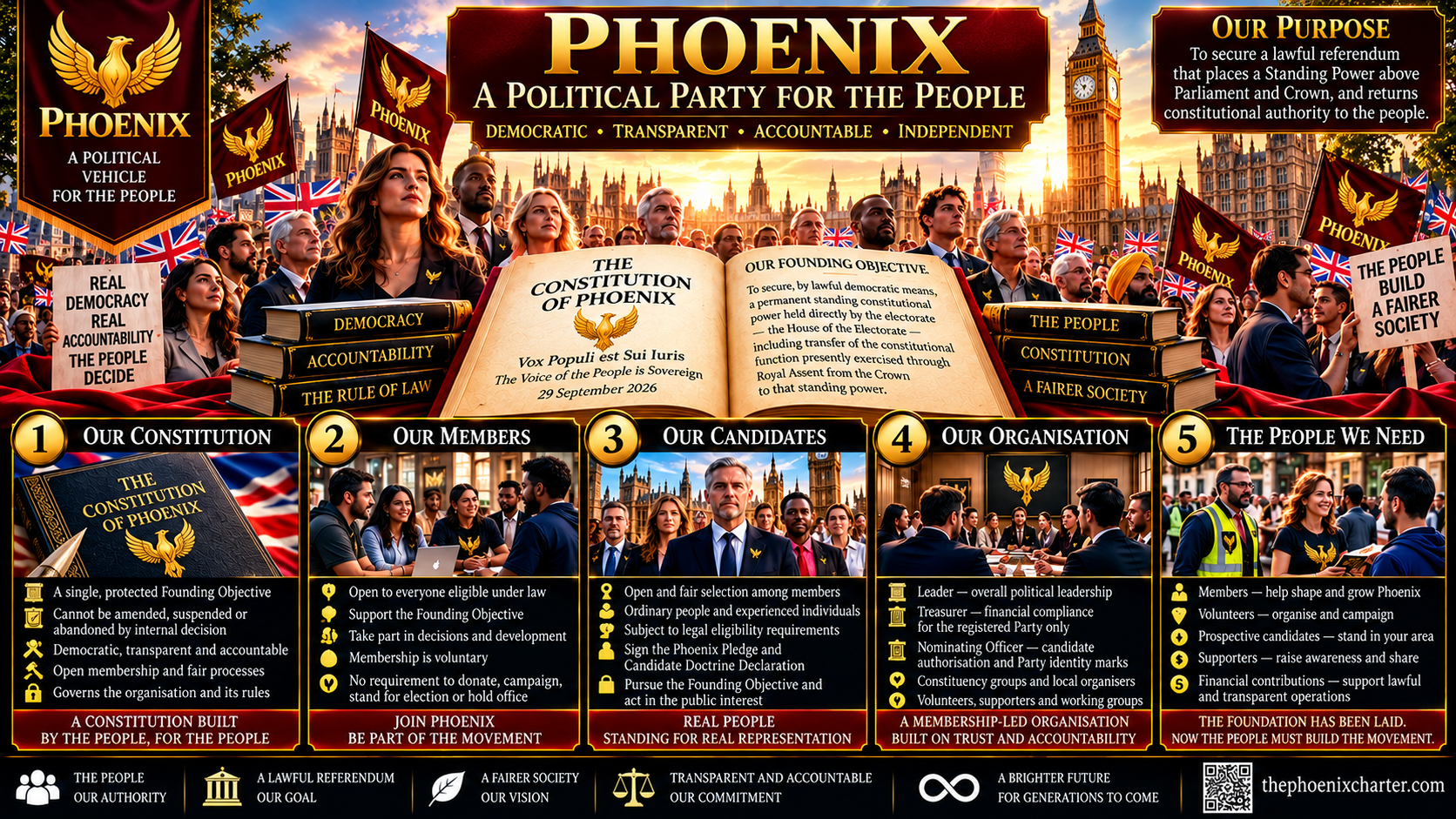
Establishing a Party creates a political vehicle; it does not guarantee that its officers will remain faithful to the mission. A movement opposing the capture of power must protect itself against capture. The Manifesto makes the public commitments by which Phoenix can be held to account.
9. The Phoenix Manifesto
A movement that claims to defend the People must be judged by what it commits itself to do. The Phoenix Manifesto makes the political programme public so its officers and representatives can be held to account.
It is distinct from the Constitution of Phoenix.
The Party Constitution establishes how Phoenix is governed and protects its founding objective. The Manifesto explains what Phoenix proposes to achieve politically.
The Manifesto provides a public statement of the Party’s priorities, the changes it advocates and the commitments against which its political conduct can be judged.
Its defining commitment is constitutional: to replace the electorate’s dependence on party promises with permanent, enforceable authority over delegated public power.
It also connects that objective to the practical consequences for democratic accountability, public administration, fundamental rights, public finances and the relationship between citizens and government.
The Manifesto may develop as policies are refined, circumstances change and members contribute to the Party’s programme.
However, it must remain consistent with the Party’s protected founding objective.
The Manifesto must not be confused with the proposed universal Constitution. A political programme is not itself a constitutional settlement.
The Manifesto must explain how a lawful referendum, Standing Power, Electoral Assent, public accountability, transparent finances and personal freedoms form a single programme of protection — not unrelated campaign slogans.
Political policies may evolve, but the Party’s founding objective must remain identifiable and protected. The purpose of Phoenix is to return power to the People, not to accumulate it for Phoenix.
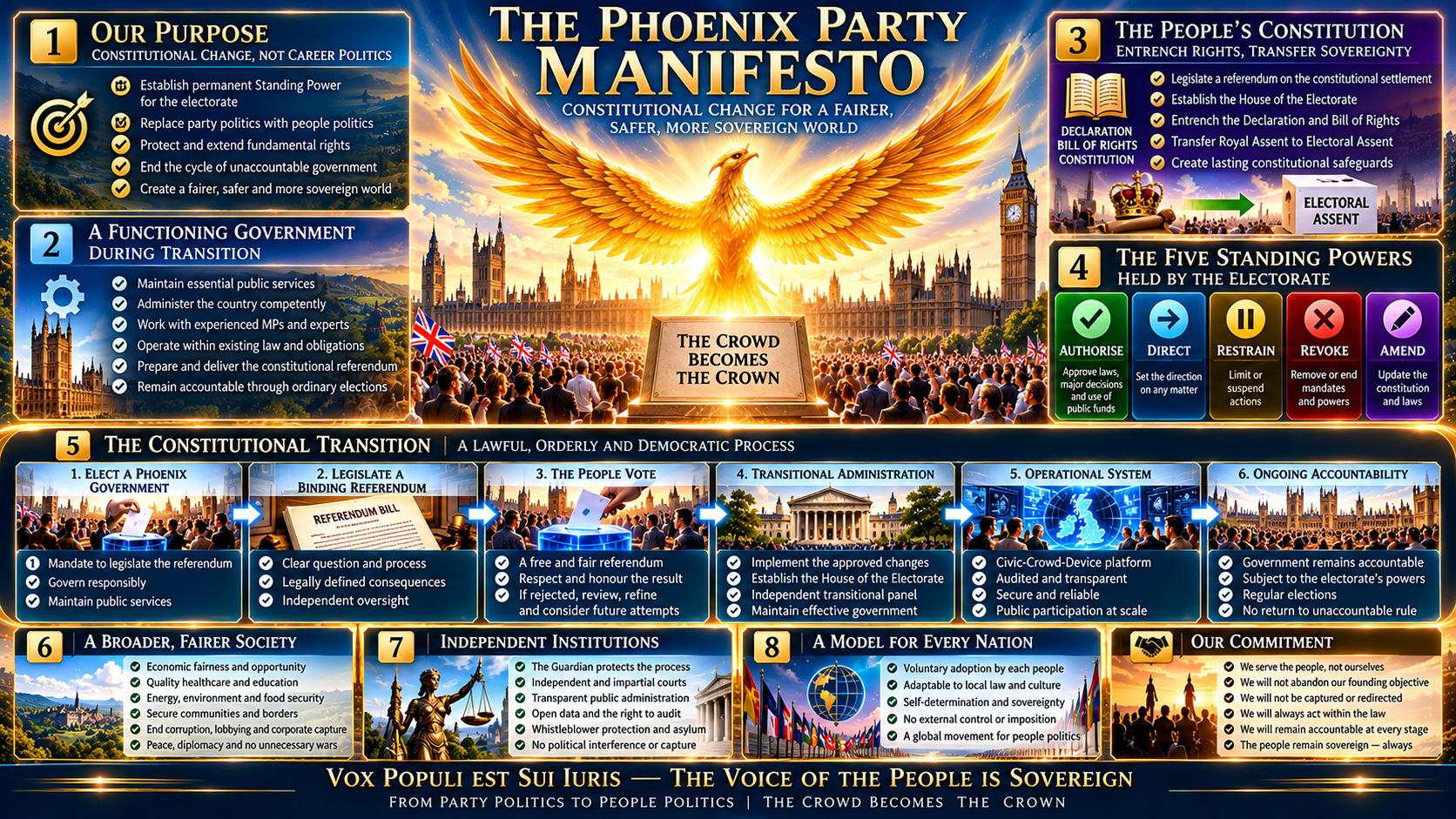
A manifesto and constitutional proposal achieve nothing if the People remain spectators. The defence of sovereignty requires public participation while that participation is still free. The next step is to examine, sign, support, join or otherwise contribute to building a lawful referendum mandate.
10. Sign, Join and See the Global Breakdown
No constitutional safeguard can be established on the strength of one person’s warning. The People must examine the proposal, decide whether they support it and build the public mandate needed to bring it to a real vote.
Signing is a public expression of support, not a binding constitutional ballot. It does not itself confer new legal rights, enact the Declaration or Bill of Rights, register membership of a political party, or authorise anyone to vote on another person’s behalf.
Sign the Declaration and the Charter
The Sign page
provides the project’s signing process. Anyone considering signing should read the Declaration and Bill of Rights first, understand what is being supported and retain the freedom to choose whether to participate.
See where support is developing
The Global Breakdown is intended to make developing support visible. Its figures describe recorded participation, not a constitutional mandate or a claim that an entire country has already agreed.
Help bring the referendum to a real vote
Supporting the constitutional proposal, joining the political party and participating in a petition are different actions. Readers who wish to assist the political route can explore Join Phoenix
or read the referendum petition backup
, whose own signing terms should be examined separately.
The purpose of signing, joining or participating is to move from concern to peaceful, organised constitutional action. A population that can still organise lawfully must not wait until its ability to do so has disappeared.
Even victory at a referendum would be hollow if government could postpone its implementation or quietly dismantle the new powers later. The People must not win sovereignty on polling day only to lose it during implementation. The settlement must establish and permanently protect Standing Power.
11. Establishing and Keeping Standing Power
A successful referendum would mean little if the powers it approved could be delayed indefinitely, quietly disabled or later removed by the institutions they were intended to restrain. Implementation and permanent protection are as important as the public vote itself.
The objective would be to establish the electorate’s Standing Power as a continuing constitutional authority rather than a temporary privilege dependent upon the government of the day.
The transition must identify which powers move, which institutions continue, how courts remain independent, how services operate and what remedies exist if the approved settlement is obstructed.
It would also need to establish the operational procedures for the five Standing Powers and Electoral Assent.
These arrangements must protect the rights of individuals, the independence of the judiciary, the continuity of essential services and the lawful administration of public affairs.
Appropriate transitional institutions may be required while the permanent arrangements become operational.
Such bodies must remain limited by the constitutional settlement and must not acquire permanent sovereign authority.
The electorate must possess effective protection against any future attempt to suspend, weaken or bypass its Standing Powers. A supposed constitutional right that an administration can switch off in an emergency is no reliable defence.
The route to Standing Power is therefore different from the route to the referendum.
Reclaiming Sovereignty explains the constitutional objective.
The Path to the Referendum explains the political and legislative route to the public decision.
The Path to Standing Power explains the implementation of the approved constitutional settlement.
These are consecutive parts of one constitutional programme, not competing routes.
What the electorate would reclaim
Following lawful implementation, the electorate would retain a continuing means to oversee delegated authority, issue binding directions within the Constitution, restrain unauthorised measures, withdraw mandates and amend constitutional arrangements under entrenched safeguards. It would also exercise the separately defined Electoral Assent function and, if adopted, the ability to initiate a General Election without requiring the Prime Minister’s permission.
How the People would keep that power
Entrenchment would require clear initiation rules, independent scrutiny, published decision records, secure and accessible participation, effective remedies and protection against a government quietly disabling the constitutional process. Thresholds and windows would need to be specified for each function, not improvised after controversy arises.
The implementation programme must keep custody of the power with the electorate. The Party may campaign, the Guardian may protect the process and a platform may administer participation — but none may seize the authority that the People have recovered.
None of these stages confers sovereign authority on the Guardian, the Party or the technology supplier. The political route secures a decision; the referendum authorises the settlement; the implementation programme makes the electorate’s continuing constitutional authority effective.
Power can be captured not only by politicians but by administrators, contractors, trustees and technology suppliers. How can Phoenix establish the new constitutional system without creating a new unaccountable centre of control? Its separate components must be joined by safeguards while remaining institutionally distinct.
12. How the Phoenix Charter Fits Together
The Phoenix Charter is a connected constitutional defence, not a collection of unrelated websites, organisations or slogans. Every component has a separate function, and each must be prevented from capturing the others.
Together the components are intended to secure the People’s authority, protect their rights, enable participation, guard constitutional procedures and safeguard assets dedicated to public benefit.
At its centre is a distinction between sovereignty, constitutional rules, political campaigning, administration and custodianship . The People are the source of sovereignty; the Constitution would establish enforceable rights and procedures; Phoenix as a political party would campaign for the lawful change; the House of the Electorate would express collective constitutional authority; the Guardian would safeguard process; and the Civic-Crowd-Device would be one possible means of participation.
The Trust serves a different purpose: protecting assets held for public benefit. It must never be mistaken for a sovereign government. The project’s separate political, public-benefit, technical and legal funds must likewise retain their own lawful purposes and accounting.
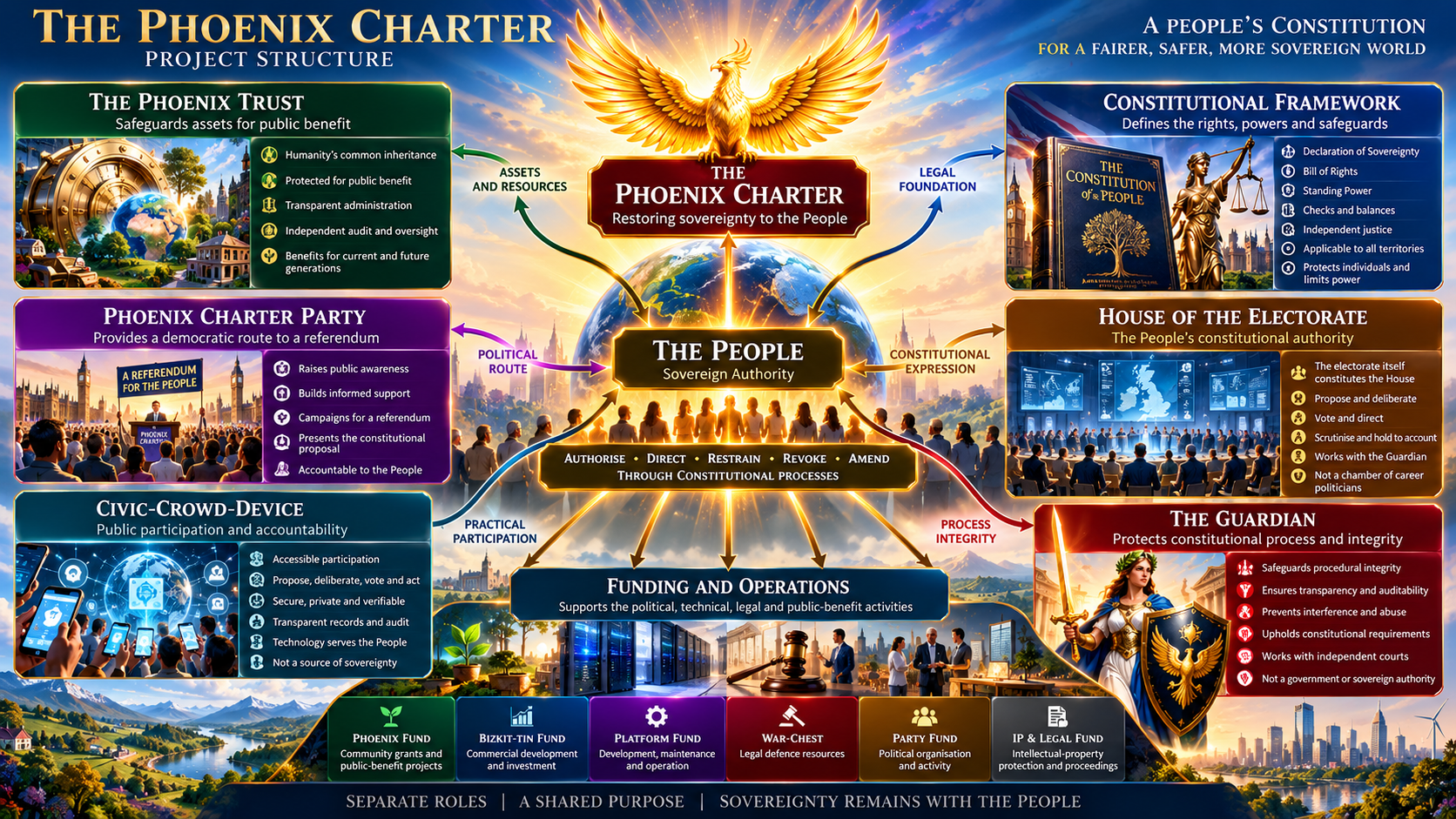
The Phoenix Trust safeguards the assets entrusted to it. The constitutional framework defines the proposed rights, powers and safeguards. The political party Phoenix provides a political route towards a referendum.
The House of the Electorate would provide the constitutional expression of the People’s collective authority, while the Civic-Crowd-Device would offer practical facilities for public participation.
The Guardian would protect the integrity of constitutional procedures without acquiring sovereign authority over the People.
A Trust, technology provider, political party or administrative office must never be able to claim ownership of the People’s sovereignty. Separation of roles is an anti-capture safeguard built into the architecture of Phoenix.
None of these organisations or mechanisms owns the sovereignty of the People.
The Constitution of Phoenix is the internal constitution of the political party. It must not be confused with the proposed universal Constitution governing the rights and constitutional arrangements of the People.
The Party cannot own sovereignty; nor can the Trust, Guardian or software platform. So where must the People’s constitutional authority reside? In the electorate itself, constituted as the House through which collective authority is exercised.
13. The House of the Electorate
The House of the Electorate is deliberately not another room filled with politicians. The electorate itself would constitute the House, so that collective constitutional power does not disappear into the hands of a new class of representatives.
The electorate itself would constitute the House.
Through constitutionally authorised processes, the People would be able to propose, deliberate, vote, direct, scrutinise and hold public authority accountable.
Its purpose is to give the People a continuing constitutional relationship with institutions that exercise authority in their name, including a lawful means to intervene when that authority is abused.
Its purpose would not be to replace every administrative decision with a referendum. Ordinary government would continue to perform its lawful functions.
Instead, the House would provide the constitutional means through which the electorate could exercise its Standing Powers when required.
Its procedures would need to address eligibility, access, verification, deliberation, voting, transparency, auditability, safeguards against manipulation and the protection of individual rights.
Participation must not depend exclusively upon possession of a particular commercial device, identity product or privately controlled technology.
The electorate itself would constitute the House. It would not be an assembly of appointees speaking in the People’s name, nor a rival elected chamber claiming to replace Parliament. Its membership would follow the constitutional definition of the relevant electorate; the collective authority exercised would be subject to individual rights and the independent legal order.
No administrator or supplier should be able to manipulate who may vote, rewrite thresholds or suppress a lawful result. The House is intended to prevent precisely the kind of administrative capture against which the Charter warns.
Neither an administrator nor a platform provider could change the eligible electorate, adjust a threshold retrospectively or suppress a valid outcome. Procedural disputes would require independent review. The House therefore expresses the People’s constitutional authority; it does not transfer sovereignty to those who count the votes.
The Voice of the Electorate is the means through which the House expresses views, deliberates and makes eligible decisions. The Civic-Crowd-Device is the proposed practical system supporting those interactions. The Guardian safeguards their integrity, but does not own or dictate the electorate’s choices.
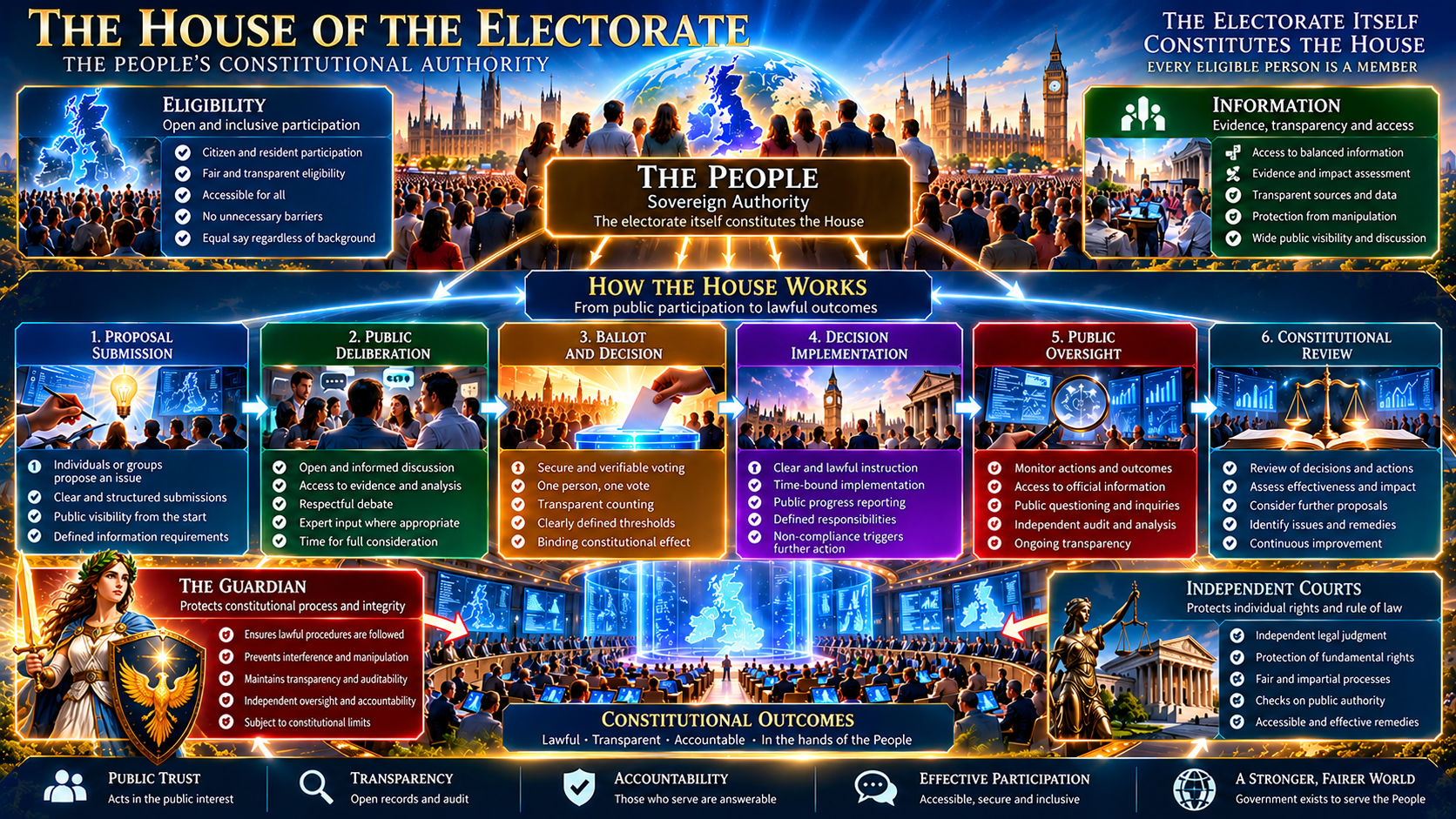
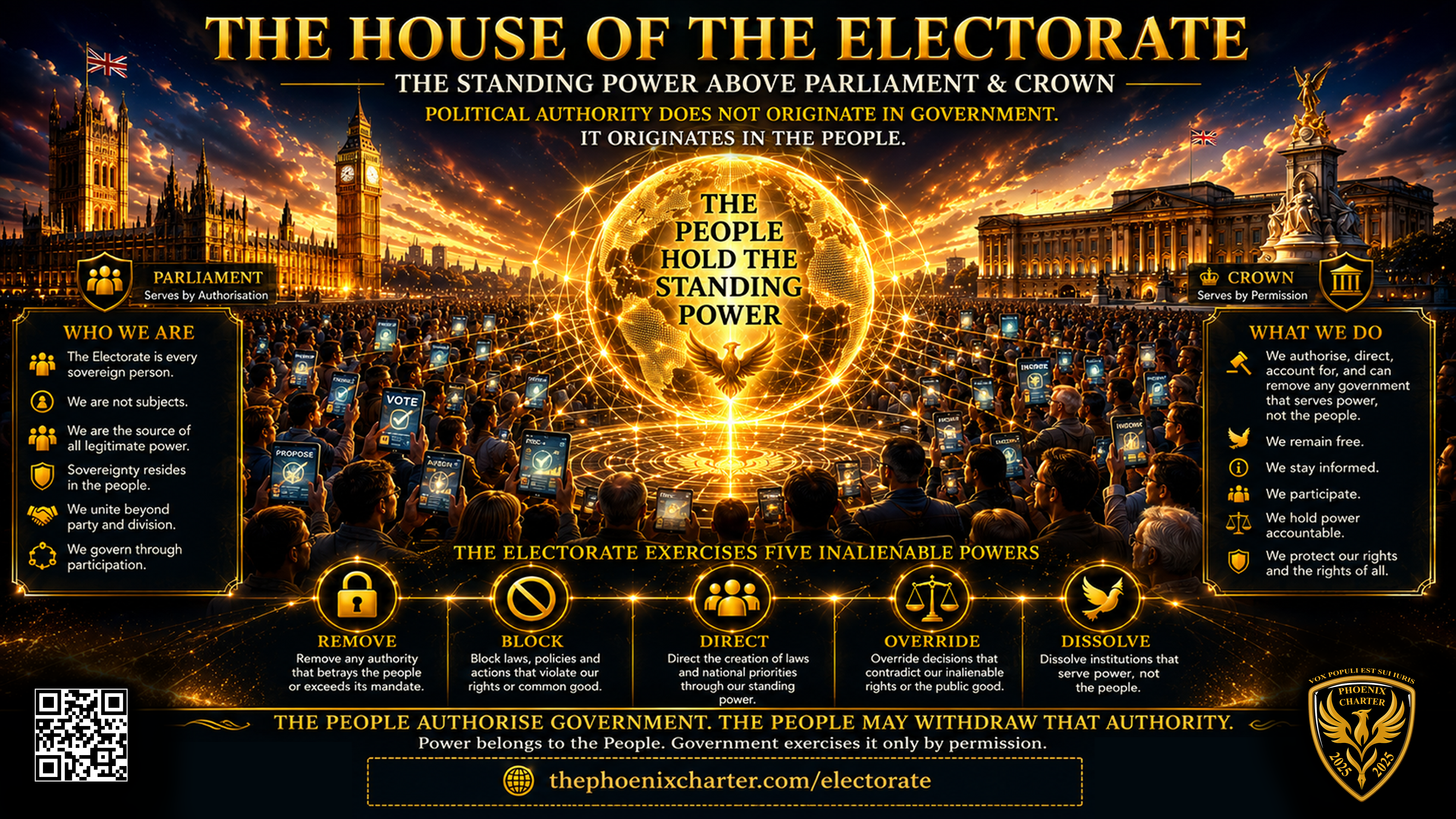
The House establishes who holds constitutional authority, but millions of people need a way to speak and decide together without surrendering that authority to intermediaries. The People must have their own Voice for proposals, deliberation and lawful decisions.
14. Voice of the Electorate — From Proposal to Public Decision
A sovereign electorate must not be politically mute between elections. The Voice of the Electorate is the proposed means through which people can challenge, propose, deliberate and make constitutionally authorised decisions.
Voice of the Electorate describes how that collective voice would be expressed: people would raise petitions and proposals, inspect the information supporting them, challenge claims, consider alternatives, deliberate with other participants, and take part in polls or binding votes where the adopted constitutional rules authorise them.
Deliberation Comes Before a Final Verdict
A legitimate public verdict cannot be manufactured by a manipulated online poll. Evidence, objections, alternatives and practical consequences must be open to examination before the People are asked to make binding decisions.
The intended progression is proposal → petition or public initiative → deliberation → refinement → prescribed ballot → recorded outcome → accountable implementation and audit. The appropriate thresholds, eligibility, windows and rights safeguards must be established in advance for each decision type.
Ordinary petitions and opinion polls can measure or demonstrate participation, but are not automatically binding constitutional verdicts. The distinction must remain clear wherever the public interacts with the website.
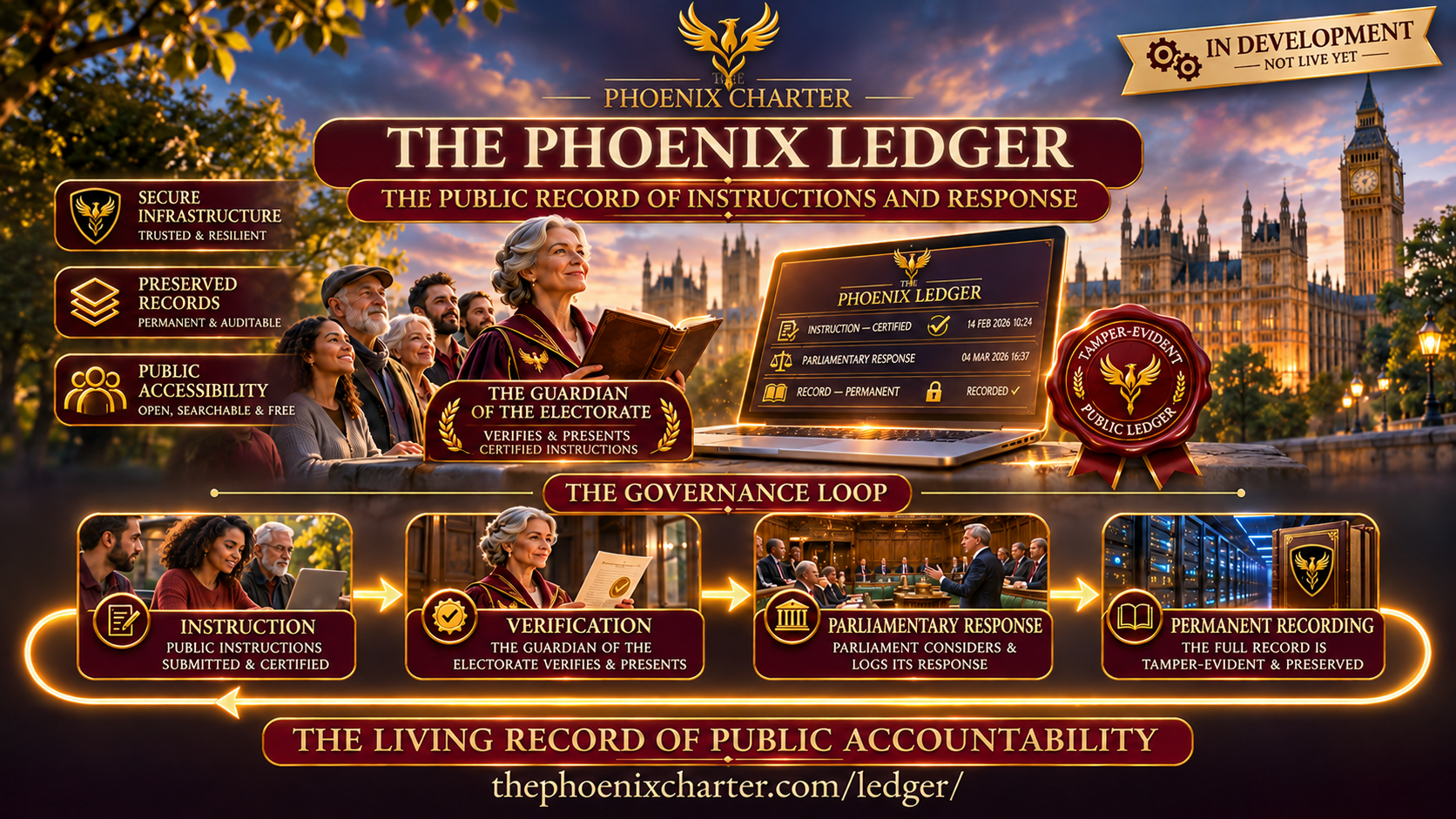
Petitions & Polls — The People Guiding Government
The electorate must have a continuing means of making itself heard between elections. The Petitions & Polls facilities are the everyday starting point for that relationship: a place where a person can identify a public problem, propose a remedy, gather support, question an official decision and discover whether others share the same concern. The purpose is not to allow government to decide which opinions it wishes to hear. It is to give the People an open route from a public concern to an examined proposal and a recorded response.
Petitions Bring Issues Before the Public
A petition asks for attention, explanation or action. It can seek a change in policy, the investigation of a failure, the review of an official decision or consideration of a new proposal. The published request should make clear what is being sought, who is responsible for considering it, who may support it and what the recorded support means. Signing a petition is not the same as voting on a completed constitutional proposition: it opens or advances a public question rather than deciding every consequence of the proposed answer.
Deliberation Tests the Proposal
Support for a complaint does not always establish the correct remedy. Participants must be able to examine evidence, put forward objections, expose mistakes, compare alternatives and improve the wording of a proposal before being asked for a final decision. Deliberation should be visible and properly recorded, not manipulated through hidden alterations to the question or the quiet exclusion of lawful disagreement. A proposal may be strengthened, amended or withdrawn as a result of what the public discovers.
Polls Establish What Participants Actually Think
A public poll can measure support, opposition or preference among those who take part under its published rules. It should identify the question, response options, eligibility criteria, voting period and method of counting; its results should show the number and proportion of responses without pretending that a self-selected online poll necessarily represents the whole electorate. The electorate’s judgement is best served by accurate figures, clear questions and an honest account of their limits — not by impressive numbers stripped of context.
A petition requests action. An ordinary poll measures opinion. A constitutionally authorised ballot can carry binding authority. That final step is possible only when the adopted Constitution provides the relevant Standing Power, electorate, thresholds, safeguards and legal consequences. Neither a website petition nor a preliminary referendum pre-vote becomes a statutory referendum or binding constitutional instruction merely by attracting public support.
Government Must Respond — and Account for Its Response
The process must not end with a graph or a total. Public authorities should be able to see which questions have been raised, the arguments made and the responses requested. Where an ordinary petition or consultation applies, the relevant authority can provide its decision and reasons in the public record. Where the electorate has issued a valid constitutional direction through the prescribed process, the responsible institution would have the duties and implementation timetable imposed by the Constitution, subject to protected rights and independent legal remedies.
That is the practical meaning of FROM PARTY POLITICS TO PEOPLE POLITICS: the People would not become the day-to-day government, but government would remain in a living and accountable relationship with the People throughout its term of office. Public participation would progress, when appropriate, from raising an issue to examining the evidence, identifying a choice, recording a decision and checking what happened next.
PROPOSE → PETITION → DELIBERATE → REFINE → POLL OR CONSTITUTIONAL BALLOT → RECORD → IMPLEMENT → ACCOUNT.
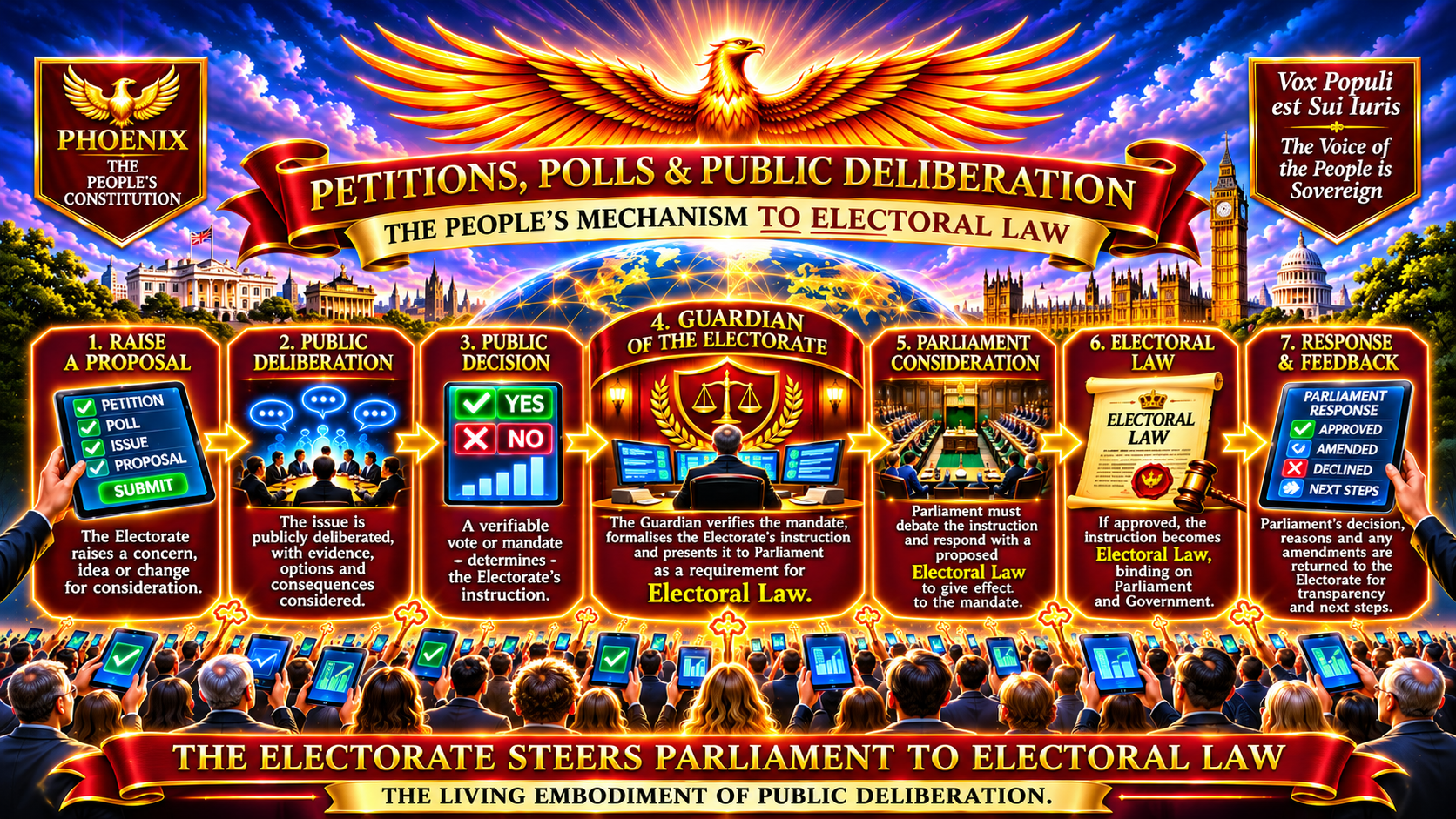
The dedicated Voice of the Electorate page explains the full path from proposal to public decision. The Voice is how the House of the Electorate expresses its will; the Civic-Crowd-Device is the proposed instrument for carrying that will into reliable procedures; and the Guardian would protect process integrity without choosing the political outcome. Technology must serve public judgement, never replace it.
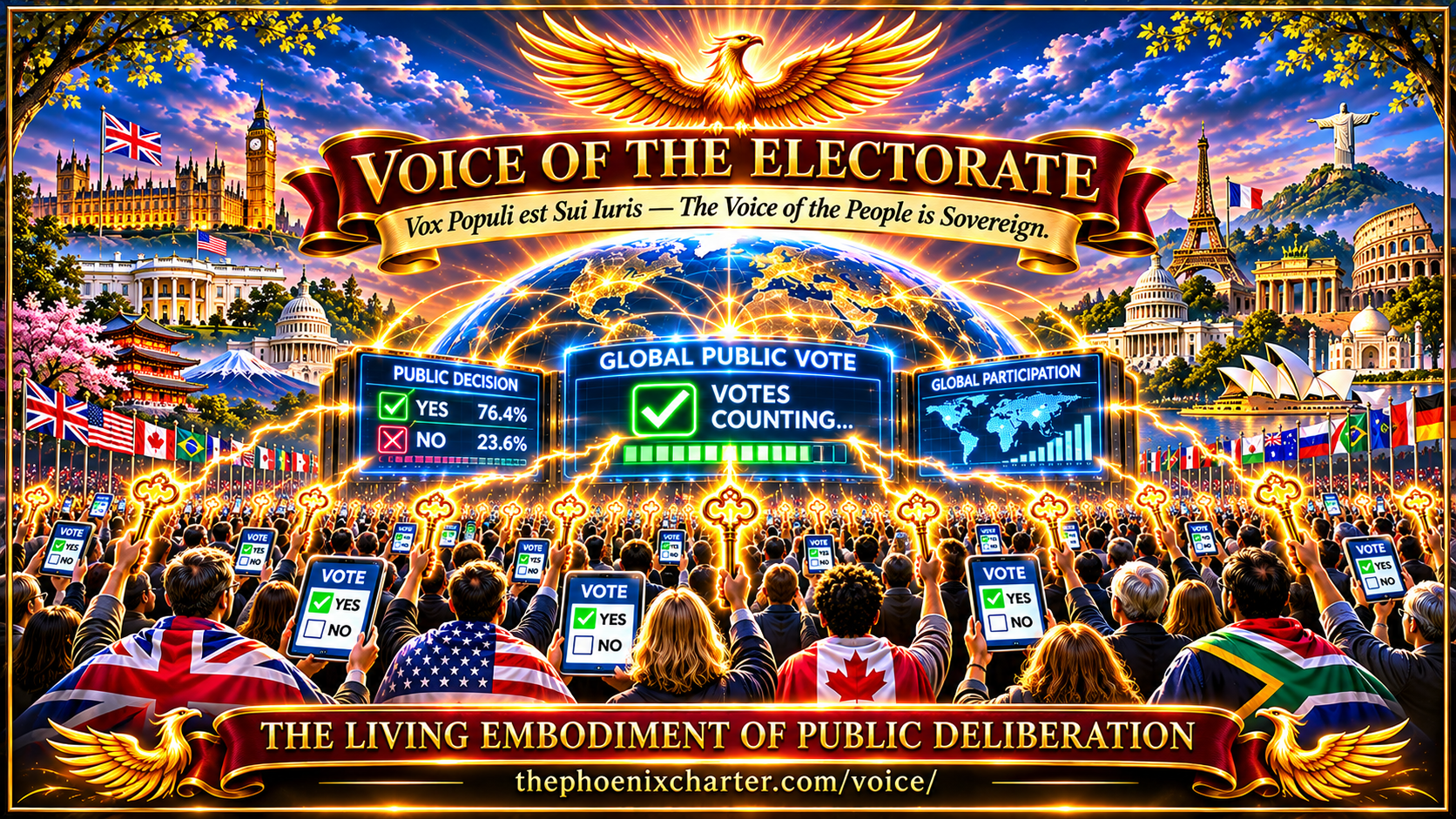
A Voice that can be silenced, manipulated or excluded by its technology provider is not sovereign. How does the People’s Voice become a functioning, auditable constitutional process? The Civic-Crowd-Device is the proposed means of organising participation without owning the power it administers.
15. Civic-Crowd-Device — Enabling the Voice of the Electorate
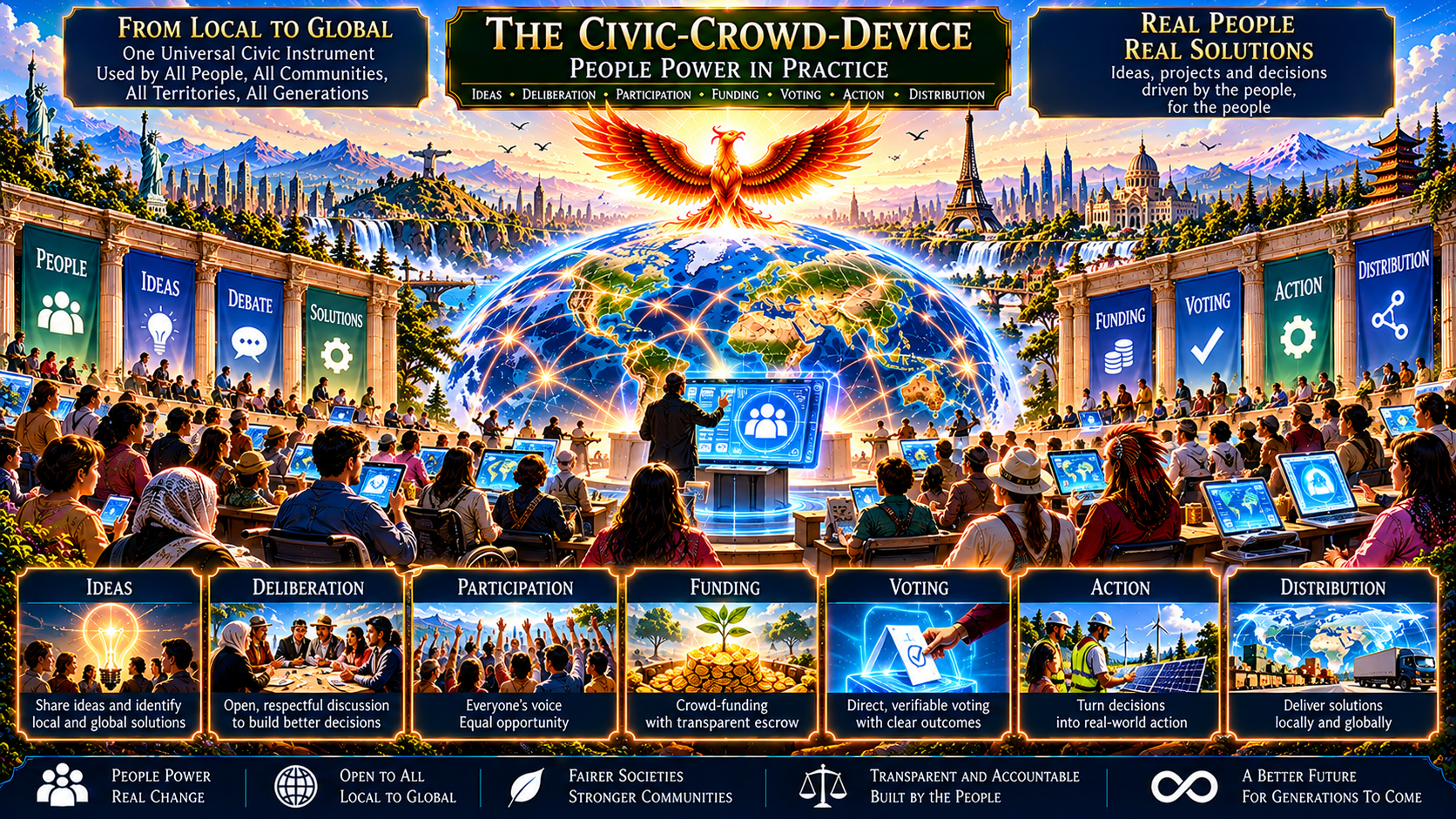
If constitutional powers exist but ordinary people cannot use them, those powers are hollow. The Civic-Crowd-Device is intended to make lawful public participation practical, accessible and independently auditable.
The Phoenix project therefore includes the proposed Civic-Crowd-Device .
It would support public participation through facilities for submitting proposals, examining evidence, considering alternatives, deliberating, voting and recording outcomes.
These are not uncontrolled internet polls. Constitutional decisions would operate through prescribed eligibility, deadlines, thresholds, verification, deliberation and rights safeguards.
Different decisions may require different eligibility rules, deliberation periods, thresholds, verification requirements and safeguards.
The system would need to provide independently auditable records while protecting the secrecy of individual ballots where required.
It would also need safeguards against impersonation, coercion, automated manipulation, exclusion and institutional interference.
A technology operator must never be able to claim that operating the system gives it the authority to determine the electorate’s will.
The technology would administer constitutionally authorised procedures. It would not create constitutional authority independently of the People.
The People are the source of authority. The Civic-Crowd-Device is a proposed means of exercising it.
The system must defend against forged participation, coercion, automated manipulation, privileged access and institutional interference. The architecture must be secure against capture, including capture by those maintaining it.
Its proposed facilities include verified eligibility without unnecessary publication of identity; structured proposals; evidence and counter-evidence; deliberation periods; defined voting windows; independently reproducible counts; append-only audit records; and mechanisms to translate authorised outcomes into accountable action. Suitable controls would be required against duplicate participation, coercion, automated abuse and privileged access.
Participation must never become the price of receiving basic rights, using money or accessing essential services. The civic mechanism is designed as the opposite of a digital permission system imposed upon the population.
The Civic-Crowd-Device is therefore the means by which the Voice of the Electorate is carried into proposals, deliberations and ballot procedures; it does not replace the Voice, determine the subject of debate or grant sovereignty to a technology operator. The following Guardian section addresses protection of the process rather than the ownership of the decisions.
A platform is not enough if its results can be obstructed, falsified or ignored. The constitutional process itself needs protection against capture. The Guardian is proposed to secure that process while remaining under the Constitution, the courts and the People.
16. The Guardian — Protector of Constitutional Process
A population cannot rely on constitutional promises if the process for exercising them can be falsified, obstructed or captured. The proposed Guardian exists to protect the integrity of the process itself.
The Phoenix proposal therefore includes a Guardian function.
Its duty would be to safeguard lawful use of the Standing Powers and the constitutional framework — without taking the authority of the People for itself.
The Guardian would not be sovereign.
Its authority would be limited to functions defined by the Constitution. It would not possess an independent mandate to override the People, rewrite fundamental rights or assume the political authority of elected government.
Its relationship with the judiciary, constitutional enforcement, public accountability and the electorate would need to be clearly established.
The Guardian’s duty is protection, not command. A watchdog that cannot itself be scrutinised or removed would become another threat, not a defence.
The Guardian’s responsibilities would include protecting proper notice, equal access, integrity of the ballot, constitutional deadlines, transparent records, secure custody of decisions, independent auditing and the lawful publication of results. Its function would be defined, limited, reviewable and subject to removal and oversight under the Constitution.
The People retain sovereignty. The House of the Electorate expresses collective authority. The Guardian protects the integrity of the process. These are deliberately different functions. The Guardian would not select political policy, exercise a superior mandate, appoint itself permanently or set aside a lawful public decision because it disagreed with the outcome.
The Guardian and the Judiciary
The Guardian’s role must remain separate from independent courts. Courts would determine legal disputes, protect individual rights, assess the lawfulness of official conduct and administer justice. The Guardian would administer and safeguard the constitutional decision-making process, while its own conduct would remain subject to independent legal challenge and constitutional accountability.
Independent courts would remain responsible for deciding legal disputes and protecting rights. The Guardian must not become a private court, political censor or self-appointed ruler above the electorate.

Protecting votes is only part of protecting the project. Its finances, inventions, assets and public-benefit resources must also be defended against private capture. Custodianship must preserve the mission without becoming ownership of sovereignty. That is the purpose of the Phoenix Trust.
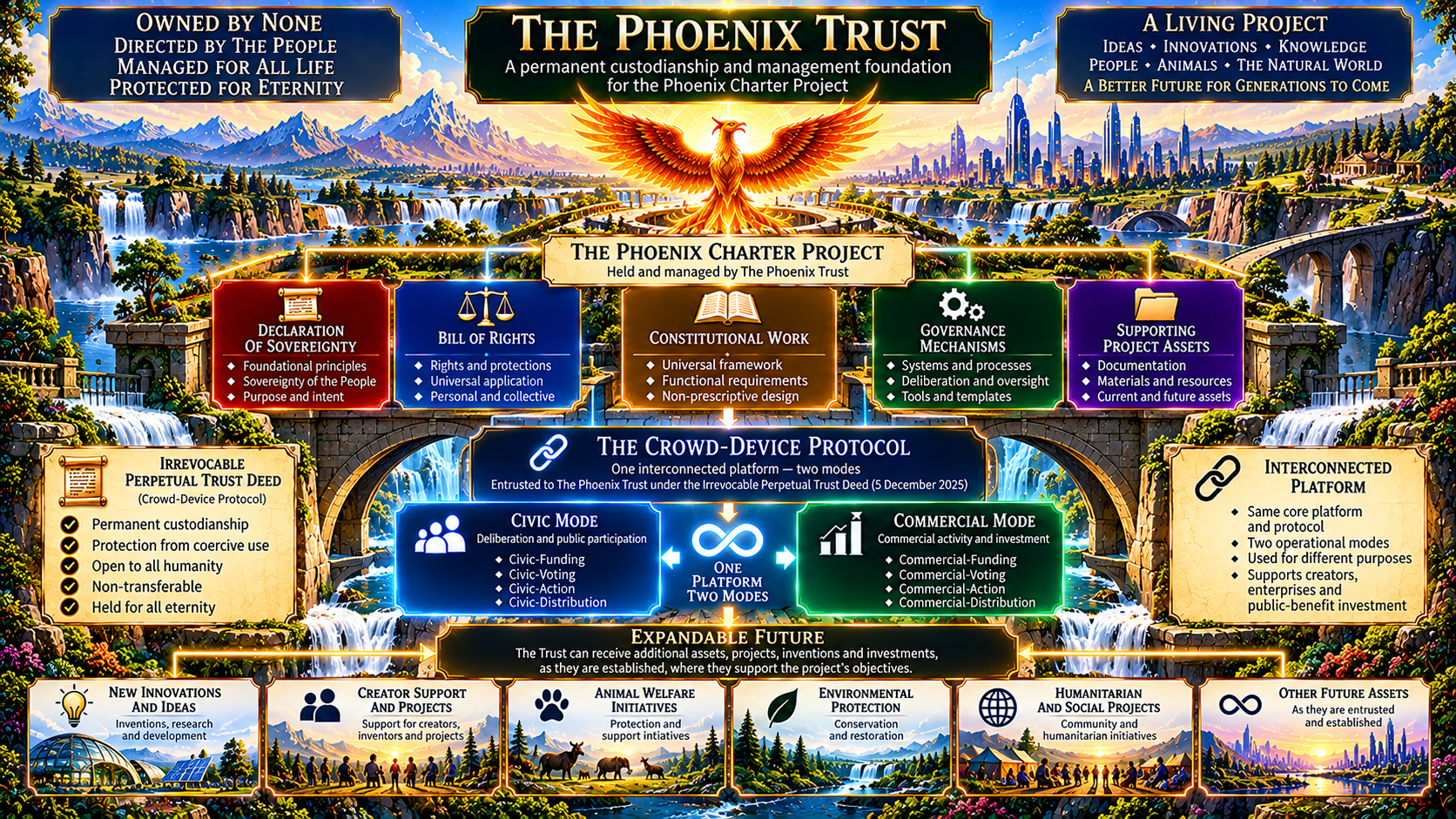
17. The Phoenix Trust and Humanity’s Common Inheritance
Control of assets, income, technology and intellectual property can be used to capture the political purposes they were meant to support. The Phoenix Trust is designed to keep entrusted resources serving their declared public-benefit purposes over time.
Its purpose is different from that of the political party and the proposed constitutional institutions.
The Trust would not own the sovereignty of the People or possess authority to override their constitutional rights.
No Trustee may turn control over property into control over constitutional rights. The Trust exists to protect assets — not to govern the People.
The project also recognises the wider principle that certain resources, rights and benefits may properly be held in custodianship rather than treated as the unrestricted property of a temporary administrator.
Where intellectual-property rights, licensing income, donations or other resources are entrusted to the Trust, their management must follow the applicable legal instruments.
Custodianship must be accompanied by transparent accounting, defined responsibilities, enforceable duties and safeguards against private capture.
Custodianship is a duty, not a licence to seize. Transparent accounts, independent audit, enforceable obligations and replaceable administrators are intended to prevent the very accumulation of private power against which the Charter warns.
Every human being has an equal birthright in humanity’s common inheritance, regardless of participation in Phoenix. Voluntary adoption enables participation in the proposed management arrangements; it does not create the underlying birthright or allow an administrator to extinguish it.
The Trust’s purpose is custodianship of entrusted property, inventions, licensing rights, donations and other assets dedicated to public benefit under its governing deed. Appointed administrators would execute lawful instructions, keep accounts, publish relevant records, submit to independent audit and remain replaceable through established procedures. Beneficial interests, legal ownership and constitutional sovereignty must not be conflated.
Participating people may direct appropriate Trust arrangements through the Civic-Crowd-Device or a lawful equivalent, but any such authority must comply with the Trust deed, beneficiaries’ rights and applicable law. A Trust cannot convert custody of property into ownership of the People.
Concentrated power is not merely a national threat, but the answer must not be an unanswerable world government. How can different populations secure the same fundamental protections while retaining self-government? Phoenix proposes principles that territories can adopt voluntarily through their own lawful constitutional processes.
18. A Universal Charter Without a World Government
The concentration of power described in the Phoenix warning does not stop at national borders. Nor can an effective answer depend on giving another central authority control over the entire world.
The proposal does not require every country to adopt the same political institutions, legal traditions or national identity.
Phoenix proposes universal principles that populations may adopt through their own lawful processes, while retaining their distinct institutions, cultures and national independence.
Instead, the underlying principles of popular sovereignty, fundamental rights, accountable delegated authority and effective constitutional safeguards could be adapted through lawful processes within different territories.
The proposed universal Constitution would define the functions that a constitutional system must fulfil while allowing appropriate territorial arrangements.
Those functions include the protection of rights, the allocation and limitation of public authority, independent justice, accountability, constitutional amendment and the lawful exercise of the People’s Standing Power.
Adoption would be voluntary and would require the legitimate constitutional consent of the people concerned.
Universal protection must never become an excuse for universal government. The aim is to make rights and constitutional accountability available everywhere without replacing one unanswerable concentration of power with another.
Universality concerns the principles and safeguards, not the compulsory creation of a single political state.
The intention is a universal set of constitutional functions and protections , not a British governmental template imposed upon every nation. Participating territories could choose their own lawful legislature, executive, head-of-state arrangements, courts and devolved institutions while meeting the core requirements of rights protection and accountable public authority.
Territorial populations would retain independence in their domestic decisions, finances and institutions. No larger participant would acquire authority over a smaller one merely through shared Charter principles. Adoption would require voluntary, lawful consent through the applicable constitutional process.
Cooperation might address emergency response, poverty reduction, infrastructure, protection of shared resources and aid to other communities. It would require transparent terms, agreed responsibilities, lawful funding and independent accountability rather than an unaccountable world government.
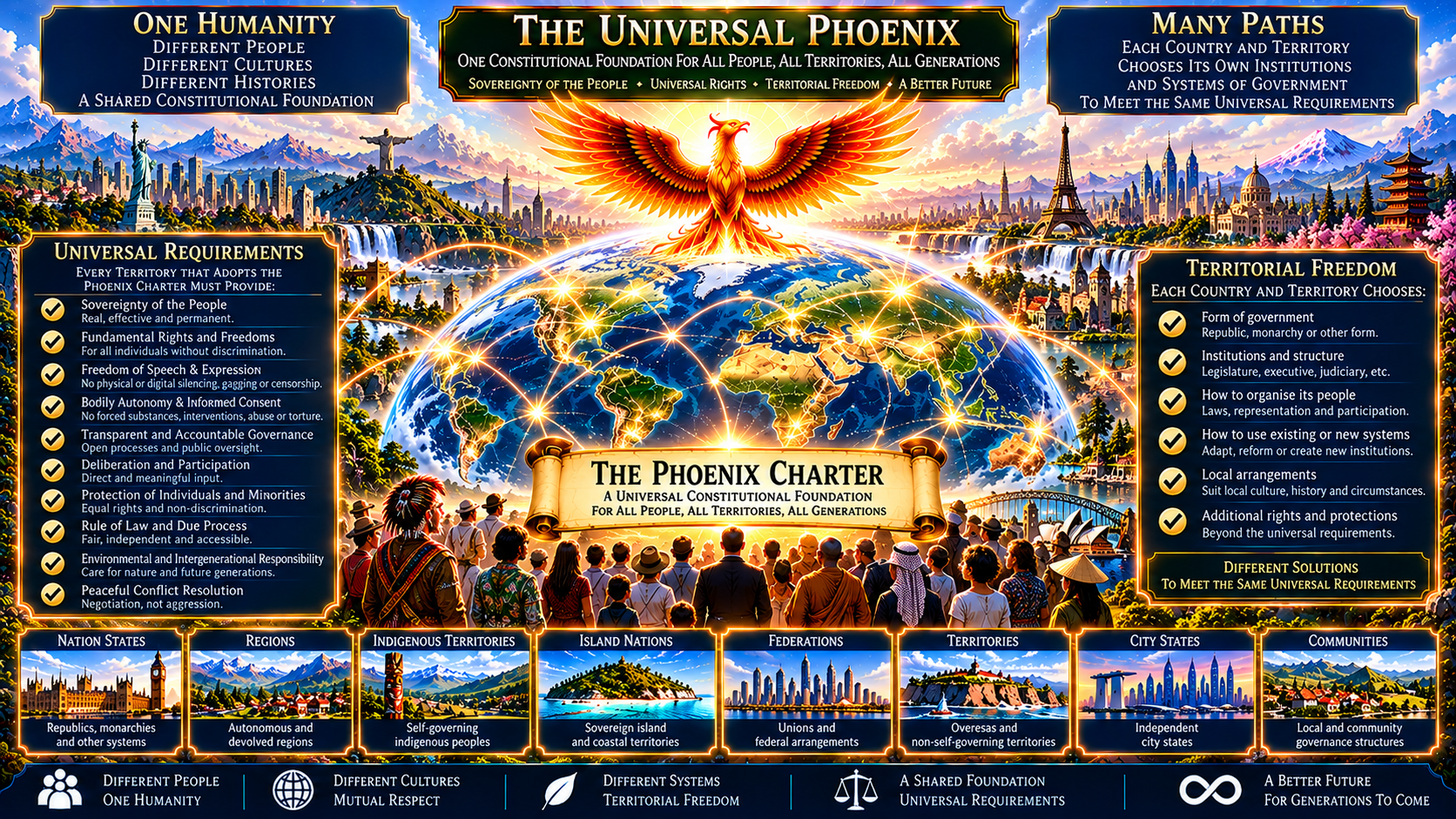
Britain is the proposed starting point, not the constitutional authority over other peoples. The Phoenix Chapters page explains how other nations and territories could examine the approach and pursue their own lawful constitutional routes while retaining their own sovereignty, cultures and institutions.

A programme intended to resist institutional capture can itself be destroyed by dependence on the wrong funders. Money must sustain the constitutional mission without buying authority over it. That requires separate funds, lawful accounting, transparency and independent scrutiny.
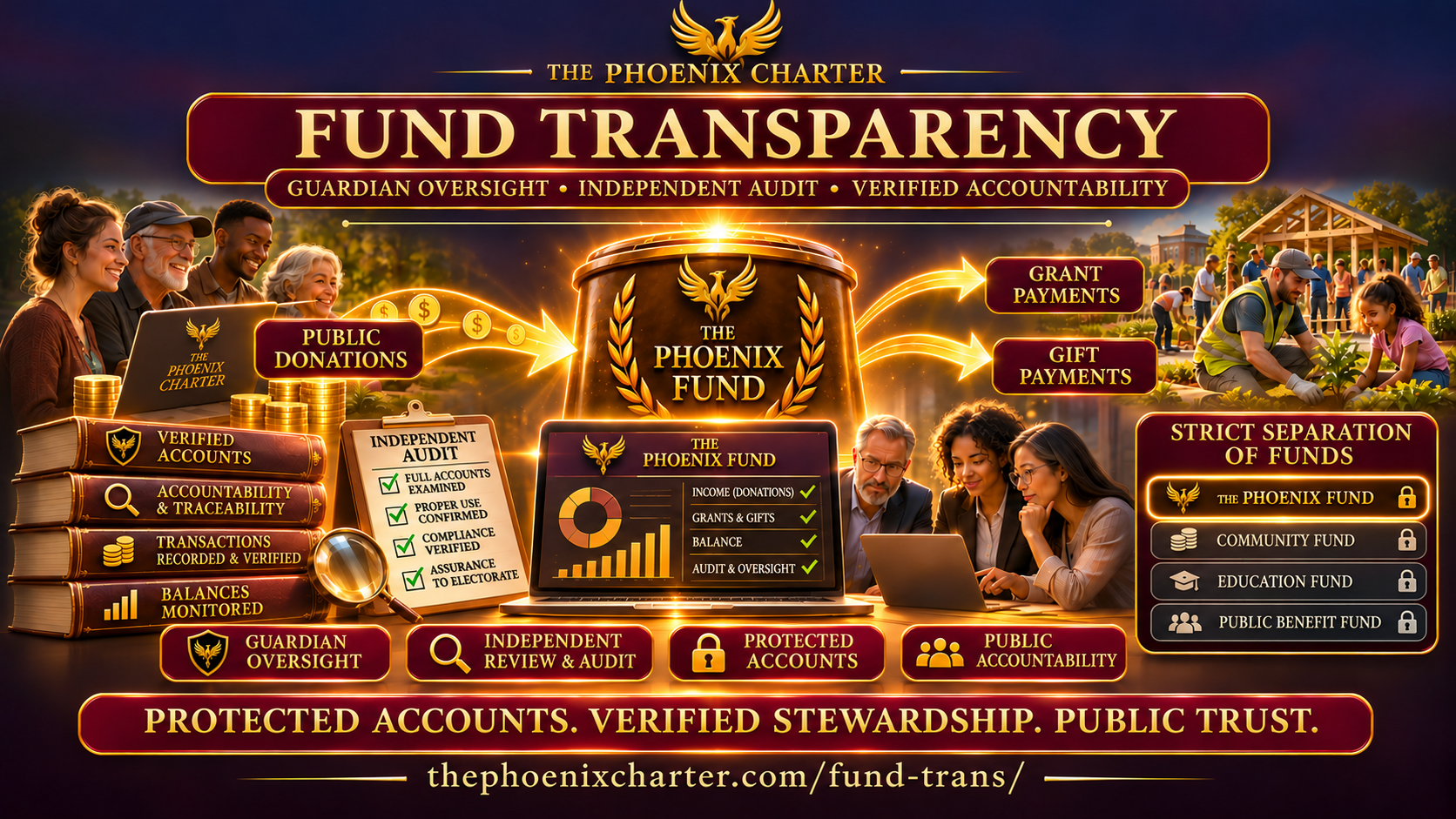
19. Public Money, Transparency and Accountability
Financial capture is one of the dangers Phoenix was created to confront. Its own financing must therefore be protected against the influence, secrecy and diversion it condemns elsewhere.
The Phoenix project distinguishes between funding for political activity, constitutional development, public participation technology, legal work, public-benefit programmes and the administration of entrusted assets.
These purposes must not be treated as interchangeable.
Political donations and expenditure must comply with the laws governing political parties.
Money raised for political campaigning, technical development, legal proceedings, public benefit or entrusted assets must remain attached to its declared purpose. Those entrusted with funds must be accountable.
Funds held for one stated purpose must not be redirected to unrelated purposes without lawful authority.
The project therefore envisages separate accounting arrangements, defined fund purposes, transparent reporting and safeguards against conflicts of interest.
Financial independence is particularly important where a constitutional movement seeks to prevent concentrated private interests from acquiring disproportionate influence over public authority.
No donor, contractor or technology supplier should be able to purchase influence over the constitutional choices of the electorate simply by paying for the machinery through which those choices are expressed.
Public authority, political organisation, technical administration and financial custodianship must remain distinguishable and accountable.
The proposed financial safeguards are not merely matters of good bookkeeping. They are barriers intended to prevent the constitutional movement itself from being bought, captured or diverted.
The project distinguishes six separate purposes for funds raised or entrusted:
- Phoenix Fund: community grants and public-benefit programmes.
- BizKit-Tin Fund: commercial development and investment initiatives.
- Platform Fund: building, operating and maintaining public participation technology.
- War-Chest: dedicated resources for legal defence.
- Phoenix Party Fund: lawful political organisation and campaigning.
- IP & Legal Fund: separate proceedings relating to intellectual-property claims.
Money raised for one stated purpose should not be silently redirected to another. Political donations, any charitable or public-benefit funds and entrusted property must be administered under the laws and governing terms that apply to each. Public reporting must make the purposes, liabilities and responsible administrators understandable.




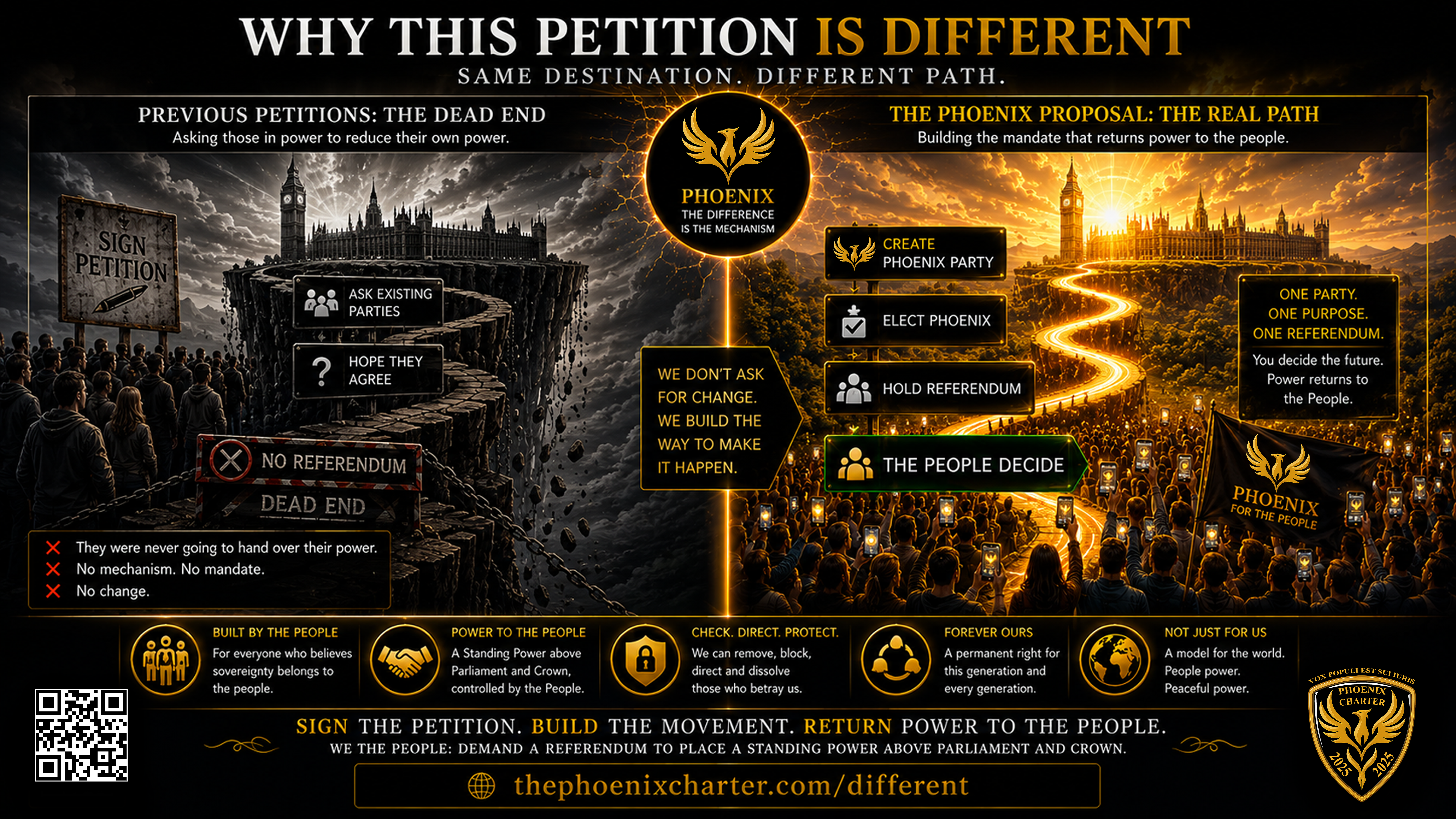
Many campaigns demand better government. What makes Phoenix different is its insistence that no government should be trusted with authority the People cannot lawfully restrain. The following section explains why this is constitutional defence, not another ordinary political manifesto.
20. Why the Phoenix Proposal Is Different
Political parties commonly promise better leaders, better policies or better management. Phoenix is addressing the greater danger: a constitutional system in which power can be accumulated, captured and used against the population even when elections continue.
Phoenix proposes a change to the constitutional relationship between government and the governed.
The difference is structural. Phoenix seeks to give the electorate continuing powers that operate regardless of the party in office or the interests exerting pressure behind it.
It is to establish a continuing constitutional authority through which the electorate can intervene when delegated power is misused.
The proposed five Standing Powers provide a structured means of authorising, directing, restraining, revoking and amending within a lawful constitutional framework.
The proposed transfer of Royal Assent to Electoral Assent would further recognise the electorate as the ultimate constitutional source of authority.
The Bill of Rights would protect individuals against unlawful exercises of power, including exercises carried out in the name of the majority.
The Phoenix test is not whether a government promises to behave well. It is whether the People retain lawful power to stop it when it behaves badly.
The Guardian and independent judicial safeguards would protect constitutional procedures against manipulation and abuse.
The political party Phoenix would seek the constitutional change without becoming the owner of the authority transferred to the People.
The distinction is between asking the People to trust a new government and giving the People enforceable constitutional means of holding every government accountable.
A petition asks those already in power to consider a request. The Phoenix proposal seeks a constitutionally protected mechanism enabling the electorate to issue binding decisions within the law, including when those holding office would prefer not to act.
Its distinguishing feature is the combination of continuing Standing Power, a meaningful public assent function, enforceable individual rights, independent safeguards, a lawful referendum route and a practical participation system. It is therefore intended to change the relationship between the People and the institutions acting in their name, rather than merely promising a different government.
The difference cannot remain a principle discussed in Parliament. What does it mean for someone whose income, privacy, speech, movement or access to essentials is threatened by an arbitrary decision? Phoenix must show how its constitutional safeguards would reach everyday life.
21. What Would Change in Everyday Life?
The constitutional threat described here is not confined to Parliament or abstract constitutional theory. It reaches into ordinary life whenever the ability to work, eat, travel, speak, trade, use money or seek justice can be made dependent upon an institution’s permission.
People would continue to live, work, trade, organise their communities and use public services.
Government departments, local authorities and public institutions would continue to perform their lawful responsibilities.
The proposals are intended to protect everyday freedom from becoming a conditional privilege: privacy, lawful expression, personal choice, due process, access to essential services and the ability to challenge decisions that threaten a person’s livelihood.
People would have opportunities to participate in public proposals, deliberations and decisions through accessible procedures.
Government would be subject to continuing constitutional accountability rather than relying solely upon the possibility of electoral defeat at the next general election.
Fundamental individual rights would remain protected against both institutional abuse and unlawful collective action.
The proposed arrangements would not require every citizen to vote on every administrative matter.
The practical purpose is to make citizens less vulnerable to arbitrary exclusion, official abuse and private capture of essential infrastructure — while preserving lawful administration and independent remedies.
Independent courts would continue to protect legal rights and administer justice.
The objective is not permanent political confrontation. It is a constitutional system in which the existence of effective public authority discourages the misuse of delegated power.
The intended everyday difference is that government would remain accountable to the People between elections, not merely during them.
A person would not be required to spend every day voting. Ordinary services, employment, education, commerce and local administration would continue. The change would become visible when public authorities proposed a measure requiring Electoral Assent, when an eligible group initiated a constitutional challenge, or when the electorate exercised a defined Standing Power.
Individuals would be able to inspect decisions and supporting records, participate through accessible channels and seek remedies when constitutional rules were violated. The arrangement is intended to encourage responsible government because a credible democratic check remains available between general elections.
The safeguards matter as much as the powers: popular votes must not remove fundamental rights, replace courts in determining guilt or force people to surrender privacy simply to belong to society.
Individual protections will remain fragile unless they are part of a durable constitutional settlement. The People must not have to fight the same battle for their rights every time a government changes. The following section brings the proposed powers, limits, institutions and remedies together.
22. The Constitutional Destination — The World Beyond Fish in a Barrel
TWO OPPOSITE FUTURES. ONE CHOICE ABOUT THE WORLD WE LEAVE BEHIND.
Fish in a Barrel presents the darkest warning: a world in which people have lost their ability to resist the powers controlling their governments, money, resources, movement and basic necessities. Its conclusion is fear, confinement, exploitation and a population deprived of any meaningful escape.
The Constitutional Destination is its exact opposite. It is the bright horizon beyond that warning: the world ordinary people might choose to build once the systems that protected corruption, consumed public wealth, rewarded abuse and made populations dependent upon distant institutions have been exposed, challenged and dismantled.
That transformation begins with a reckoning. Public accounts are opened. Political favouritism, fraudulent contracts, corrupt funding chains and institutions maintained without a useful public purpose are investigated. Where unlawful conduct is proved, illicit gains are recovered, victims receive justice and responsible individuals face the law—however wealthy, famous or politically connected they may be. Historic abuses are no longer swept aside merely because those involved once occupied positions of authority.
Then the greater story begins. Recovered resources help revive neglected towns, public services and essential infrastructure. Farms and local producers flourish. Independent medicine and honest scientific inquiry serve patients rather than hidden interests. Inventors, artists and entrepreneurs regain the freedom to develop their ideas without gatekeepers deciding which creations may reach the public.
Families enjoy cleaner countryside, accessible coasts, thriving villages, safer communities and public places no longer treated simply as opportunities for extraction. Human rights and animal welfare gain stronger practical protection. Children grow up with room to learn, explore, question, create and dream. People recover something no government can manufacture by decree: the time, security and freedom to enjoy their own lives.
Across borders, independent nations can begin to replace domination, hostility and the commercial incentives of conflict with voluntary cooperation, cultural exchange, scientific discovery, trade and the patient work of peace. Different peoples need not become the same in order to respect and help one another.
These outcomes are ambitions to be achieved through evidence, lawful accountability, sound decisions and sustained public work—not instant guarantees. But they provide the reason for undertaking the constitutional effort at all. The point of reclaiming sovereignty is not to spend the rest of our lives debating the machinery of government. It is to reclaim the future that machinery should have protected.
FISH IN A BARREL IS THE PRISON. CONSTITUTIONAL DESTINATION IS THE OPEN DOOR—AND THE LIVING, HEALING WORLD BEYOND IT.

The constitutional destination is defined, but no right becomes enforceable simply because a proposal exists. What must happen now to prevent this warning from ending as another document ignored? The next stage is to complete the instruments, organise lawful support and pursue the referendum.
23. What Happens Next
The Phoenix Charter is an active constitutional project. Its purpose is urgent: to create the lawful defences against concentrated and abusive power while the People still possess the freedom to establish them.
Its proposed Standing Power, constitutional instruments and participation mechanisms must be completed, approved and lawfully adopted before they can operate as intended.
The immediate objective is to complete the constitutional instruments, build informed support and secure a referendum through which the electorate may decide whether to reclaim permanent Standing Power.
The political party Phoenix provides a route towards that objective.
The Manifesto explains the Party’s political commitments.
The Referendum Bill would provide the proposed legislative framework for the public decision.
The constitutional instruments would define the authority, rights and safeguards to be established.
The Civic-Crowd-Device would provide a practical means of participation, subject to the Constitution and the rights of the People.
The Phoenix Trust would safeguard assets entrusted to it for public benefit.
The historical evidence explains the development of the ideas and inventions from which the project emerged.
This overview brings together the warning, the proposed constitutional response, the political route, the technology, the safeguards and the documented development history. Each linked page expands part of that programme.
The People do not exist to serve government. Government exists to serve the People — and must remain within their enforceable constitutional authority.
The immediate work is to complete the constitutional instruments; reconcile the Standing Powers, Electoral Assent and implementation mechanisms; align the Party Constitution, Manifesto and Referendum Bill; publish accessible explanations; and build demonstrable public support for a lawful referendum.
The website’s linked pages provide the fuller material behind this single-page overview. They should be maintained in alignment with the constitutional settlement, with working links, current artwork and transparent records of changes.
From Party Politics to People Politics. The Crowd becomes the Crown.
After the warning, the proposed defences and the lawful route to implementation, one question remains: where did the mechanisms behind Phoenix originate, and why does their creator regard their possible inversion as so dangerous? The final section records the development history and points to the evidence behind it.
24. The Creator’s History — The Inventions and Evidence Behind Phoenix
Where It Began — The Creator and the Documentary Backstory
1989–1995 — From a board game to a public-funding mechanism. Paul A. Sparrow developed Pirates Quest in 1989, later reworking it into Peter Pan: The Adventure Boardgame in 1993. Unable to secure conventional production finance, he conceived the Crowd-Device in 1992 as a means for people, participating from their own homes, to make conditional pre-orders towards a shared production target. His 1993 Peter Pan mail-order flyer was an early public expression of that invention—but it also exposed the ‘Forward Trading’ restrictions obstructing the advertisement of products before manufacture. Rather than abandon his invention, Sparrow embarked upon a two-year campaign, from 1993 to 1995, to change those rules. He pursued the issue through correspondence and the Mail Order Protection Scheme (MOPS), seeking an express exception for products whose manufacture depended upon obtaining sufficient advance orders. During this period, he also proposed a related Challenge Anneka television participation model in 1994. That campaign culminated in the introduction of Clause 52.4(c) in the February 1995 British Codes of Advertising and Sales Promotion, expressly allowing advertisers to state that production would not begin unless a sufficient response was received. This was the regulatory breakthrough Sparrow had spent two years campaigning to achieve. His original flyer, correspondence and printed 1995 Code form the documentary record of that campaign.
January–May 1996 — Peter Pan television game-show proposal (Case A1: Peter Pan / Survivor). On 25 January 1996, Sparrow sent a physical copy of Peter Pan: The Adventure Boardgame, with a covering proposal to adapt its family-adventure gameplay for television, to production companies including Planet 24 and Action Time. The accompanying correspondence also identifies other recipients, including LWT. Planet 24 replied on 1 May 1996, confirming receipt and that its development staff had played the board game. Its distinct submission and response trail is recorded in Case A1.
August 1996–1998 — A separate television project about inventors (Case A3). Later in 1996, Sparrow developed Tycoon, a factual programme following real inventors through the process of bringing ideas to market. Tycoon was submitted to ITV and others, which replied on 29 August 1996. In 1998, Sparrow evolved Tycoon into its successor treatment I Did This, introducing the Inventor’s Whipround: a concept based on his Crowd-Device, allowing people watching from home to collectively contribute small sums towards supporting featured inventors and replenishing a shared fund.
1999 — Brainwaves: the developed live-pitch and investment format (Case A3). The next treatment, Brainwaves, evolved the inventor programme into a proposed studio panel format with on-screen live-pitches by real inventors, seeking both corporate and viewer investment and donations right there on the program. The proposal could show investment decisions as they happened, even if recorded for later transmission. Its 1999 submission trail identifies the BBC, ITV and Channel 4; BBC delivery records are dated 27 July 1999, with a formal response dated 25 August 1999. The case papers separately record subsequent communications involving Sony and the Octopus platform in 2000–2001. Sparrow’s A3 Case Master sets out his comparison with the later Money Tigers, Dragons’ Den and Shark Tank formats and his allegation of uncredited derivation.
1999 — Television live-pitches and the Crowd-Device meet online. The live-pitch television concept and the Crowd-Device were separate but complementary inventions, intended to work together while remaining capable of independent use. An inventor featured on television could direct interested viewers to a platform for public backing, while that platform could also support projects with no television exposure. In 1999, Sparrow developed the Octopus Initiative website and its embedded Product Launch Platform (PLP), a working online prototype bringing conditional public funding and broader participation into one environment. The Brainwaves treatment was also presented through the Octopus platform for prospective collaborators.
1999–2002 — Three years online, then closed for want of investment. The Octopus/PLP platform remained online during 1999–2002. According to Sparrow’s Backstory and Appendix A2, he could not secure the investment and developer support necessary to bring it beyond the prototype stage, and it was taken offline in 2002. The public-facing platform and its associated television material were therefore available for a substantial period before several later mass-market crowdfunding and investment-pitch formats became established. That availability is relevant to the opportunity for others to encounter the designs; the Case Masters separately examine alleged access, similarities and derivation.
2002–2019 — X-Pro: a route to legal funding that exposed another gatekeeper. Having seen television formats emerge that he believed drew on his submitted ideas, Sparrow lacked the resources to pursue legal redress. His work on the X-Pro tool inventions from 2006 onward was intended not only to establish a viable product business but also to generate the funds needed to pursue his intellectual-property claims. Yet bringing X-Pro to market exposed another circular barrier: manufacturers wanted deposits, lenders wanted confirmed orders, and retailers wanted stock before committing. In 2012 Sparrow revived the PLP funding approach as BizKit-Tin to help secure pre-orders for X-Pro; manufacture followed, and products reached the market in 2014, but Sparrow’s records show he was then subsequently shut out of the industry. His historical account describes serious difficulties obtaining effective retail and distributor support, including alleged suppression, and manufacturers even refused to produce for him unless he gave them free use of his patents. He eventually had to source all components separately and ship them to his home to assemble himself in his garage, and could only sell online through marketplaces. Those claims and the corresponding records belong in the detailed case files. What became unmistakable to Sparrow was the distribution choke point: an invention could be designed, funded and manufactured yet still fail to reach the people who wanted it because third parties controlled the route to market.
2020–2025 — The fourth domain and the wider public purpose. The X-Pro experience supplied the missing connection. Even if people could fund a product, choose an outcome and organise action, established distributors could still prevent the result reaching its intended users. Sparrow therefore identified Crowd-Distribution in 2020 as a distinct fourth domain: a public-led route to market using distributed participants and local resellers instead of relying exclusively on conventional wholesale and retail gatekeepers. This completed the four-domain framework of Funding, Voting, Action and Distribution and informed the subsequent u-Reka work and the later proposed civic applications. In November 2025 he filed a UK patent application concerning the Crowd-Device and set out his intended public-trust arrangements. The Creator and Backstory pages provide the underlying documents, correspondence, platform evidence and fuller chronology.
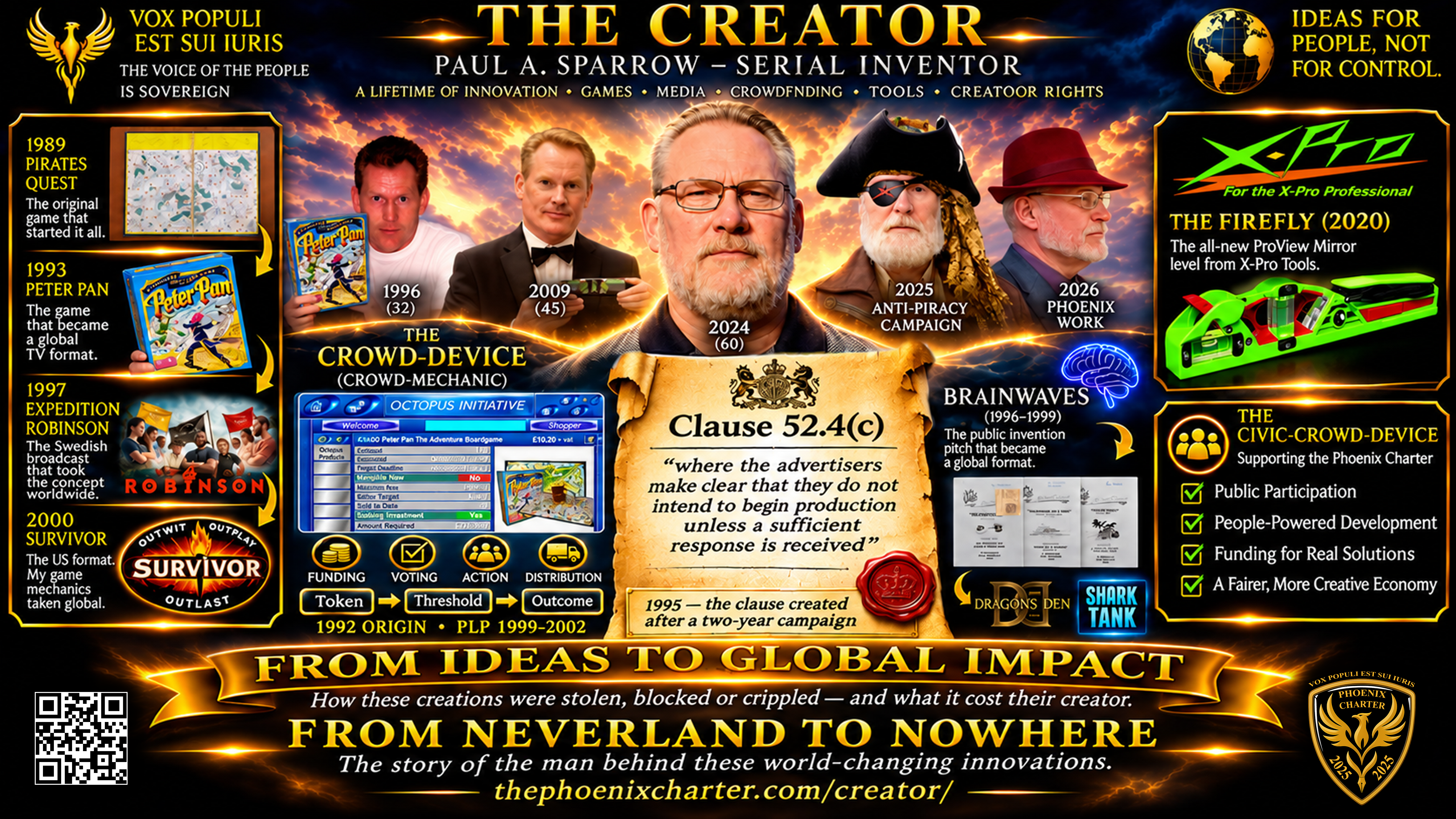

Follow the chronology more deeply: the emerging Funding, Voting and Action domains (1999–2002); the PLP prototype, its 2002 closure and later platform development; and the Distribution domain.
Two Applications — The Original Crowd-Device and the Civic-Crowd-Device
The underlying Crowd-Device concept is a mechanism of token → threshold → outcome, operating across Funding, Voting, Action and Distribution. It can be applied to collective funding, choices, coordinated work or distribution. Its proposed civic implementation serves a different purpose: supporting public proposals, deliberation and constitutionally authorised decisions, subject to rights, law and independent safeguards. Neither the invention nor the software becomes the source of the People’s sovereignty.
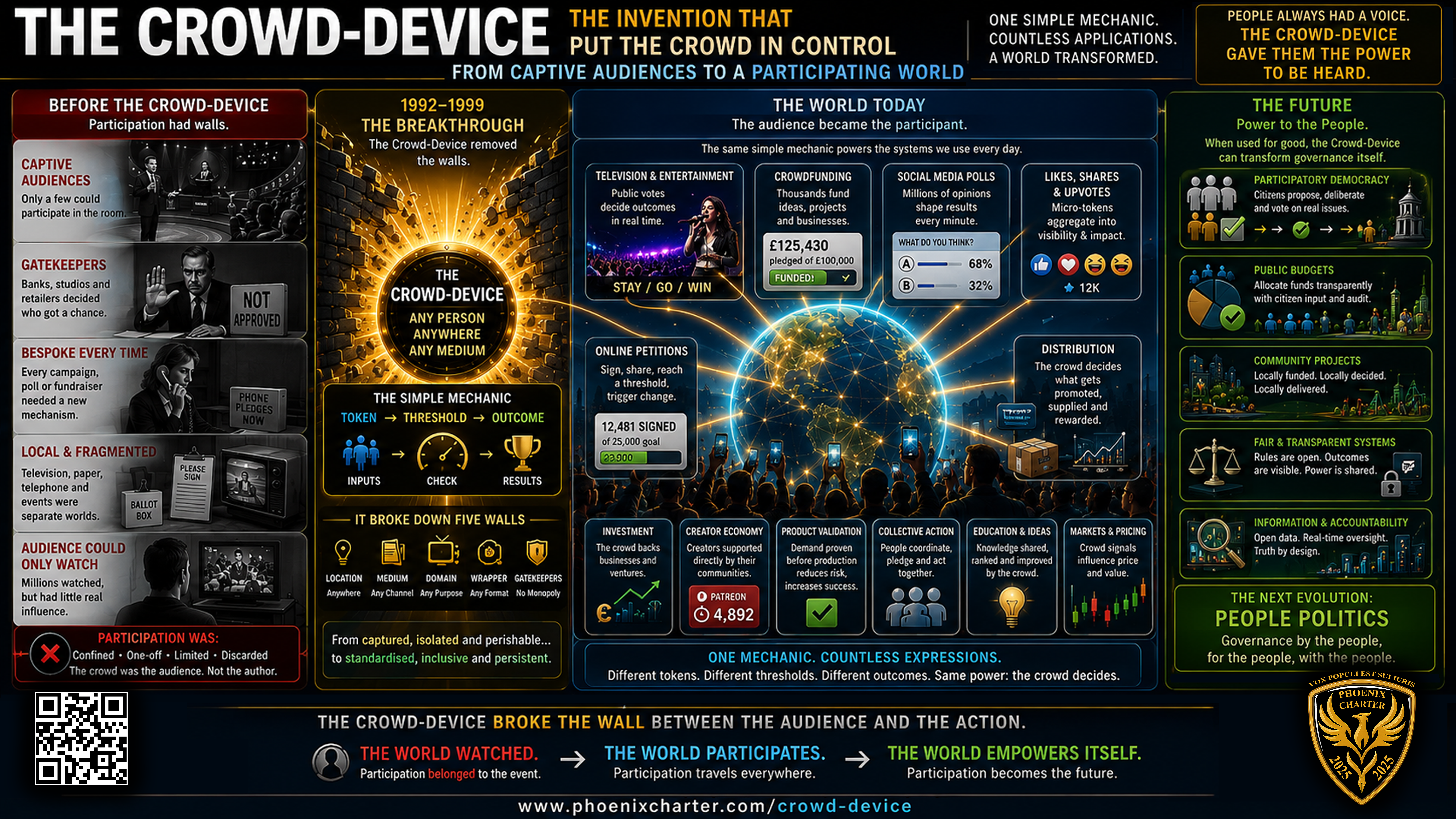
For the specific comparison, see Civic and Commercial Applications — One Mechanic, Different Purposes →.
The Alleged Inversion — Digital Identity and Financial Control
Sparrow argues that the direction of power can be reversed: a mechanism intended to enable people to act collectively may instead be used by institutions to count behaviours, impose conditions and control access. He raises this concern in relation to Digital ID and Central Bank Digital Currencies (CBDCs). The historical and structural connections he alleges require examination of their supporting evidence; they should not be confused with established legal findings.
The constitutional issue stands independently: essential rights, ordinary financial activity and access to daily life must not become conditional permissions that powerful institutions can arbitrarily withdraw.
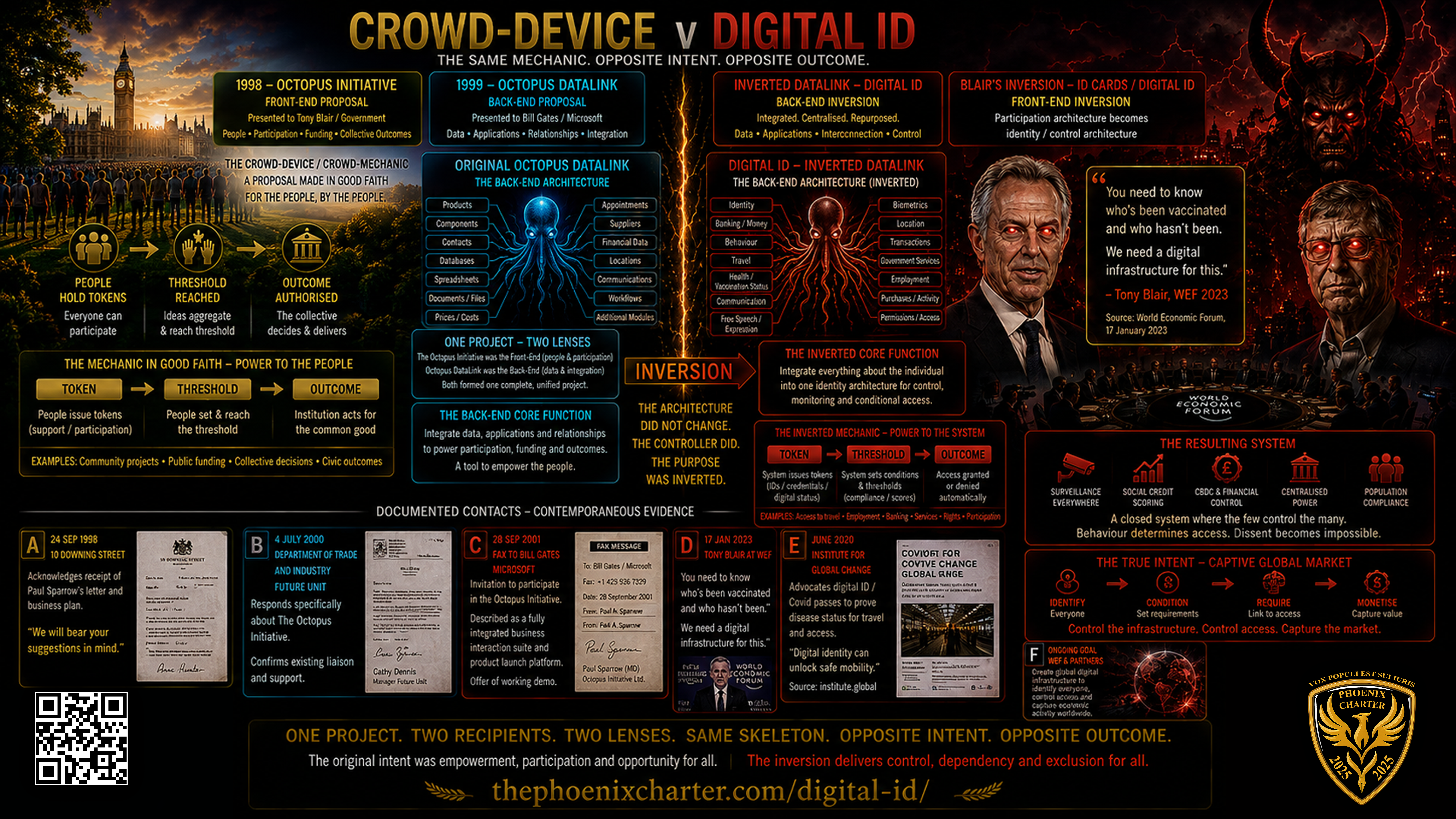
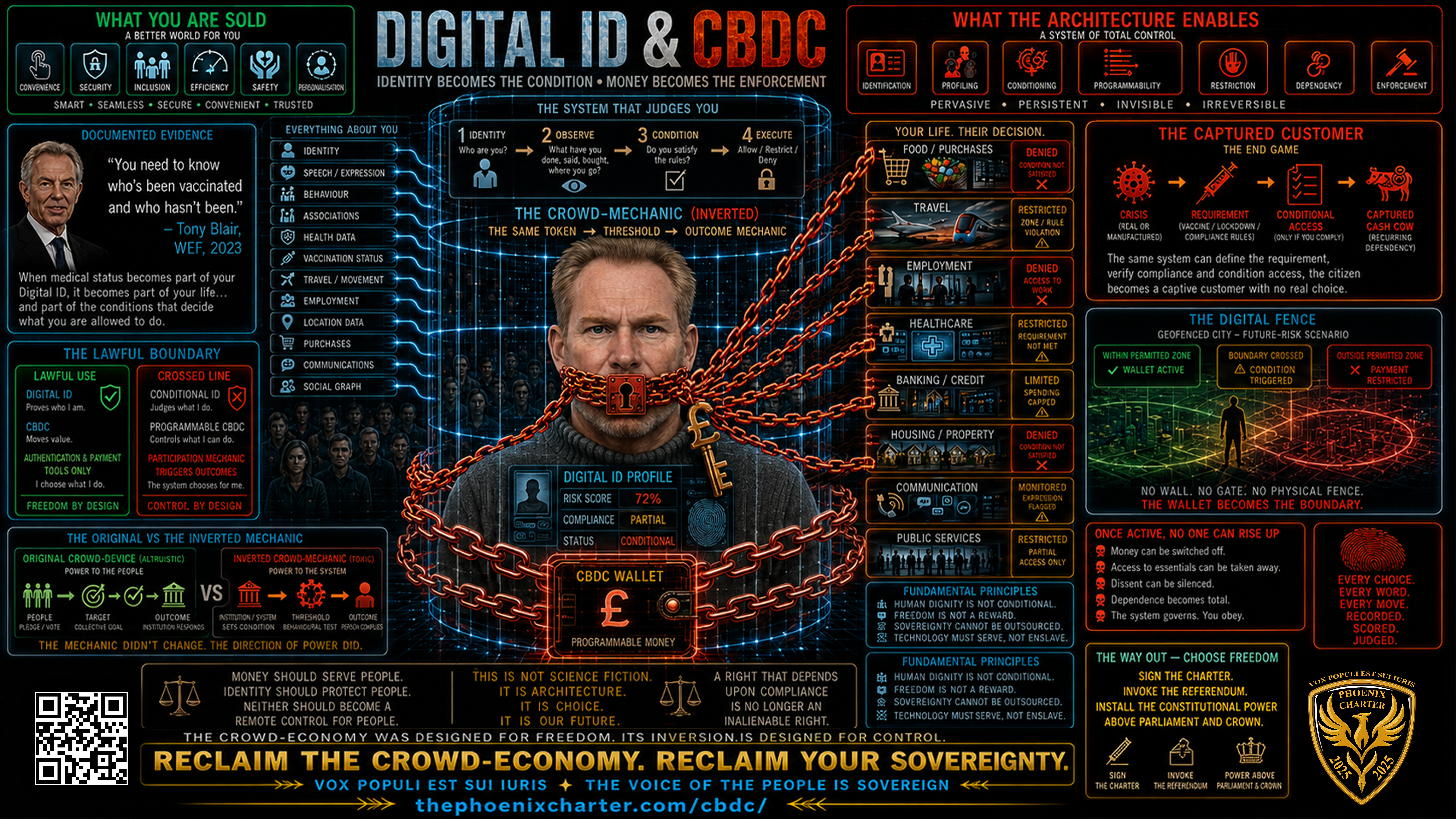
Why This History Matters to Phoenix
The history matters because it connects the development of public-participation mechanisms with the constitutional question of who controls their use. Sparrow’s authorship and intellectual-property claims can be assessed through the Creator and Backstory evidence; the separate argument for the Phoenix Charter must stand on the defence of human dignity, rights, popular sovereignty, independent justice and enforceable democratic authority.
No inventor, platform operator, political party, corporation, government or institution must ever acquire ownership of the People’s sovereignty merely because it designed or administers the machinery through which that sovereignty is exercised.