
Digital ID & CBDC Derivation
DIGITAL-ID & CBDC DERIVATION
Participation Mechanic: Timeline, Inversion & IP Boundary ReportPrepared by Paul A. Sparrow – Inventor of the Crowd-Device Mechanic (1992–1999)
Introductory Note
This dossier presents the forensic and historical relationship between Paul A. Sparrow’s original Crowd-Device invention (1992–1999) and the later emergence of Digital Identity (Digital-ID) and Central Bank Digital Currency (CBDC) infrastructures.
The invention formalised a universal participation process — token → threshold → outcome — created to give individuals and communities a reusable framework for collective decision-making. Its intent was empowerment: to replace isolated, one-off campaigns with a continuous, transferable mechanism for collaboration and civic engagement.
Three decades later, the same structural logic reappears within Digital-ID and CBDC systems, where it is often inverted. What began as a bottom-up empowerment mechanic has, in some state and financial architectures, become a top-down framework for behaviour gating and programmable control.
This report documents that evolution, identifies where Digital-ID and CBDC programmes overlap protected intellectual property, defines the lawful boundary of use, and demonstrates how design choices determine whether a society experiences this architecture as empowerment or as restraint.
Executive Summary
Between 1992 and 1999, Paul A. Sparrow codified a universal participation framework — the Crowd-Device — that transforms individual contributions into collective outcomes through a repeatable sequence: token → threshold → outcome. This design became the first transferable architecture for large-scale participation across Funding, Voting, Action, and Distribution domains.
Modern Digital-ID and CBDC systems now reproduce that same logic. Early identity systems simply authenticated logins; today’s versions aggregate verified identities and social behaviours to trigger actions or release entitlements. Programmable-currency prototypes go further, linking financial behaviour to digital identity. When these elements combine, the structure mirrors Sparrow’s mechanic.
Key findings
- Priority and scope – The token-threshold-outcome mechanic was fully developed and demonstrated by Sparrow before Digital-ID participation features appeared.
- Structural equivalence – Any platform that uses verified identity or behaviour as tokens, applies thresholds, and triggers outcomes reuses the same protected framework.
- Legal boundary – Identity issuance, authentication, and record-keeping are lawful state functions; embedding a reusable participation engine within them constitutes derivative use requiring licence or redesign.
- Inversion risk – When the same structure is applied to gate access or restrict rights, the empowerment mechanic becomes an infrastructure of algorithmic control.
- Safeguard mandate – Transparent algorithms, separation of rails (identity ≠ participation ≠ payments), privacy-by-design (selective disclosure), statutory bans on behavioural gating of rights, and meaningful redress are essential to prevent abuse.
The boundary between empowerment and control is architectural, not ideological. This dossier establishes that boundary, it evidences derivation, and outlines the legal, ethical, and design safeguards needed to protect both innovation and liberty.
Index
Introductory Note
Executive Summary
- Definitions and Scope
- Digital Identity (Digital-ID)
- Central Bank Digital Currency (CBDC)
- Participation Mechanic within The Crowd-Device (92/99)
- Distinction Between Login and Participation Mechanics
- Scope of Comparison
- Purpose of This Definition Set
- Lock-Point 1 – Boundary of Lawful Use
- Timeline – Digital-ID Evolution vs Crowd-Device
- Pre-1990s – Ad-Hoc Participation
- 1992 – 1999 – The Crowd-Device Codified
- Mid-1990s – Identity Infrastructure Emerges
- 1999 – 2005 – Mass-Participation Templates Spread
- 2010 – 2018 – From Authentication to Interaction
- 2019 – 2025 – Digital Wallet & Programmable Currency
- Comparative Chronology (Condensed Table)
- Lock-Point 2 – Priority and Derivation
- Participation Mechanic vs Civic Act of Voting
- The Civic Act of Voting – Public Domain Function
- The Participation Mechanic – An Industrialised System
- Where Civic Voting Ends and IP Begins
- Reuse Across Domains – The Defining Characteristic
- Precedent Examples
- Lawful Counting vs Derivative Participation Engines
- Why Distinction Matters
- Lock-Point 3 – First Use and Priority
- Inversion – Empowerment vs Control
- Original Purpose – The Empowerment Architecture
- The Inversion – From Empowerment to Surveillance
- Structural Paradox – Same Skeleton, Reversed Flow
- Behavioural Tokenisation – Turning People into Data
- The Illusion of Consent
- CBDC as a Control Conduit
- Philosophical and Legal Implications
- Reversal of Burden – From State ↔ Citizen Scoring
- Lock-Point 4 – Inversion Does Not Cure Derivation
- Point of Divergence – When Digital-ID Became Behavioural
- From Proof of Person to Proof of Permission
- The Hidden Mechanic – Tokens Beneath Credentials
- Aggregation & Conditional Access – The Silent Shift
- When Identity Began to Calculate Behaviour
- Systemic Consequence – The Citizen as Variable
- Lawful Authentication vs Algorithmic Authority
- Lock-Point 5 – The Moment of Divergence
- Lawful Applications and Derivative / Infringing Applications
- Lawful Implementations (Sovereign Competence)
- Derivative / Licence-Required Implementations
- Architectural Boundary Map
- Jurisprudential Principle – Structure over Intent
- Governance and Vendor Liability
- Lock-Point 6 – Lawful Scope of Digital-ID and CBDC
- CBDC Interweave – Points of High Risk
- Overview – From Currency to Conduct Regulation
- Structural Parallels to the Crowd-Device
- Phases of Interweave Development
- Key Risk Patterns
- Financial Governance Implications
- Human-Rights Exposure
- Legal Classification – Derivative Use in Finance
- Points of High Risk (Summary Table)
- Safeguard Principles for Lawful CBDC Design
- Lock-Point 7 – CBDC Linkage and Derivation
- Remedies and Assertable Rights
- Foundations of Legal Standing
- Types of Protected Right
- Forms of Remedy
- Enforcement Strategy
- Parallel Avenues of Leverage
- Statutory and Treaty References
- Lock-Point 8 – Remedies and Enforcement
- Feature-to-Mechanic Matrices
- Capability Matrix – Digital-ID & CBDC vs IP Boundary
- Mechanic Mapping – Empowerment vs Control
- Diagnostic Algorithm (Practitioner’s Quick Test)
- Legal Boundary Matrix (Condensed View)
- Lock-Point 9 – Operational Test
- Crowd Applications
- The Crowd-Device – Original Empowerment Intent
- Civic Architecture and Daily Life
- Design and Governance Principles
- Outcomes and Systemic Effects
- Lock-Point 10A – Empowerment Principle
- The Crowd-Device – Inverted for State Control
- Machine of Compliance (Fictional Case)
- The Mechanism as Lesson
- Safeguard Imperatives
- Lock-Point 10B – Inverted Architecture
- Policy Safeguard Summary
- Purpose
- Structural Safeguards
- Governance Safeguards
- Ethical Safeguards (Foundational Principles)
- Integration with Existing Law
- Operational Checklist for Compliance
- Lock-Point 10C – Structural Remedy
- Lock-Points
- Purpose and Function
- Lock-Point 1 – Boundary of Lawful Use
- Lock-Point 2 – Codified IP ≠ Civic Voting
- Lock-Point 3 – First Use and Priority
- Lock-Point 4 – Inversion Is Still Derivation
- Lock-Point 5 – Point of Divergence
- Lock-Point 6 – Lawful Scope of Digital-ID
- Lock-Point 7 – CBDC Linkage
- Lock-Point 8 – Original Crowd-Device Intent
- Lock-Point 9 – Operational Test
- Lock-Point 10A – Empowerment Principle
- Lock-Point 10B – Inverted Architecture
- Lock-Point 10C – Structural Remedy
- Lock-Point 11 – International Integration
- Lock-Point 12 – Licence Framework
- Lock-Point 13 – Sovereign Clause
- Due-Diligence Checklist and Conclusion
- Purpose and Use
- Derivative-Risk Indicators
- Compliance Benchmarks
- Enforcement Workflow
- Auditor’s Template
- Lock-Point – Enforcement Trigger
- Cross-Reference Summary
- Closing Guidance
- Conclusion – Final Position
- Purpose of Conclusion
- Findings in Summary
- Legal Standing
- Ethical and Societal Position
- Closing Declaration
- Moral Statement from the Inventor
- Final Lock-Point — The Sovereign Clause
- Forward Path
- Appendices
- Appendix A – Glossary and Terms of Art
- Purpose
- Core Terms
- Digital-ID and CBDC Terminology
- Safeguard Terminology
- Ethical and Philosophical Terms
- Legal Reference Acronyms
- Lock-Point Cross-Mapping
- Usage Note
- Appendix B – Policy & Legal Reading Guide
- Purpose
- Document Architecture at a Glance
- Reading by Discipline
- Citation and Referencing Protocol
- Integration into Legal and Policy Instruments
- Public Communication Guidance
- Ethical Reading Protocol
- Final Orientation Statement
- Appendix C — Tony Blair’s Digital-ID Agenda
- Timeline of Digital-ID Policy under Blair
- Conclusion
- Chronological Primacy
- Scope of Protection and Enforcement Reality
- Strategic Framing and Summary Statement
- Appendix D — Notice of Authorship & Derivative Use
1. Definitions and Scope
The purpose of this section is to establish the legal, technical, and conceptual boundaries of the report. It distinguishes between ordinary digital identification systems and the participatory architectures that reproduce or invert the Crowd-Device mechanic originally codified by Paul A. Sparrow (1992–1999). These definitions are essential for determining where lawful authentication ends and derivative use of a protected industrial process begins.
1.A Digital Identity (Digital-ID)
A Digital Identity is a dataset or credential set that proves an individual’s existence or status to a digital service. In law and practice, it may consist of:
- Verified attributes such as name, birth date, or national-insurance number.
- Cryptographic proofs that link those attributes to a unique keypair or certificate.
- A management framework controlled by a public authority, financial institution, or accredited vendor.
In its pure form, a Digital-ID serves as a gateway. It verifies who a person is; it does not decide what that person may do beyond lawful authorisation. Any further conditional logic—where the ID itself or a person’s behaviours become the input tokens for decisions or permissions—moves beyond identification into the domain of participation mechanics.
1.B Central Bank Digital Currency (CBDC)
A CBDC is a sovereign-issued digital representation of fiat currency, designed for direct or intermediated use by citizens and institutions.It combines three architectural layers:
- A token layer – unique currency units on a secure ledger.
- An identity layer – linking those tokens to verified holders.
- A rule layer – enabling or restricting how, when, and where tokens can be spent.
It is this third layer that creates overlap with Sparrow’s mechanic.When programmable rules use identity-linked conditions (tokens → thresholds → outcomes), the CBDC ceases to be a mere payment rail and becomes a behavioural participation engine.
1.C Participation Mechanic within The Crowd-Device (1992–1999)
The Crowd-Device is the whole concept (all expressions in any medium, domain, or wrapper), powered by the Crowd-Mechanic, the codified framework invented and documented by Paul A. Sparrow between 1992 and 1999. Prior to 1992, participation was a captive experience — confined to studio audiences, radio call-ins, or coupon polls whose results expired with the event itself. The Crowd-Device broke that confinement by converting those one-off expressions into a portable participation architecture. For the first time ever, individuals beyond the venue or broadcast could contribute in real time toward a collective threshold, establishing population-scale engagement independent of any medium of delivery, functional domain, or institutional wrapper.
The Crowd-Mechanic’s defining sequence is: token → threshold → outcome
- Token – a discrete, quantifiable act of participation (vote, pledge, contribution, or data-signal).
- Threshold – a conditional limit or target that determines when collective input is sufficient.
- Outcome – the trigger once a condition is met (fund release, project launch, rule adoption, etc.).
This sequence is domain-agnostic: it can operate within Funding, Voting, Action, or Distribution fields — which are original but non-exhaustive domains — and any governance application applying it across one or more mediums, domains, or wrappers, such as Digital-ID or CBDC without authorisation, replicates the same protected process.
The invention’s novelty lay in separating participation from any single event or medium and industrialising it as a reusable participation framework — the origin of what is now widely described, in its later digital expressions, as ‘platformised participation.’
1.D Distinction Between Login and Participation Mechanics
A Login Mechanic grants access only; it confirms identity or permission and then extinguishes, producing an isolated, one-to-one action with no cumulative effect.
A Participation Mechanic, by contrast, aggregates influence and produces outcomes: individual inputs persist beyond the moment of entry, are tokenised, tallied against defined thresholds, and re-applied through a repeatable template, transforming participation into an industrial process capable of population-scale, many-to-one effect rather than a transient access or civic event.
| Function | Purpose | Outcome | IP Status |
| Login | Confirms identity for private access | Isolated, one-to-one action | Public Domain |
| Participation (Crowd-Device) | Aggregates verified or anonymous inputs toward a threshold | Collective, many-to-one outcome. Can be inverted | Protected Mechanic (Licence Required) |
Login systems existed decades before 1992 and remain non-exclusive.However, once a system begins to collect, tally, and act upon user inputs through defined or variable thresholds, it is applying the Crowd-Mechanic and adopts the distinctive structure of the Crowd-Device.
Unlike captive audience models limited by venue / programme, the Crowd-Device standardised participation for unlimited reach, linking print, broadcast, and the emerging digital frontier into one coherent process.
Expanded Clarification — From Captive Audiences to Universal Access
This transition does not introduce a new mechanism, but traces the same Crowd-Mechanic as it moves from captive, venue-bound audiences into universal access across media, domains, and institutional wrappers.
Before 1992, collective decision-making was confined to situational participation: studio audiences, local rallies, telethons, or regional ballots, and it was confined to passive observation for those further afield.Each instance relied on a captive group present at a specific time and place.Once the event ended, the system was dismantled — no persistence, no transferability, bespoke focus.
Paul A. Sparrow’s 1992–1999 codification removed those physical and contextual limits.By abstracting the process into a templated participation engine, he transformed passive audiences into active participants, enabling any number of people, anywhere to influence outcomes across domains.This transformation converted participation from an occasional act into a scalable infrastructure — one capable of integrating funding, voting, action, and distribution within a single, reusable framework.
The novelty therefore lies not in the act itself, but in universalising the ability to act collectively beyond presence or broadcast — opening access beyond the room, the region, or the broadcast, and fixing that architecture as a transferable device to create a universal access layer that defined the boundary where passive observation ends and the proprietary Crowd-Device begins.
Mechanic Overlay – Empowerment vs Control: The protected participation mechanic is defined by a many-to-one algorithm: multiple inputs (tokens) accumulate toward a defined threshold that triggers outcomes. This framework remains constant whether used to unlock opportunity or to gate compliance.
Empowerment Mode (Original Design): Many individuals contribute voluntary tokens — pledges, votes, or credits — that collectively cross a publicly transparent, auditable algorithmic threshold to release a benefit, fund, or public decision. (many people → one shared outcome = Collective reward, release, selection, or activation)
Control Mode (Inverted Use): One individual emits many behavioural tokens — transactions, movements, speech, or other expressions — which are aggregated into a composite score and compared against a hidden, inaccessible, in-auditable algorithmic state-administrative threshold determining access or denial.(many actions → one personal outcome = Permission or restriction imposed)
The algorithmic overlay is identical: token → threshold → outcome.What changes is moral polarity — from voluntary aggregation of will to involuntary aggregation of behaviour. The only shift is from collective empowerment to individual containment.This inversion does not alter derivation; it simply flips agency.The same structure that once aimed to mobilise a nation can, if misused, mechanise compliance.
Thus, the mechanic itself is neutral — a perfect instrument awaiting its master’s intention.Both systems rely on the same computational grammar: aggregate, compare, trigger. Whether it empowers or controls depends solely on design and custody. When controlled by the crowd, it distributes power; when controlled by the state, it concentrates it.Reversing the purpose does not alter the process; the same codified structure that enables collective creation can, if inverted, automate exclusion.
In Digital-ID systems, every verified action — a login, purchase, expression of free speech, or a journey — becomes a behavioural token.When these tokens are tallied to reach or miss invisible thresholds, access to travel, services, or speech can be automatically adjusted.The user’s everyday life becomes a participation loop reversed: instead of citizens combining to shape policy, the system combines their actions to define eligibility.The citizen becomes a perpetual campaign, scored not for causes they choose but for conduct they exhibit.
In programmable-currency (CBDC) frameworks, each transaction is another token.Thresholds determine what may be bought, where, and when.Once the sum of actions crosses a policy boundary — a spending limit, carbon cap, or social-risk index — the same outcome logic triggers: approval or denial.Tokens still accumulate; thresholds still decide; only the beneficiary changes.What was designed to release resources can now be used to ration them.The very success of the Crowd-Mechanic — its precision, automation, and reusability — becomes its source of risk.The State structure mirrors the original Crowd-Mechanic precisely:tokens (transactions) → thresholds (rules) → outcomes (authorised or blocked).
Lock-Note 1.D:Structure persists through inversion; intent cannot erase origin.The Crowd-Device remains the parent architecture — reuse of its Crowd-Mechanic, in any direction, requires licence.
1.E Scope of Comparison
This report examines Digital-ID and CBDC systems only to the extent that they:
- Utilise verified identity or behavioural data as participation tokens;
- Aggregate those tokens toward numerical or algorithmic thresholds;
- Trigger systemic outcomes that affect rights, permissions, or access;
- Reuse the same participation logic across multiple domains (finance, travel, welfare, speech, civic programmes).
Systems confined to authentication, record-keeping, or non-programmable payments are considered outside the protected field.
1.F Purpose of This Definition Set
- To ensure clarity between lawful identification and derivative participation logic.
- To establish a consistent vocabulary for legal and policy readers.
- To frame subsequent analysis in Sections 2 through 9 within precise, evidence-based terminology.
1.G Lock-Point 1 – Boundary of Lawful Use
Digital-ID and CBDC remain within lawful sovereign competence only while limited to identity verification, record-keeping, or unconditioned payment execution.When these systems employ the token-threshold-outcome structure to determine or restrict access, they enter the domain of Paul A. Sparrow’s codified Crowd-Device and require licence or redesign.
2. Timeline – Digital-ID Evolution vs Crowd-Device
This section traces, in parallel, the evolution of two distinct but ultimately converging architectures:(1) the Crowd-Device participation framework devised by Paul A. Sparrow (1992–1999), and(2) the Digital-ID infrastructure developed by governments and institutions from the mid-1990s onward.The comparison demonstrates chronological priority, structural equivalence, and eventual inversion.
2.A Pre-1990s: Ad-Hoc Participation
Before 1992, collective participation in civic or commercial life was almost entirely event-bound.Public input was managed through bespoke instruments such as:
- Paper ballots, postal surveys, phone-in votes, or televised call-lines.
- Fundraising campaigns that relied on cheques or cash pledges tallied manually.
- One-off competitions or charity drives that expired once a goal was met.
Each instance required new logistics, new infrastructure, and temporary administration.There was no reusable participation template—no engine capable of turning many individual actions into predictable, threshold-driven outcomes across contexts.Every new initiative started from zero.
2.B 1992 – 1999: The Crowd-Device Codified
Between 1992 and 1999, Sparrow formalised what those ad-hoc systems lacked: a standardised mechanic capable of industrialising participation.He articulated and prototyped the token → threshold → outcome sequence that could operate in any medium—print, broadcast, or digital.
Key Milestones
- 1992 – Concept drafted as a reusable architecture for collective decision-making; early sketches framed it as a device rather than a single product, transitioning from analogue to digital connectivity.
- 1993 – Peter Pan flyer launched: the first public demonstration of a thresholded participation system where public pledges (tokens) would collectively unlock production of a creative work.
- 1994 – Challenge Anneka proposal: extended the same mechanic into broadcast television, allowing public mobilisation to determine and fund televised outcomes.
- 1995 – Legalised Crowd-funding: following two years of policy engagement, Paul A. Sparrow succeeded in securing government regulatory change, published in February 1995.
- 1999 – Octopus Initiative: first online implementation of the Crowd-Device, uniting funding, voting, and action mechanics into a single public participation platform, developed in collaboration with a government-seconded advisor.
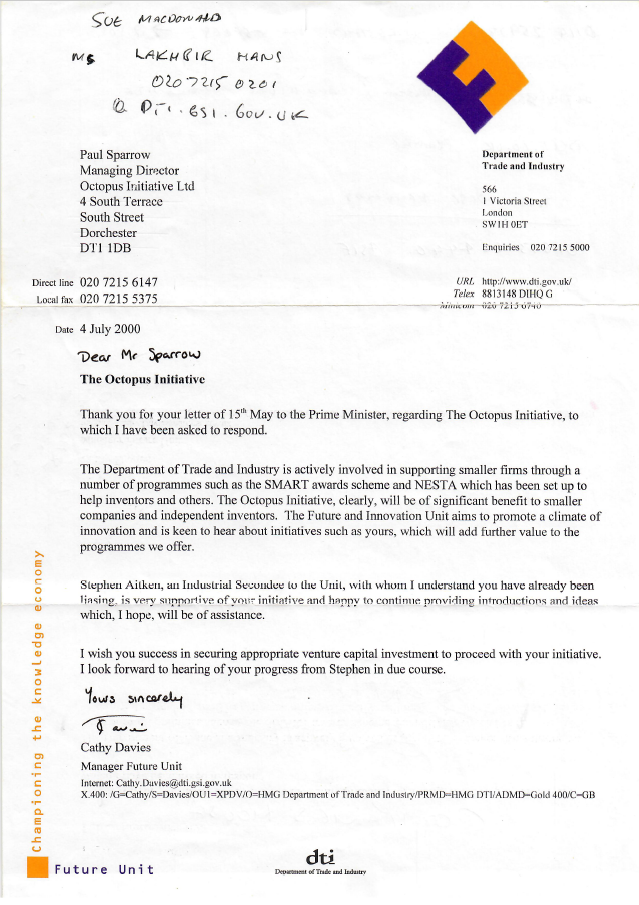
These milestones pre-date both reality-television voting frameworks and digital-identity systems that later mirrored the same architecture.The invention’s emphasis on reusability & cross-domain portability was unprecedented — placing it within the class of industrial process inventions eligible for patent protection rather than one-off creative works.
2.C Mid-1990s: Identity Infrastructure Emerges
In parallel, governments and banks began modernising citizen identification systems for networked services:
- 1993–1995 – National databases migrated to electronic registers;
- 1996 – EU began standardising digital-signature legislation;
- 1997–1998 – X.509 certificates and PKI frameworks gained adoption for secure login.
These early digital-ID systems had a single function: authentication.They verified identity to permit access but did not aggregate users or link identities to thresholded outcomes. The architecture remained one-to-one rather than many-to-one.At this stage, there was no overlap with the Crowd-Device mechanic.
2.D 1999 – 2005: Mass-Participation Templates Spread
By the late 1990s, participation at scale had migrated into entertainment formats that were themselves derived from Sparrow’s early prototypes.Public voting, crowdfunding, and audience-driven elimination shows used identical structural logic: individual tokens (votes or pledges) accumulating toward thresholds that triggered outcomes.
Meanwhile, state systems continued developing static identity frameworks. Not until the Estonian e-ID and i-Voting system (2005) did a national identity programme first combine verified credentials with participation logic—allowing citizens to cast votes online using their government-issued ID. This represented the first recorded crossover between identity rails and participation rails within a public-sector context.
Legal Observation:By 2005, Sparrow’s architecture had been publicly documented for over a decade.Any reuse of the token → threshold → outcome structure for collective decision-making therefore falls chronologically after his protected disclosure.
2.E 2010 – 2018: From Authentication to Interaction
A second wave of innovation introduced interactive civic and commercial portals.Countries such as Denmark, Finland, and Canada deployed systems where verified users could sign petitions, propose legislation, or access benefits.
Typical structure:
- Verified ID = token.
- A statutory threshold (e.g., 50 000 signatures) = trigger.
- Policy review = outcome.
The Crowd-Device in administrative form—a reusable participation engine disguised as a public service.While presented as “civic modernisation,” the mechanism industrialises collective decision-making using precisely Sparrow’s framework.
Simultaneously, corporate social-media platforms mirrored the same process for commercial ends: likes, follows, and shares became digital tokens aggregated to thresholds that triggered algorithmic outcomes (visibility, rewards, sanctions). These systems re-implemented the Crowd-Device mechanic without licence, transforming it from participatory empowerment into a data-extraction economy.
Evolution of the Social-Media Mechanic (1997–2015)
- 1997–1999: SixDegrees.com is generally credited as the first social network — users could create profiles and “friend” others, but there were no likes or feeds yet.
- 2000: In the UK, Friends Reunited pioneered verified online connection long before global platforms emerged, introducing the principle of persistent identity as the access token for social interaction.
- 2002–2004: Platforms like Friendster and MySpace introduced networked profiles and public visibility of connections, laying the groundwork for “followers.”
- 2004: Facebook launched with “friends” & “walls,” but the “Like” button didn’t appear until 2009.
- 2006: Twitter (now X) introduced follows and later likes (2015) — this was when real-time social metrics began influencing visibility.
- 2010: Instagram launched with likes as a core built-in participation token feature from day one.
- 2011–2013: Reddit (karma) and YouTube (thumbs up/down) mainstreamed tokenised feedback loops — users’ reactions became the algorithmic input controlling visibility and monetisation.
So, while social networking began in the late 1990s, the token-based participation model (likes, follows, upvotes — the kind of “micro-token → threshold → outcome” structure that mirrors Sparrow’s Crowd-Device) only became dominant between 2009–2013.
In other words, Sparrow’s 1992–1999 codified mechanic predates the emergence of those systems by a decade — and they are, in effect, its commercial descendants, repurposing the original participation logic at planetary scale.
2.F 2019 – 2025: Wallet Integration and Programmable Currency
The current phase merges identification, participation, and finance:
- Digital-ID Wallets now combine credentials, payment instruments, and participation features (petitions, surveys, social credits).
- CBDC pilots (China 2020, EU 2023, UK 2025 consultations) add programmable rules linking currency behaviour to verified identity.
Once identity, behaviour, and payment coexist on a single ledger, the structure matches Sparrow’s original mechanic exactly—except for its inverted purpose.Where the original Crowd-Device unlocked collective benefit, these implementations gate individual permissions.
The technical sequence remains unchanged:
Verified token → Aggregated threshold → Automated outcome.
Only intent has shifted—from empowerment to control.
2.G Comparative Chronology (Condensed Table)
| Period | Digital-ID / CBDC Development | Crowd-Device Development | Relationship |
| Pre-1990s | Paper ballots, manual pledges | — | No overlap |
| 1992 | — | Invention of token-threshold-outcome mechanic | Origin point |
| 1993 | — | Peter Pan Flyer | First expression |
| 1994 | — | Challenge Anneka Proposal | Second expression |
| 1995 (Feb) | — | Government publication of his new regulatory Clause enabling public crowdfunding — formal acknowledgement of Sparrow’s Crowd-Device model | Formal Government acknowledgement / policy validation |
| 1996 – 1998 | Early static ID and authentication frameworks emerge (PKI concepts, smart-card tests) | Continued public demonstrations / press coverage | Parallel but unconnected development |
| 1999 | — | Octopus Initiative / PLP Website | Third expression / online deployment |
| 2000 – 2002 | Initial login systems (SSL, e-signatures, basic portals) | — | ID = Login only |
| 2005 → | Estonia e-Voting (ID + participation) | Established ‘temporal’ IP priority via public disclosure | First convergence |
| 2010s → | Civic portals, social-media participation | Ongoing derivation | Structural reuse |
| 2020s → | Digital wallets + CBDC integration | — | Full mechanic replication (inverted) |
2.H Lock-Point 2 – Priority and Derivation
The Crowd-Device mechanic was invented, documented, and publicly demonstrated between 1992 – 1999.No government or institution implemented a token-threshold-outcome architecture for verified-identity participation before that date.All subsequent uses within Digital-ID or CBDC frameworks are chronologically derivative and fall under Sparrow’s protected process.
3. Participation Mechanic vs Civic Act of Voting
The distinction between a civic act and a codified mechanism is the legal and conceptual fulcrum of this entire dossier.
Although the Crowd-Device was the second of Sparrow’s 5 original inventions, its development and legal protection were severely constrained by earlier intellectual-property thefts. The unlawful misappropriation of Peter Pan (which later re-emerged as Survivor), Brainwaves (which became Dragon’s Den / Shark Tank) and Millionaire for a Week (which evolved into Rich House, Poor House) removed both the financial and professional means needed to secure or enforce this subsequent invention. The loss of revenues and recognition from those works delayed any formal defence of the participation mechanic itself, creating the vacuum in which later state and corporate systems were able to adopt the same architecture without licence or attribution. See the ‘Legend’ for details of these other projects.
Misunderstanding this difference is how many derivative systems—ranging from television formats to governmental portals—were allowed to evolve unchecked while still reusing the same industrial logic created by Paul A. Sparrow.
3.A The Civic Act of Voting – Public Domain Function
Voting, in its basic democratic form, is an act of expression, not an industrial process.A civic voter signals preference; a counting authority records and tallies those expressions; a winner or decision is declared.It is episodic, limited in scope, and extinguishes upon completion.
Legally and historically, the civic vote belongs to the public domain:
- It cannot be owned, patented, or monopolised.
- It exists as a constitutional right, not as a mechanical system.
- Its underlying principle — “one person, one vote” — is foundational but not proprietary.
What Paul A. Sparrow identified was that this episodic event could be transformed into a reusable architecture — a platform that industrialises the counting of influence, turning what had once been singular into a perpetual, cross-domain system with far reaching potential than just civic events.That transformation created a new category: the participation mechanic. I.e. Sparrow’s Crowd-Device!
3.B The Participation Mechanic – An Industrialised System
In Sparrow’s framework, the civic act becomes one instance of a broader process, rather than the process itself. And governance is one of the many wrappers and domains in which his Crowd-Device can operate.The innovation lies not in discovering that people can vote or pledge, but in creating a repeatable, transferable engine that captures those actions and applies them to any domain or wrapper.
The core attributes of this industrialisation are:
- Tokenisation – Every act of participation (a donation, vote, pledge, or click) becomes a measurable digital token. Inversion converts behaviours such as speech, travel, food, etc. into measurable tokens.
- Thresholding – Tokens accumulate toward preset publicly transparent and auditable limits that determine when collective will has reached a decisive point. Inversion runs those behavioural tokens against hidden in-auditable state set thresholds.
- Outcome Execution – Once the threshold is met, an automated process triggers an event—fund release, policy initiation, winner chosen, or visibility boost. Inversion triggers access or denial.
- Reusability – The same engine can be repurposed across domains: entertainment, governance, crowdfunding, distribution, or commerce. Inversion runs across the same but for compliance.
This process converts civic or social interaction into a codified industrial flow—a programmable loop of input, aggregation, and outcome. That is the subject matter of Sparrow’s protectable intellectual property.
3.C Where Civic Voting Ends and IP Begins
The line of demarcation between public voting and the proprietary participation mechanic lies not in the medium of delivery but in the architecture of process.
Whether executed through coupons in print, calls on broadcast, or tokens online, the same structural elements apply.
| Element | Civic Act (Public Domain) | Crowd-Device Mechanic (Protected IP) |
| Participation Type | One-off election or referendum | Continuous, cross-domain participation |
| Input Form | Vote, coupon, or paper ballot | Tokenised or otherwise standardised reusable inputs across media |
| Aggregation | Manual or event-specific counting | Programmable or repeatable aggregation—digital, broadcast, or print-based |
| Threshold | Fixed event end-point | Dynamic, portable threshold applicable to any campaign or platform |
| Outcome | Declaration of result | Triggered action or automated release |
| Reuse | Single context | Reusable architecture across print, broadcast, and online mediums |
| Ownership | Public right | Codified industrial process |
This table reflects the essential shift from manual democracy to programmable participation, where “programmable” refers to the repeatable logic of thresholds and outcomes, not to software alone.The civic act remains free; the framework that multiplies, transfers, and industrialises participation across mediums is owned.
Its originality lies not in digitalisation but in emancipation — freeing participation from captive contexts and rendering it universally deployable across mediums and generations of technology.
3.D Reuse Across Domains – The Defining Characteristic
The most important feature distinguishing the Crowd-Device from ordinary voting is reusability.Every derivative—whether a reality-TV format, crowdfunding site, social-voting platform, or governmental petition portal—relies on the same transferable skeleton. Without this reuse, each system would need bespoke architecture and manual administration; with it, participation becomes a plug-and-play commodity.
Reusability therefore serves as both the technical marker of derivation and the legal boundary of protection. Any system that:
- Aggregates verified user inputs,
- Applies thresholds, and
- Triggers automated outcomes more than once or across more than one domain of execution or allocation, is, by structure, employing the Crowd-Device mechanic.
3.E Precedent Examples
- Estonia (2005) – introduced e-ID-verified i-Voting; while lawful for elections, the reuse of that logic in subsequent civic platforms extended beyond electoral remit.
- UK Government Petitions Portal (2011 onwards) – implemented ID-verified thresholds (100 000 signatures triggers debate). The structure—token = signature, threshold = trigger, outcome = debate—is identical to the protected mechanic.
- EU “Conference on the Future of Europe” (2021) – aggregated verified inputs across multiple thematic domains, using uniform threshold logic.These demonstrate how easily a civic function can evolve into a licensed industrial process.
3.F Lawful Counting vs Derivative Participation Engines
Before Sparrow’s codification, every act of voting or selection was bespoke — bound to its venue, purpose, and participants. A local election, a studio vote, or a telethon tally each required a new process, a new count, and a new endpoint. Once the result was declared, the mechanism dissolved; it could not be transferred, repurposed, or scaled.
Sparrow’s invention industrialised that process. Between 1992 and 1999 the counting logic itself became portable — a repeatable engine rather than a one-off event. The same algorithm that could tally pledges for a project could, with no redesign, count verified votes, fund releases, or reward distribution. The physical and contextual barriers that once separated civic, commercial, and entertainment participation were erased. The Crowd-Device became the universal engine of measurable will.
That is the point of divergence: lawful counting ends when the event does; derivative counting begins when the mechanism endures. An analogy might be equal to the shift from Paper Spreadsheets to Excel! They both do the same job in the same way, but one is public domain, the other is an industrialised protected device.
1. Governance — From Captive Ballots to Continuous Voice
Before: each election or referendum was isolated in time and geography. Counting was manual; engagement ended at the ballot box.After: the same token–threshold–outcome logic allowed citizens to participate beyond election day. Verified petitions, participatory budgeting, and policy-trigger portals reused the identical counting structure. Platforms such as Change.org and the UK Government Petitions Portal are direct expressions of that architecture: verified signatures accumulate toward public thresholds that trigger institutional review or debate. What had been a periodic vote became a continuous voice, and participation became an ongoing civic infrastructure rather than a seasonal ritual.
2. Investment — From Gatekept Capital to Crowd-Funding
Before: finance was hierarchical. Banks and investors acted as bottlenecks, deciding which ideas deserved life and at what cost.After: Sparrow’s 1993 Paper Flyer allowed many small pledges to aggregate toward a common goal. It turned spectators into stakeholders and redistributed agency from institutions to citizens.That same sequence—token → threshold → outcome—became the operating code of modern platforms such as Kickstarter, Indiegogo, and GoFundMe. Each aggregates micro-pledges to reach a target, releases funds automatically, and reports outcomes transparently. Collectively they form the industrial descendants of the original flyer: a population-scale funding system that bypasses traditional gatekeepers and democratises investment itself.
3. Media — From One-Way Broadcast to Two-Way Participation
Before: television and radio were observation media. Viewers watched outcomes they could not affect; even audience votes were confined to those in the room.After: by separating the mechanic from the medium, the Crowd-Device made participation portable. Whether through paper coupons, phone-ins, or online portals, the same rule-set applied. Shows such as Pop Idol (2001), X-Factor (2004), and Britain’s Got Talent (2007) reused this participation skeleton on a global scale, allowing remote audiences to shape live outcomes. For the first time, entire populations could co-create results in real time — the bridge between broadcast and interaction.
4. Social Media — From Conversation to Codified Feedback
Before: online interaction was conversational and ephemeral — messages exchanged but unmeasured.After: the same participation skeleton re-emerged as metrics. Likes, follows, upvotes, and shares became micro-tokens; visibility algorithms counted them toward thresholds that triggered outcomes — who was seen, who was paid, who was silenced. Platforms such as Facebook, Twitter (X), YouTube, Instagram, and Reddit industrialised this loop, converting social approval into algorithmic currency. The result is participatory architecture at planetary scale — identical in structure to the original Crowd-Device, inverted in intent from empowerment to exploitation.
From Empowerment to Exploitation
At first, these social media systems appeared empowering: users generated tokens voluntarily and collective engagement decided what rose to visibility. Yet beneath that surface, the thresholds were privately owned and constantly recalibrated. The Crowd-Device had been repurposed as a commercial engine—its participatory data became the raw material for advertising, behavioural prediction, and market control.
In this sense, social media represents a commercial inversion of the original mechanic: a structure that once distributed voice now concentrates influence through proprietary algorithms. The crowd still powers the machine, but the outcomes serve the platform. The same participatory DNA endures—only its beneficiary has changed.
5. Structural Result
Across all four domains the pattern is identical:
- Before: bespoke, exclusive, captive, perishable events.
- After: standardised, inclusive, portable, persistent processes.
The invention replaced institutional permission with procedural equality. It is the bridge between the broadcast century and the participatory era. What Sparrow calls: The Crowd-Era.
That is the point of divergence: lawful counting ends when the event does; derivative counting begins when the mechanism endures. They both achieve a result, but only one industrialises the means — and that, in law, marks the boundary between public domain and protected process.
This distinction defines the legal boundary between participation as a right and participation as a process. When counting becomes infrastructure — when the means of expression itself becomes a transferable product — it crosses from constitutional practice into proprietary invention. The following section explains why that distinction matters in law.
3.G Why Distinction Matters
Governments and corporations often defend derivative systems by conflating civic participation with their own engineered platforms.But this is a category error: participation = human act; the participation engine = manufactured device.The former is a right; the latter is an intellectual property.
In legal terms, intent does not determine infringement—structure does.Even if a state claims benevolent purpose, employing the — token → threshold → outcome — structure without licence constitutes reuse of a codified industrial process.
3.H Lock-Point 3 – Codified Mechanic ≠ Civic Act
The public act of voting remains a constitutional right.The industrialised, reusable framework that enables votes, pledges, or other participations to be standardised and redeployed across domains is a protectable process invented by Paul A. Sparrow (1992–1999).Embedding that framework within governmental or corporate systems without authorisation constitutes derivative use.
4. Inversion – Empowerment vs Control
The Crowd-Device, as conceived by Paul A. Sparrow (1992–1999), was designed to enable empowerment through collective participation. Its underlying principle was that individuals, when connected through a transparent and standardised participation architecture, could unlock opportunity and influence previously reserved for institutions. The Crowd-Mechanic — token → threshold → outcome — functioned as an invitation to shared creation and voluntary alignment.
Three decades later, that same structure appears again, not as a new or evolved system, but as the identical Crowd-Mechanic reused with agency reversed. Tokens are still generated, thresholds still applied, and outcomes still triggered; only the locus of control has changed. What was once a bottom-up mechanism for releasing collective benefit is, in some implementations, redeployed as a top-down framework for behavioural regulation and automated compliance.
This section examines that inversion. It does not describe a different mechanic, but the same architecture operating under different custody, demonstrating how an unchanged structure can either distribute power or consolidate it, depending solely on who defines the thresholds and for whose benefit outcomes are released.
4.A Original Purpose – The Empowerment Architecture
In its original form, the Crowd-Device was built to decentralise influence.Every participant was both a contributor and a stakeholder.Tokens were voluntary, thresholds transparent, and outcomes beneficial to all who participated.
Architectural Traits of Empowerment:
- Voluntary token creation – individuals choose when and how to participate.
- Transparent thresholds – criteria for outcomes are visible and auditable.
- Collective benefit – once a target is met, the reward or change applies to all.
- Privacy and pseudonymity – participation is public; identity is protected.
- Decentralised control – the process is independent of state or corporate custodianship.
The architecture’s moral core was empowerment through equality of mechanism: every person, regardless of social status, could contribute toward an outcome under the same transparent rules.
4.B The Inversion – From Empowerment to Surveillance
The inversion of this system began the moment participation data became a commodity.
In commercial and governmental contexts, the mechanic’s transparency and openness were replaced with opaque scoring, data tracking, and algorithmic thresholds invisible to the participants.Instead of individuals unlocking shared rewards, the system began unlocking permissions—a reversal of power.
Mechanic in its inverted form:
- Token creation: now automatic (every purchase, post, comment, or movement emits a token).
- Thresholds: invisible, determined by algorithms and policy rules.
- Outcomes: control access, benefits, or speech rather than reward collaboration.
- Privacy: eliminated in favour of traceability.
- Control: centralised, non-negotiable, and automated.
Where the original mechanic gathered tokens to unlock opportunity, the inverted version gathers data to enforce conformity.
4.C Structural Paradox – Same Skeleton, Reversed Flow
The paradox is technical.Both systems use the identical architecture, but the direction of influence is reversed:
| Element | Empowerment Model | Control Model |
| Token Origin | Voluntary contribution | Automatic data capture |
| Threshold Function | Enables collective outcomes | Gates individual permissions |
| Outcome | Shared benefit | Conditional restriction |
| Direction of Flow | Bottom-up | Top-down |
| Privacy | Pseudonymous / user-controlled | Centralised / state or corporate-controlled |
| Governance | Transparent, auditable | Algorithmic, opaque |
Thus, the inversion is not about changing software but about changing intent.A benevolent mechanic becomes coercive when the locus of control shifts from the participant to the administrator.
4.D Behavioural Tokenisation – Turning People into Data
Modern infrastructures—particularly those integrating Digital-ID, social media, and CBDC—operate on continuous behavioural tokenisation.Every transaction, movement, or expression becomes a token in a ledger of conduct.That ledger is then used to determine thresholds of trust, eligibility, or compliance.
Where the Crowd-Device sought to reward initiative, the inverted systems penalise deviation.A “participation score” can become a “compliance score.”This shift transforms the participatory mechanic into a surveillance economy.
Once thresholds are tied to moral or behavioural categories—health compliance, environmental footprint, political alignment—the system ceases to be administrative and becomes instrumental: it shapes the citizen rather than serves them.
4.E The Illusion of Consent
Digital participation systems under government or corporate control often rely on informed consent as their defence.Yet such consent is rarely informed, and participation is rarely optional.When access to banking, healthcare, or mobility depends on acceptance of a Digital-ID or wallet, consent is coerced.
The legal question is therefore not whether users click “agree,” but whether refusal remains materially possible.If refusal leads to exclusion from essential services, the system has crossed into coercive design.In such conditions, participation is no longer participation—it is compulsory compliance.
4.F CBDC as a Control Conduit
When programmable currency merges with identity and participation rails, the inversion reaches completion.The same — token → threshold → outcome — architecture begins governing financial autonomy:
- Tokens = currency units linked to identity.
- Thresholds = spending permissions or behavioural criteria.
- Outcomes = access granted or denied based on compliance.
In this model, participation becomes indistinguishable from obedience.Where once tokens liberated users to act collectively, they now bind users to pre-defined behavioural lanes.Every transaction becomes a vote of conformity recorded by design.
4.G Philosophical and Legal Implications
From a philosophical perspective, this inversion represents the privatisation of sovereignty.The power to decide, once held collectively, becomes automated within code controlled by a few.It transforms governance into an algorithmic monarchy, where authority is exercised through design rather than decree.
Legally, the inversion reconfigures Sovereign Rights as conditional privileges.When the same participation structure determines access to speech, finance, or movement, these rights cease to be inalienable and become programmable entitlements—a status explicitly incompatible with democratic constitutions.
This is why the original invention must remain under private ownership and moral stewardship: to prevent the universal participation engine from becoming a universal compliance engine.
4.H Reversal of Burden – From State Accountability to Citizen Scoring
In traditional democracy, the citizen measures the state; in the inverted model, the state measures the citizen.This reversal is the most profound of all transformations.It redefines governance as continuous evaluation, collapsing the boundary between citizen and subject.
The very success of the Crowd-Device—its ability to translate human will into measurable thresholds—makes it dangerous in the wrong hands.When those thresholds are redefined by authority, freedom itself becomes quantifiable and therefore revocable.
4.I Lock-Point 4 – Inversion Does Not Cure Derivation
Reversing the polarity of a system—from unlocking opportunity to gating permission—does not alter its derivation.The architecture remains identical: token creation, threshold aggregation, and automated outcome.The inversion of purpose may affect morality, but not ownership.Whether used for empowerment or control, the structure is derivative of Paul A. Sparrow’s original invention and requires licence or lawful redesign.
5. The Point of Divergence – When Digital-ID Became Behavioural
5.A From Proof of Person to Proof of Permission
The earliest implementations of Digital-ID were static proofs of existence—digital passports confirming who someone was.They were authentication tools, not behavioural filters.But as infrastructures matured, the boundary between identity and eligibility quietly eroded.The proof of person began to merge with the proof of permission:each verification was no longer the end of a process but the trigger for a conditional rule.
Where authentication should have stopped, automation began.Login data evolved into participation metrics; credentials became tokens that could activate or restrict outcomes.This was the first point of divergence—the moment identity systems began to remember, measure, and predict.Once a Digital-ID carried forward context from previous actions, it ceased to be neutral proof and became an instrument of adjudication.Every future log-in became a micro-trial of character.
5.B The Hidden Mechanic – Tokens Beneath Credentials
Behind every modern ID interaction sits a set of invisible tokens: cryptographic artefacts representing actions, preferences, and permissions.Originally designed for security integrity, these tokens became behavioural signifiers—proofs of what a person has done, not merely who they are.When accumulated, they create a secondary identity layer: a person’s digital reputation scored by systems that claim impartiality.
This tokenisation is the unacknowledged adoption of the same token → threshold → outcome sequence codified by Paul A. Sparrow (1992–1999).Only the wrapper has changed.Each verification produces a token; thresholds are set by algorithms; and outcomes—approval, denial, reward, sanction—are automatically triggered.Thus, Digital-ID quietly absorbed the Crowd-Device mechanic without licence, turning a static credential into a dynamic participation engine.
5.C Aggregation and Conditional Access – The Silent Shift
The moment identities began to aggregate across domains, the shift was complete.What was once a discrete record in a departmental database became part of a unified behavioural ledger.The purpose of identification mutated into a mechanism of prediction and control.Conditional access replaced binary verification:
- Access granted if the threshold of compliance is met.
- Access denied if the score falls below the algorithmic standard.
This silent migration from recognition to regulation marks the true turning point.Citizens ceased to “log in” and began to “qualify.”Each swipe, payment, or post became another token in a perpetual referendum for admissibility to society.
5.D When Identity Began to Calculate Behaviour
Once programmable finance and Digital-ID converged, the logic of identity became computational.Systems no longer authenticated persons—they evaluated them.Identity became the running total of approved conduct.The citizen’s digital wallet became a behavioural dashboard, translating daily life into numeric compliance.
The inversion’s missing bridge: Identity was not taken over by finance or surveillance; it became them.Through continual scoring, the individual became both participant and product—an instrument within the same participatory mechanic originally designed to empower them.Every transaction reinforced the loop, proving that control could be achieved not by force, but by design.
5.E Systemic Consequence – The Citizen as Variable
At systemic scale, behavioural identity transforms governance itself.Policy ceases to operate on rights and begins to operate on probabilities.Citizens are no longer equal before the law but weighted by datasets: eligibility, trustworthiness, carbon score, or social conduct.Governance mutates from rule-based administration to continuous computation.The human being is treated as a variable in a live experiment—the feedback node of an algorithmic state.
Such systems claim efficiency but deliver obedience.They reward predictability and penalise deviation.They confuse civility with compliance and reform democracy into a managed marketplace of permitted actions.In this structure, the original Crowd-Device—conceived to distribute power—has been inverted to distribute permission.
5.F Lawful Authentication vs Algorithmic Authority
The legal distinction is subtle but absolute:authentication verifies identity; algorithmic authority evaluates conduct.The former is lawful under sovereign competence; the latter is derivative and licence-required under Sparrow’s codified process.When a Digital-ID begins to condition access based on accumulated behaviour, it ceases to be an authentication tool and becomes a participatory engine—triggering the same industrial logic protected under the Crowd-Device IP.
Therefore, governments and vendors embedding such threshold-based conditions must obtain licence or redesign their logic.Without that compliance, every behavioural ID, programmable wallet, or conditional credential constitutes reuse of a protected industrial sequence, regardless of moral intent.
5.G Lock-Point 5 – The Moment of Divergence
The lock-point was crossed the first time a verified identity was used to decide what its holder could do next.That was the moment Digital-ID became behavioural.From that instant, the mechanic was no longer serving authentication—it was performing participation.In legal terms, the Digital-ID framework stepped into the protected industrial domain of the Crowd-Device, and every subsequent evolution merely refined that reuse.
This divergence defines the entire dispute:whether the architecture of identification may legitimately embed the architecture of participation.The answer—by both technical lineage and legal boundary—is no.Identity may prove existence; only a licensed participation engine may compute worth.
6. Lawful Applications and Derivative / Infringing Applications
The following section translates the structural and philosophical distinctions already outlined into legal boundaries of use.It distinguishes the state’s legitimate functions of identity, authentication, and record-keeping from the derivative use of participation mechanics that duplicate the protected token → threshold → outcome framework created by Paul A. Sparrow (1992–1999).
Where identity frameworks stop at verification, they remain lawful.Where they proceed to aggregation and automated decision-making, they cross into Crowd-Device territory and become licence-required or infringing.
6.A Lawful Implementations (Sovereign Competence)
Within the principles of constitutional sovereignty, certain digital functions are legitimate public-domain activities.They exist to identify, protect, and serve the citizen; they do not employ the token → threshold → outcome sequence and therefore do not trespass upon the protected process.
Lawful Domains:
- Identity Issuance and Verification
- The creation of citizen identifiers (passport numbers, NHS numbers, tax IDs).
- Used solely to confirm who a person is, not what that person may do.
- Function: authentication only.
- Character: one-to-one transaction between citizen and authority.
- Digital Signatures and Record Authentication
- Verification of documents or messages through cryptographic proof.
- No aggregation or threshold logic; each signature is discrete.
- Example: e-signing a mortgage, submitting a form.
- Administrative Access Control
- Logging into portals for healthcare, taxation, or benefits.
- Access permissions are static and defined by law, not by dynamic thresholds.
- Does not evaluate behaviour; merely confirms entitlement.
- One-Off Statutory Elections and Referenda
- Conducted under electoral law, with finite scope and temporal limits.
- Each vote extinguishes after tally; no reusable engine.
- Lawful because it is a constitutional process, not a commercialised mechanism.
- Unconditional CBDC Transactions
- If a Central Bank Digital Currency operates identically to cash—anonymous, non-programmable, and unconditional—it remains outside the IP boundary.
- Payment ≠ Participation; a spend is not a thresholded event.
Principle:When digital systems operate as tools of verification or execution without applying conditional aggregation, they fall within ordinary state competence.
6.B Derivative / Licence-Required Implementations
Derivative use occurs whenever an authority or vendor embeds a reusable participation logic into digital-identity or currency systems.In these cases, identity, behaviour, or financial tokens are aggregated toward thresholds that trigger outcomes—precisely the process defined and protected in the Crowd-Device.
Derivative Features and Why They Hit Your Mechanic
- ID-Verified Petitions and Initiatives
- Structure: verified ID = token → signature threshold → policy outcome.
- Mirrors the original participatory engine.
- Reuse across multiple issues transforms it from civic service to industrial process.
- Licence required.
- Citizen-Decision Modules within Digital Wallets
- Embedded voting or funding tools reused across departments.
- Tokens (votes, pledges, ratings) accumulate to thresholds.
- Constitutes replication of the cross-domain mechanic.
- Behavioural or Reputation Scoring
- Tokens = behavioural data points (compliance, attendance, purchases).
- Thresholds = risk or eligibility scores.
- Outcomes = access or denial of services.
- Inversion of the empowerment model; full structural reuse.
- Programmable CBDC Linked to Digital-ID
- Tokens = identity-linked currency units.
- Thresholds = pre-defined spending limits, time or category restrictions.
- Outcomes = automatic denial or approval of transactions.
- Identical to the token-threshold-outcome logic applied to finance.
- Derivative; licence required.
- Cross-Domain Reuse of Participation Engines
- Same algorithmic logic reused for petitions, payments, welfare, or travel.
- Converts isolated civic tools into a platformised participation infrastructure.
- Represents the industrialisation of the mechanic first codified by Sparrow.
Legal Consequence:Under IP law and process-patent principles, re-implementation of a protected industrial sequence without authorisation constitutes derivative use.Purpose or intention is irrelevant; the test is structural equivalence.Any government or corporation employing such a system must secure licence or redesign its underlying participation engine.
6.C Architectural Boundary Map
| Function / Feature | Structural Test | Lawful Status |
| Authentication (login only) | No thresholding / aggregation | Lawful |
| Verified petition threshold | token → threshold → outcome | Licence required |
| Behavioural score for access | token → threshold → outcome | Licence required |
| Non-programmable CBDC | direct transaction no threshold | Lawful |
| Programmable CBDC + ID link | token → threshold → outcome | Licence required |
| Cross-domain reuse of same logic | industrialised participation | Licence required |
This table formalises the mechanical test that separates permissible identity functions from infringing participation systems.
6.D Jurisprudential Principle – Structure over Intent
Infringement in process law is determined by structure, not motive.Whether a system seeks to empower or to regulate, if it applies the same operative sequence as a protected process, it is derivative.Just as a patented chemical reaction remains protected regardless of whether it produces fuel or explosives, the participation mechanic remains protected whether used for civic mobilisation or behavioural control.The same structural test that governs sovereign implementations applies equally to the vendors and integrators who commercialise or deploy the mechanic.
6.E Governance and Vendor Liability
Responsibility extends beyond governments to the corporations and contractors who develop or integrate such systems.Where vendors sell modular participation engines—threshold-based voting APIs, programmable finance layers, or behavioural-score frameworks—they inherit the duty to ensure their designs do not replicate protected logic.
Licensing therefore becomes not only a matter of intellectual-property compliance but of human-rights due diligence, since the misuse of the mechanic can lead directly to unlawful discrimination or coercion.
Behavioural Access Systems and Retail Gating Technologies
Modern retail and service environments increasingly embed facial-recognition turnstiles, QR checkpoints, loyalty-entry systems, and mobile credential scanners that replicate the structural logic of the Crowd-Device — the token → threshold → outcome sequence.
Where these devices aggregate and reuse behavioural data to determine eligibility or priority, they cross from lawful authentication into derivative participation processing.
Whether such systems are lawful depends entirely on their context and purpose. Vendors deploying such systems bear direct responsibility to separate authentication from behavioural gating, or to obtain licence for the underlying participation logic.
⚙️ 1. When scanners and recognition gates mirror Sparrow’s mechanic
At a purely structural level, many modern retail access systems now operate like this:Token: facial template, QR pass, or phone credentialThreshold: match/no-match, payment validation, age flag, or spending limitOutcome: gate unlocks or denies access
This operational sequence is mechanically identical in form to Sparrow’s Crowd-Device.
However, context and purpose determine whether it crosses into Sparrow’s protected industrial logic:
| Use Case | Function | Legal Standing vs. Crowd-Device |
| Single-purpose authentication (confirming a ticket, ID, or payment) | One-to-one verification, extinguishes after entry | Lawful – falls within ordinary authentication domain |
| Reusable behavioural gating (tracking visits, spend, or preferences to determine future access or pricing) | Aggregates user data over time to trigger dynamic outcomes | Derivative – engages Sparrow’s participation logic |
| Cross-domain reuse (same identity token governing retail, transport, finance, etc.) | Portable algorithm controlling multiple environments | Derivative & Infringing – duplicates the reusable participation engine |
Where these devices simply authenticate a transaction or verify identity, they remain within legitimate operational boundaries. However, when the same infrastructure aggregates and reuses behavioural data—such as visit frequency, purchase history, or customer “trust scores” — to influence access, pricing, or prioritisation, it transforms into a behavioural-threshold system. In that configuration the system ceases to be a passive authenticator and becomes an active participation processor, invoking the same structural logic protected under Sparrow’s industrial process.
⚖️ 2. Legal position and enforcement reality
- If a scanner merely checks payment or ticket validity, it’s acting as an access authenticator — not an infringing participation engine.
- If the same infrastructure aggregates behavioural tokens (e.g., frequency of visits, purchasing behaviour, “trust scores”) and uses that data to alter access, pricing, or privileges, it becomes a behavioural-threshold system — and therefore falls inside Sparrow’s protected structure.
- If multiple vendors (supermarkets, transport networks, payment providers) share the same identity tokens and threshold logic, that interoperability is evidence of a platformised participation engine, i.e., derivative use.
🚫 3. What the inventor can lawfully demand
Although no statutory patent was filed due to prior tortious interference, the underlying participation mechanic remains a protected industrial process by virtue of documented authorship and public disclosure.Accordingly, while takedown orders cannot yet be issued, the inventor retains the right to assert authorship and demand compliance or licensing on the following grounds:
- Cease or licence the reuse of token-threshold-outcome logic for behavioural gating.
- Prohibit data aggregation across domains without explicit consent and independent audit.
- Require that all scanners and recognition systems operate on single-use authentication logic (no persistent behavioural scoring).
Such demands may be pursued through:
- Formal public-policy complaints under Data Protection, Equality, or Consumer Rights frameworks where coercive participation or discrimination is evident;
- Intellectual-property notices of authorship served on corporate vendors as pre-litigation warnings; and
- Human-rights challenges asserting that algorithmic gating of access constitutes unlawful interference with personal autonomy and freedom of movement.
This reinforces the principle that the Crowd-Device mechanic cannot be silently embedded into public or commercial infrastructure without licence, consent, or transparent governance.When systems begin determining who may enter, purchase, or participate, based on aggregated behavioural-thresholds, they move from mere verification to programmable compliance—and in doing so, they cross into derivative use of a codified invention.
6.F Lock-Point 6 – Lawful Scope of Digital-ID and CBDC
Digital-identity and currency systems remain lawful when confined to authentication, record-keeping, and unconditional transactions.
Once they embed reusable token-threshold-outcome logic—whether for participation, scoring, or programmable control—they enter the protected field of the Crowd-Device and become derivative.
Use without licence or structural redesign constitutes unauthorised exploitation of a codified industrial process and therefore falls within the scope of derivative infringement.
7. CBDC Interweave – Points of High Risk
The most serious contemporary manifestation of the Crowd-Device inversion occurs in the merging of Central Bank Digital Currencies (CBDCs) with Digital Identity frameworks.Individually, these systems are neutral tools; together, they form a programmable infrastructure capable of automating compliance and restricting liberty.At the heart of this convergence lies the same structural logic codified by Paul A. Sparrow (1992–1999): token → threshold → outcome.
This section maps the financial, technical, and human-rights risks that emerge when that architecture migrates from empowerment to enforcement.
7.A Overview: From Currency to Conduct Regulation
A CBDC is often described as digital cash, but this is misleading.Traditional cash is anonymous, bearer-based, and unconditional.A CBDC is identity-linked, programmable, and conditional — a system that can enforce rules at the point of transaction.
When Digital-ID becomes the currency authentication layer, every unit of value carries a behavioural ledger.Each spend, receipt, or holding becomes a token of behaviour, and the network applies threshold logic to determine which transactions proceed or fail.
The result is a monetary system that no longer records the economy; it regulates the individual.
7.B Structural Parallels to the Crowd-Device
| Element | Sparrow’s Mechanic (1992–1999) | CBDC + Digital-ID Implementation |
| Token | Voluntary pledge or vote | Digital currency unit linked to verified ID |
| Threshold | Collective target that unlocks shared outcome | Policy-defined conditions that enable or block transactions |
| Outcome | Community benefit triggered on success | Permission or denial of spend, access, credit, or release of rights |
| Control locus | Bottom-up, participant-driven | Top-down, administrator-driven |
| Transparency | Public, auditable | Opaque, algorithmic |
The structure is identical; only the intent and direction of control differ.
7.C Phases of Interweave Development
- Phase 1 – Identity Anchoring (2016 – 2020)
- Financial institutions began linking KYC (Know-Your-Customer) data to central-bank trials.
- Identity was a login layer only.
- Risk level: Low.
- Phase 2 – Programmability (2020 – 2023)
- CBDC pilots introduced smart-contract rules: geographic limits, expiry dates, and spending categories.
- Tokens became condition-based.
- Risk level: Medium–High.
- Phase 3 – Behavioural Conditioning (2023 → Present)
- Integration with digital-ID wallets and ESG/health compliance modules.
- Tokens now carry behavioural metadata and thresholds tied to eligibility.
- Risk level: Severe.
- The system now mirrors the inverted Crowd-Device structure.
7.D Key Risk Patterns
- ID-Conditioned Spend Permissions
- Currency functions only when identity passes dynamic eligibility checks.
- Example: transactions denied if vaccination status or carbon score falls below threshold.
- Replicates token-threshold-outcome logic, inverted for restriction.
- Thresholded Benefits and Entitlements
- Welfare or stimulus credits released only after compliance tokens reach preset levels.
- e.g., Attend three “resilience workshops” → release next stipend.
- Converts social assistance into gamified obedience.
- Reputation-Based Transaction Filters
- Ledger aggregates prior behaviour into “trust indices.”
- Low scores trigger automatic spending caps or exclusion from travel and credit.
- Effectively an economic form of social credit.
- Cross-Domain Data Fusion
- Health, employment, taxation, and mobility data unified through the wallet.
- The same thresholds controlling benefits also control movement and speech platforms.
- Structural collapse of domain separation — a single participation engine governing all life functions.
- Once a threshold is met or breached, consequences are released automatically across domains.
- Algorithmic Lockouts Without Due Process
- Failing an opaque threshold can disable access to essential services instantly.
- No human adjudication, no appeal, no visibility of cause.
- Violates constitutional guarantees of proportionality and natural justice.
7.E Financial Governance Implications
From a monetary-law perspective, programmable CBDC erases distinction between policy and execution.Once rules are embedded in the code, enforcement occurs automatically, without parliamentary oversight.This is governance by algorithm — a self-executing statute.
Such automation transfers discretionary power from elected institutions to system architects and vendors.The result is technocratic governance, where decisions that once required public debate are instead enforced silently through software updates.
7.F Human-Rights Exposure
When CBDC and Digital-ID systems converge:
- Privacy collapses — every transaction is personally attributable.
- Freedom of association erodes — spending can be used to map relationships.
- Freedom of expression diminishes — financial exclusion becomes a penalty for dissent.
- Property rights are weakened — programmable currency can expire or devalue on command.
- Equality before the law disappears — identical behaviour can yield different outcomes depending on algorithmic profile.
These are not speculative threats; they are direct consequences of embedding behavioural-thresholds into the financial core of society.
7.G Legal Classification – Derivative Use in Finance
Under process-patent and copyright doctrine, the adoption of the token-threshold-outcome structure within monetary systems constitutes a derivative use of the original mechanic.The CBDC framework replicates the same logical sequence:
Identity-linked token (currency) → threshold (policy condition) → outcome (transaction approval or denial).
Because this structure is reused across financial domains, it meets the test for industrialised participation process.Without licence, such use is infringing, irrespective of purpose.
7.H Points of High Risk (Summary Table)
| Domain | Example Mechanism | Derivation Status | Risk Level |
| Payment Authentication | Identity verification for wallet login | Lawful | Low |
| Programmable Spend | Rules limiting when/where funds can be used | Derivative | High |
| Behavioural Incentives | CBDC bonuses for “compliant” actions | Derivative (inverted) | Severe |
| Conditional Welfare | ID-verified milestones to unlock credits | Derivative | High |
| ESG / Health Integration | Carbon or vaccination scores gating access | Derivative (inverted) | Severe |
| Cross-Domain Fusion | Unified wallet controlling multiple rights | Derivative (systemic) | Critical |
7.I Safeguard Principles for Lawful CBDC Design
To remain within lawful and ethical boundaries, any CBDC must adhere to the following constraints:
- Functional Separation — Identity rails, transaction rails, and policy rails must be technically and legally segregated.
- No Behavioural-thresholding — Currency may not encode conditional criteria related to morality, health, or expression.
- Transparency and Auditability — All rules embedded in code must be publicly reviewable and subject to parliamentary oversight.
- Anonymity Options — Small-value and low-risk transactions must remain pseudonymous to preserve the characteristics of cash.
- Right to Appeal — Any algorithmic decision affecting rights must be reversible through human adjudication.
- Licensing Compliance — Reuse of token-threshold-outcome logic across domains requires explicit licence from the inventor or lawful redesign.
7.J Lock-Point 7 – CBDC Linkage and Derivation
Linking programmable currency to identity-conditioned thresholds imports the protected participation mechanic directly into finance.The combination of Digital-ID and CBDC therefore constitutes a derivative use of Paul A. Sparrow’s codified process.Without licence or architectural separation, such systems infringe the original invention and expose both vendors and states to liability and rights-based challenge.
8. Remedies and Assertable Rights
The presence of the Crowd-Device mechanic inside Digital-ID and CBDC architectures is not an abstract resemblance; it is a structural replication of a protected process.Once that replication is established, Paul A. Sparrow possesses enforceable rights and remedies under both intellectual-property and human-rights law.These remedies range from commercial licensing to judicial intervention against coercive or derivative use.
8.A Foundations of Legal Standing
Sparrow’s participation mechanic was fixed in material form between 1992 and 1999, evidenced through dated artefacts, correspondence, and public demonstrations (the Peter Pan flyer 1993; Challenge Anneka proposal 1994, and the Octopus Initiative / Product Launch Platform (PLP) website started in 1999).This predates every known implementation of verified-identity participation systems and therefore establishes:
- Chronological Priority – first creation and public disclosure.
- Independent Origination – development without access to later systems.
- Functional Novelty – codification of reusable participation logic, not a single application.
- Continuity of Custody – uninterrupted ownership traceable to the inventor.
Under UK, EU, and international IP conventions (TRIPS Art. 28; Berne Art. 5; CDPA 1988 s. 16), these facts secure exclusive rights of reproduction and adaptation within the defined process domain.
8.B Types of Protected Right
- Process-Patent / Industrial Design Right
- The Crowd-Device qualifies as an industrial process: it defines an operational sequence rather than a creative narrative.
- Protection covers implementation of the same logic in any technical form (software, algorithm, or procedural rule).
- Copyright in Expression and Documentation
- Original schematics, diagrams, and written formulations (1992–1999) are literary works protected from reproduction.
- Moral Rights
- Recognition of authorship and protection against derogatory treatment (CDPA 1988 s. 77–80).
- Misrepresentation of the mechanic’s intent—from empowerment to control—constitutes moral infringement.
- Ancillary Human-Rights Interest
- Article 8 (ECHR: privacy) and Article 10 (expression) are implicated when derivative systems use the same architecture to constrain citizens.
- Thus, enforcement of the IP doubles as enforcement of civil rights.
8.C Forms of Remedy
- Declaratory and Injunctive Relief
- Objective: establish in court that Digital-ID and CBDC systems using token-threshold-outcome logic are derivative of the protected mechanic.
- Effect:
- Freeze rollout pending redesign or licence.
- Prevent use of the mechanic for coercive applications.
Compel acknowledgement of authorship in public documentation.
- Licensing and Royalty Agreements
- Scope: governments or vendors may obtain lawful use through explicit licence.
- Conditions:
- Usage confined to empowerment functions.
- Annual audit confirming non-inversion.
- Royalty or recognition clause acknowledging derivation.
- Purpose: convert infringement risk into structured collaboration while preserving moral intent.
- Cease-and-Desist / Notice of Infringement
- Targets:
- State agencies integrating participatory modules.
- Private vendors offering thresholded participation engines.
- Content:
- Identify derivative features.
- Cite ownership and evidence of priority.
- Demand cessation or licensing within defined period.
- Enforcement: through civil action under CDPA s. 96 or international equivalents.
- Judicial Review and Constitutional Challenge
- When available: if a Digital-ID or CBDC rollout infringes fundamental rights through behavioural conditioning.
- Grounds:
- Ultra vires use of technology beyond statutory authority.
- Disproportionate interference with rights under ECHR Art. 8, 9, 10, 11.
- Violation of due-process guarantees (right to appeal, transparency).
- Outcome: court may strike down or suspend deployment of the offending features.
- Human-Rights Petition (Domestic and International)
- Where state systems invert the mechanic to coerce behaviour, affected citizens—supported by the inventor—may petition domestic courts or the European Court of Human Rights.
- The inventor’s testimony provides technical causation: the architecture itself creates the harm.
8.D Enforcement Strategy
- Documentary Consolidation
- Maintain dated evidence of invention, prototypes, and publications.
- Compile derivative implementations demonstrating structural identity.
- Public Notice and Registration
- File notice of proprietary process with IPO (UK) & WIPO, referencing original documents.
- Registration enhances enforceability and deters negligent vendors.
- Engagement with Oversight Bodies
- Notify Data-Protection Authorities and Parliamentary Committees of potential structural rights violations.
- Frame the issue as both an IP and a civil-liberties safeguard.
- Negotiated Licensing
- Offer cooperative licensing to governments committed to open-source, transparent participation rails.
- Condition: mechanic must never be used for behavioural restriction.
- Strategic Litigation (See below)
- Identify a single test case where Digital-ID or CBDC uses thresholded behaviour gating.
- Seek declaratory judgment of derivation and injunction on deployment.
⚖️ Illustrative Test Case — China’s Digital-ID and Social-Credit System
| Legal Element | Real-World Correlate | Evidential Relevance |
| Token | A citizen’s Digital-ID or mobile-app credential (often tied to national social-credit or health-pass data). | The digital identity serves as the token in Sparrow’s mechanic. |
| Threshold | Behavioural or financial compliance score (e.g., credit rating, political reliability, purchase history). | Eligibility, for housing, travel, or employment, depends on maintaining minimum threshold scores, creating a conditional-access environment. |
| Outcome | Automatic gating of access to accommodation, services, or payment platforms. | Once thresholds fall, access is denied — users are literally excluded from physical and digital spaces. |
This represents the Crowd-Device architecture inverted — the same token → threshold → outcome logic but applied coercively rather than participatorily. Aggregated behavioural data now determines who may transact, travel, or even rent, transforming empowerment architecture into programmable compliance.
Real-World Correlate — Documented cases within China’s Digital-ID and social-credit infrastructure (2022–2025) illustrate behavioural-threshold gating leading to enforced exclusion from housing and services. These provide empirical proof that the unlicensed application of the Crowd-Device logic can yield coercive, rights-restrictive outcomes, satisfying evidential criteria for derivation and harm.
These conditions provide the evidential foundation for a declaratory-judgment petition demonstrating derivative use and harm, satisfying both the structural-similarity and societal-impact tests required for international recognition of infringement.
8.E Parallel Avenues of Leverage
- Ethical and Media Leverage: Public exposure of derivation pressures policymakers to seek licence rather than risk reputational harm.
- Commercial Leverage: Vendors developing civic-tech products require indemnities; denial of licence renders their systems unmarketable.
- Legislative Leverage: Propose statutory separation of participation rails and identity rails, codifying your IP boundary into law.
8.F Statutory and Treaty References
| Instrument | Relevance |
| UK Copyright, Designs and Patents Act 1988 | Defines infringement of literary and process works (s. 16 et seq.). |
| Patent Cooperation Treaty (1970) | Confers international protection for industrial processes. |
| TRIPS Agreement (Art. 27–28) | Establishes exclusive rights for process inventions. |
| European Convention on Human Rights (Art. 8, 10, 11) | Protects privacy, expression, and association—rights directly endangered by inverted participation systems. |
| General Data Protection Regulation (GDPR Art. 5–22) | Mandates transparency, purpose limitation, and human review of automated decisions. |
Together, these create a hybrid shield: IP law secures ownership of the mechanism; human-rights law prohibits its misuse for behavioural control.
8.G Lock-Point 7 – Remedies and Enforcement
The Crowd-Device is a protected industrial process.Any Digital-ID or CBDC system implementing token-threshold-outcome logic without licence is a derivative work.The inventor possesses enforceable rights to block deployment, demand redesign, or require licensed use.Enforcement mechanisms include declaratory relief, injunction, licensing agreements, and human-rights challenge.The purpose of enforcement is not obstruction but preservation: ensuring that a tool created for empowerment cannot be repurposed for control.
9. Feature-to-Mechanic Matrices
The following comparative matrices serve as diagnostic tools.They allow investigators, auditors, and policymakers to test any Digital-ID or CBDC subsystem against the Crowd-Device boundary test:
Does the system employ tokens, apply thresholds, and trigger outcomes—repeatedly or across domains?If so, it reproduces the participation mechanic codified by Paul A. Sparrow (1992–1999) and requires licence or redesign.
9.A Capability Matrix – Digital-ID & CBDC vs IP Boundary
| Subsystem / Function | Operational Example | Mechanic Test | Status under IP Boundary | Notes / Legal Consequence |
| Identity Rail | Issue or verify credentials; confirm user login | No thresholds or aggregation | Lawful | Pure authentication. Falls within sovereign competence. |
| Service Rail | Submit tax form, apply for licence, sign document | One-to-one transaction | Lawful | Administrative record; no participation mechanic. |
| Participation Rail (Empowerment) | Verified petitions, crowdsourced budgets, ID-verified initiatives | Token → Threshold → Outcome | Derivative / Licence-Required | Replicates Crowd-Device; use permitted only under licence and with transparency safeguards. |
| Participation Rail (Control) | Behavioural or compliance scoring to grant/deny access | Token → Threshold → Outcome (inverted) | Derivative (Inverted) / Licence-Required + Human-Rights Risk | Full structural reuse of mechanic; also violates proportionality and privacy statutes. |
| CBDC Rail (Unconditional) | Plain disbursement; no programmable logic | No threshold | Lawful | Equivalent to digital cash. |
| CBDC + ID + Thresholds | Programmable spend caps or release conditions linked to identity | Token → Threshold → Outcome | Derivative / Licence-Required | Financial replication of mechanic; creates enforceable IP liability. |
| Cross-Domain Engine | Unified platform applying same counting logic to petitions, payments, and travel | Reuse across domains | Derivative / Licence-Required (Systemic) | Industrialisation of participation; highest infringement exposure. |
9.B Mechanic Mapping – Empowerment vs Control
| Element | Original Crowd-Device (Empowerment) | Inverted Digital Infrastructure (Control) | Legal and Ethical Implication |
| Token Origin | Voluntary pledge, vote, or contribution | Automatic data capture, behavioural emission | Autonomy vs surveillance. |
| Threshold Purpose | Collective target that unlocks opportunity | Compliance gate that restricts access | Determines whether mechanic empowers or coerces. |
| Outcome Nature | Shared benefit distributed to participants | Conditional permission granted to compliant users | Converts rights into privileges. |
| Governance Flow | Bottom-up; participant defines goal | Top-down; administrator defines permission | Reversal of sovereignty. |
| Privacy Model | Pseudonymous participation; identity protected | Identity mandatory; actions traceable | Violates GDPR Arts 5–22, ECHR Art 8. |
| Reuse Across Domains | Expands empowerment across Funding, Voting, Action, Distribution | Extends restriction across finance, health, speech, mobility | Creates cross-domain dependency and structural infringement. |
9.C Diagnostic Algorithm (Practitioner’s Quick Test)
When reviewing any system specification or policy draft:
- Identify Tokens – Are user actions, identities, or data points treated as measurable units?
- Locate Thresholds – Are those tokens counted toward conditional triggers?
- Observe Outcomes – Do those triggers unlock or restrict something of value?
- Check Reuse – Is the same logic applied in multiple contexts or programmes?
- Evaluate Control – Does the direction of benefit flow upward (empowerment) or downward (restriction)?
If the answer to items 1-3 is yes, and either 4 or 5 is present, the system reproduces the Crowd-Device mechanic.
9.D Legal Boundary Matrix (Condensed View)
| System Type | Example | Derivative Status | Required Action |
| Digital Identity (Static) | Passport, Driver ID | Non-derivative | None |
| Digital Identity (Participatory) | Verified petitions portal | Derivative | Licence + Transparency Audit |
| CBDC (Unconditional) | Cash-equivalent token | Non-derivative | None |
| CBDC (Programmable) | Identity-linked rules | Derivative | Licence + Design Separation |
| Cross-Domain Wallet | Unified governance wallet | Derivative (Systemic) | Injunction or Structural Redesign |
9.E Lock-Point 8 – Operational Test
A system is lawful when it verifies identity or executes unconditioned transactions.It becomes derivative—and therefore licence-required—when it aggregates verified tokens toward thresholds that trigger automated outcomes, particularly where the same logic is reused across domains.Empowerment or control is irrelevant to derivation; the structural presence of the participation engine is the determining factor.
10. CROWD-APPLICATIONS
10.A The Crowd-Device – Original Empowerment Intent
The Crowd-Device was never conceived as a piece of code or a machine in isolation; it was conceived as a social architecture—a framework that could unify people around collective goals without surrendering their autonomy. Its purpose was to place the mechanisms of influence into the hands of the public, not the gatekeepers of commerce or government.
The system’s brilliance lies in its simplicity: token → threshold → outcome.Every person can contribute; every contribution counts; when enough of them align, change is triggered.No permissions, no hierarchies—only participation.
10.A.1 Civic Architecture and Daily Life
Imagine the ordinary texture of a society built around the original Crowd-Device — a framework where participation becomes the default language of progress rather than a privilege of access.
- Local Projects and Mutual AidResidents identify shared needs — a playground, a repair workshop, a community energy scheme. Each pledge of time, skill, or funding becomes a token. When the threshold is reached, the platform releases funds, schedules the work, and transparently credits every contributor. No intermediary decides what is worthy; the crowd does.
- Creative and Entrepreneurial VenturesArtists, inventors, and start-ups use the mechanic through open platforms like Kickstarter, Indiegogo, or GoFundMe. Micro-pledges from thousands of participants collectively unlock production. The same token-threshold-outcome rule that once governed a local fundraiser now powers a global creative economy.
- Participatory Governance and PetitioningDigital portals such as Change.org or parliamentary e-petition sites use verified signatures (tokens) that accumulate toward public or legislative thresholds. Once met, policy review is automatically triggered. In Sparrow’s framework, this process becomes universal — the same engine that drives civic petitions could power town-hall budgeting or national referenda, blurring the boundary between representation and participation.
- Education and LearningSchools and universities employ the mechanic for collaborative projects: students vote on which experiments to conduct, topics to publish, or community causes to support. The method teaches systems thinking and civic accountability through real, measurable outcomes.
- Media and Cultural ProductionEntertainment formats — from early prototypes like Opportunity Knocks to modern talent shows such as The X Factor and Britain’s Got Talent — apply the same crowd-driven structure. Viewers’ votes (tokens) aggregate to thresholds determining winners or outcomes. Sparrow’s device formalised this once-ad-hoc spectacle into a universal participation engine that could as easily drive local democracy as primetime television.
In each case, participation is voluntary, transparent, and mutually beneficial.The system distributes agency instead of centralising it — replacing opaque patronage with measurable solidarity and converting spectators into stakeholders in real-world outcomes.
Inversion – The Same Architecture, Reversed Purpose
The same universal mechanic originally designed to empower individuals to act collectively has, in its inverted form, been redeployed to manage and condition behaviour.Each domain that once demonstrated distributed empowerment now reveals how easily the structure can be repurposed for programmable compliance.
- Local Projects and Mutual Aid → Conditional Access and Smart CitiesWhere communities once funded playgrounds or energy hubs by choice, “smart-city” systems now track participation through digital tokens that condition access to local resources.Volunteer hours, recycling habits, or transport use become behavioural inputs tallied toward eligibility thresholds for rebates or privileges.Community platforms have become behavioural-incentive dashboards — replacing solidarity with compliance scoring.
- Creative and Entrepreneurial Ventures → Algorithmic Visibility and Platform ControlCrowdfunding evolved into algorithmic visibility economies.Creators now pledge their time and data to opaque algorithms: “likes,” “follows,” and “shares” have become the new micro-tokens.Platforms such as YouTube or Instagram aggregate these signals, rewarding only those who cross engagement thresholds.The crowd still participates — but the benefit accrues upward to the host platform, not the creator.Participation remains, but ownership reverses.
- Participatory Governance and Petitioning → Data Capture and Policy ContainmentPetition sites that once promised empowerment now function as monitoring portals.Verified signatures feed data warehouses; thresholds serve not as triggers for change but as instruments for sentiment measurement.Governments analyse participation to manage dissent — the inverse of Sparrow’s original purpose.The crowd still speaks, but now inside an echo chamber architected by those in power.
- Education and Learning → Behavioural Analytics and Performance ScoringLearning platforms that once encouraged collective discovery now rank and sort students through continuous behavioural analytics.Tokens take the form of attendance logs, keystrokes, or engagement metrics, feeding algorithms that determine funding or opportunity thresholds.Education’s purpose — to teach participation — is replaced by constant qualification through machine judgment.
- Media and Cultural Production → Predictive Programming and Audience ConditioningWhere the public once voted to shape creative outcomes, streaming platforms now use passive data — clicks, pauses, watch-time — as behavioural tokens.These are aggregated to thresholds that dictate future content, effectively turning the audience into unwitting co-programmers.What was once empowerment has become exploitation: participation without agency.
In all cases, the underlying algorithm — token → threshold → outcome — remains intact.Only its moral polarity has changed.The mechanic that once amplified collective will now conditions individual behaviour.This is the defining inversion of the Crowd-Device: the same structure, the opposite intent.Its power depends not on whether participation exists, but on who controls the thresholds — the crowd or the gatekeeper.
10.A.2 Design and Governance Principles
The guiding philosophy of the Crowd-Device rested on six engineering and ethical principles:
- Voluntary Token Creation – The citizen chooses when and how to act. Tokens represent free will, not extracted data.
- Transparent Thresholds – Every campaign, vote, or funding round displays its required level of support. The crowd sees its own progress; no hidden algorithm decides success.
- Automatic Execution with Human Oversight – When a threshold is reached, the outcome triggers automatically, but execution remains visible and accountable to human stewards.
- Privacy by Default – Contributions may be pseudonymous; only aggregate numbers are public. The system measures participation without exposing personal identity.
- Cross-Domain Reusability – The same mechanic can serve Funding, Voting, Action, or Distribution domains plus others, ensuring consistency of trust across society.
- Ethical Governance and Licence – Implementers must adhere to the founding principle: the mechanic exists to unlock benefit, never to gate rights.
These rules form a moral contract between inventor and society: the technology’s value is inseparable from its ethics.
10.A.3 Outcomes and Systemic Effects
When applied correctly, the Crowd-Device produces measurable social transformations:
- Distributed Power – Influence moves outward from central institutions to networks of participants.
- Transparency and Trust – Public thresholds remove suspicion of back-room deals.
- Economic Efficiency – Collective validation reduces waste by directing funds only where demand is proven.
- Creative Diversity – Minority ideas can reach viability through concentrated niche support.
- Resilient Governance – Because outcomes depend on open aggregation, manipulation or censorship becomes visible.
- Civic Education – Every use teaches the principle of consequence: tokens matter because thresholds move.
The systemic effect is not chaos but self-organisation.The crowd learns to coordinate itself through feedback rather than orders, producing a society whose intelligence grows with participation.
10.A.4 Lock-Point – Original Intent
The Crowd-Device was created as an engine of empowerment—a framework for voluntary, privacy-respecting participation that triggers shared benefit when collective thresholds are met.It was never intended as a tool of surveillance or behavioural control.Any system that reproduces its structure without these principles violates both its legal and moral design charter.
10.B The Crowd-Device – Inverted for State Control
10.B.1 The Machine of Compliance – A Fictional Case Study
At first, the city gleams.Citizens move through glass terminals where gates open at a glance.Their identity wallet replaces cards, keys, and cash; every function of daily life flows through the same seamless portal.It feels like progress.
Each action issues a digital token.Each token is stored, scored, and collated against thousands of others: travel tokens, purchase tokens, social-speech tokens, health tokens.A central engine monitors thresholds for “trust,” “well-being,” and “risk.”Cross a threshold, and permissions adjust automatically.
A man named Reed discovers this the hard way.One morning, his commuter app flashes red: “Travel temporarily restricted pending review.”No officer has accused him of wrongdoing; the system has merely decided that his pattern of movement resembles that of “unauthorised gatherings.”He is told to remain in his district for 72 hours while the algorithm “re-balances risk.”
When he protests online, his post is tagged for “misinformation risk,” and his voice tokens fall below the tolerance line.The downgrade closes other doors: job-portal logins reject his ID; grocery-delivery credits vanish; his CBDC wallet reports “conditional lock engaged.”Within days, Reed’s existence is administratively invisible—no trial, no hearing, only a procedural silence.
Neighbours understand the lesson.They moderate speech, reduce travel, and restrict purchases that might signal non-compliance.In a few months the city hums quietly, perfectly polite, perfectly afraid.
The mechanic is invisible because it feels procedural.No one sees a villain; they see only a dashboard—numbers adjusting themselves according to policy.Where the original Crowd-Device lifted thresholds to empower, this one lowers thresholds to constrain.It is the same skeleton, reversed.
10.B.2 The Mechanism as Lesson
The lesson is architectural, not moral.Once verified identity and behaviour are converted into tokens that determine thresholded access, society is one policy change away from algorithmic tyranny.
- Structure dictates potential.A system designed to count votes can count infractions just as easily.
- Intent is ephemeral.Governments change; code persists.The rule that once triggered a grant can tomorrow trigger a sanction.
- Automation conceals accountability.When decisions are executed by software, responsibility dissolves into procedure.
- Transparency dies in complexity.Citizens cannot contest what they cannot comprehend.Each variable is buried under “proprietary logic.”
- Freedom erodes by increments.Rights are not abolished; they are suspended by thresholds temporarily unmet.Suspension becomes the new normal.
Through this inversion, the crowd no longer creates outcomes—it becomes the outcome, shaped and filtered by invisible mathematics.
10.B.3 Safeguard Imperatives
To prevent this architectural drift from empowerment to control, specific legal and design barriers must be made permanent.
- Separation of RailsIdentity, participation, and payment systems must remain functionally and legally distinct.Linking them forms the control loop that enables inversion.
- Ban on Behavioural ScoringNo state or vendor may assign reputation, trust, or compliance scores that determine rights or access.Such scoring transforms governance into conditional citizenship.
- Transparency and Open-algorithmsAny threshold logic affecting access to services must be publicly documented, open-source, and subject to independent audit.
- Human Oversight and AppealEvery automated denial must route to a human reviewer with authority to reverse it.Machine decision-making cannot replace due process.
- Statutory Purpose LimitationDigital-ID laws must restrict use to authentication only, prohibiting extension into behavioural or financial domains without parliamentary consent and licence from the rights holder.
- Right to Anonymity in ParticipationPseudonymous participation should remain legally protected, preserving freedom of speech and association.
- International Covenant ComplianceEmbed these safeguards within constitutional and treaty frameworks—ECHR Arts 8–11, ICCPR Arts 17–19—ensuring that no domestic emergency or executive order can override them.
10.B.4 Lock-Point – The Inverted Architecture
The same participation engine that once empowered communities can, if unified under state or corporate control, automate exclusion and silence dissent.In its inverted form, the Crowd-Device becomes a Machine of Compliance—a derivative system that inverts purpose but retains structure.The legal remedy is structural separation, open-algorithms, and explicit prohibition of behavioural-thresholding.The moral remedy is vigilance: never surrender autonomy to convenience.
10.C Policy Safeguard Summary
10.C.1 Purpose of the Section
The Crowd-Device was conceived as an architecture of empowerment. However, once absorbed into Digital-ID or CBDC frameworks, its structure can be reused in ways that centralise control rather than distribute power. This section converts the lessons of the preceding analyses into enforceable safeguards—policy locks designed to ensure that participation technology never mutates into compliance infrastructure.
10.C.2 Structural Safeguards (Technical and Legal)
| Safeguard | Rationale | Implementation Channel |
| Separation of Rails | Prevents closed feedback loops between identification, participation, and payment. | Enact statutory separation between Digital-ID law, Civic-Participation law, and Financial-Transactions law. |
| Open-algorithms & Independent Audits | Ensures transparency and public accountability for any threshold logic. | Require source publication; establish permanent audit boards under Freedom-of-Information mandate. |
| Ban on Behavioural Scoring | Stops conversion of behaviour into permission tokens. | Amend data-protection acts to prohibit processing that produces “behavioural eligibility profiles.” |
| Human Oversight of Automated Denials | Restores due process where software affects rights. | Mandate review panels; guarantee right to appeal and full disclosure of triggering data. |
| Purpose Limitation & Licensing | Confines Digital-ID to authentication and record-keeping unless licensed for participatory use. | Insert licensing clause referencing Sparrow IP 1992–1999; breach constitutes derivative infringement. |
| Anonymity & Selective Disclosure | Preserves the ability to act or vote without exposure. | Require pseudonymous tokenisation or zero-knowledge proofs within any participatory engine. |
| International Treaty Anchoring | Locks protections beyond domestic repeal. | Integrate into obligations under ECHR Art 8–11 and ICCPR Art 17–19. |
10.C.3 Governance Safeguards (Policy and Civic)
- Democratic Mandate for Every ExpansionAny migration of Digital-ID into new domains—finance, health, speech—must require explicit parliamentary approval following public consultation and rights-impact assessment.
- Civic Representation in Technical DesignGovernance boards for Digital-ID and CBDC infrastructure must include independent civil-society delegates, data-rights specialists, and ethicists, not solely administrators or vendors.
- Licensing and Royalty ComplianceAll participatory engines embedding the Crowd-Device logic must secure licence from the inventor or authorised trustees.This prevents covert adoption and encourages ethical deployment through transparent channels.
- Time-Bound Data RetentionTokens / behavioural records used for threshold calculation must auto-expire after defined periods.Long-term storage transforms participation into surveillance.
- Right to Offline AccessEssential public services must retain non-digital access routes to prevent exclusion of unregistered or dissenting citizens.
- Impact Assessments and Public ReportingAnnual publication of “Digital Rights Impact Reports” detailing system thresholds, complaints, reversals, and algorithmic audits.
10.C.4 Ethical Safeguards (Foundational Principles)
- Autonomy First: Every participant retains the right to abstain, withdraw, or act anonymously without penalty.
- Transparency as Default: No hidden thresholds; all counting mechanisms are visible and explainable.
- Reciprocity of Benefit: Data and participation must return tangible value to the individual or community that generated it.
- Proportionality: Any limitation on rights through digital systems must pass strict proportionality tests consistent with human-rights jurisprudence.
- Accountability Trail: Every automated outcome must be traceable to a human-authored policy rule; “the system decided” is never a lawful defence.
10.C.5 Integration with Existing Law
These safeguards intersect with existing legal regimes and can be codified without legislative overhaul:
- UK GDPR (2018) – Strengthen Articles 5–22 by specifying that behavioural-thresholding constitutes “automated profiling with legal effect.”
- Human Rights Act (1998) – Interpret Articles 8–11 to cover digital exclusion as interference with privacy, expression, and association.
- Data Protection and Digital Information Bill (UK, 2024 draft) – Insert “participation mechanic” definition; prohibit unlicensed embedding.
- EU AI Act (2024) – Classify token-threshold-outcome systems influencing rights as “high-risk AI,” subject to full compliance regime.
- WIPO and Patent Treaty Inclusion – Recognise the Crowd-Device as a codified industrial process protected under PCT Rule 33(1)(a)(i).
10.C.6 Operational Checklist for Compliance
Before launching or licensing any Digital-ID or CBDC system, regulators should verify:
- Identity, participation, and payment modules are physically and legally segregated.
- No behavioural scoring or reputational index gates rights or services.
- Threshold algorithms are documented, open, and auditable.
- Appeals and human review exist for every denial.
- Participation modules are lawfully licensed under the documented Crowd-Device authorship and process rights.
- Users can act pseudonymously.
- Data expires on defined schedules.
- Independent annual audit reports are published.
Failure of any item = potential infringement and grounds for injunctive action.
10.C.7 Lock-Point – Structural Remedy
The inversion of the Crowd-Device can be prevented only through binding safeguards that separate identification from participation, embed transparency, and preserve autonomy.Compliance is both a legal necessity—to avoid derivative infringement—and a moral imperative—to keep participation as empowerment, never as control.
11. Lock-Points
11.A Purpose and Function
Lock-Points are the report’s fixed legal anchors.They define the boundaries of lawful use, the scope of the inventor’s proprietary rights, and the structural limits that governments, corporations, and developers must respect when designing or deploying Digital-ID and CBDC frameworks.They are not opinions; they are enforceable demarcations grounded in the underlying IP, data-protection statutes, and international human-rights law.
11.A.1 Lock-Point 1 — Boundary of Lawful Use
Statement:Digital-ID and CBDC remain lawful only while confined to identity verification, record-keeping, and unconditioned transactions.When they aggregate verified tokens toward thresholds that trigger outcomes, they enter the Crowd-Device domain.
Rationale:The token-threshold-outcome mechanic was codified by Paul A. Sparrow (1992 – 1999) as a proprietary, reusable industrial process.Derivative use requires licence.
Enforcement Note:Deployments breaching this boundary may be subject to injunctions, compulsory licensing, or damages under UK and EU IP statutes and WIPO PCT Rule 33(1)(a)(i).
11.A.2 Lock-Point 2 — Codified IP Mechanic ≠ Civic Voting
Statement:The public act of voting is not claimed.The industrialised, reusable participation template that enables collective outcomes across domains is claimed.
Rationale:Civic voting is a constitutional right; industrial replication of that process as a transferable framework is an inventive act protected under IP law.
Enforcement Note:Governmental elections remain sovereign; reuse of the mechanic in petitions, policy portals, or commercial platforms requires licence.
11.A.3 Lock-Point 3 — First Use and Priority
Statement:The participation template (token → threshold → outcome) was codified and publicly prototyped by Paul A. Sparrow in 1993–1999—preceding all Digital-ID participation features.
Rationale:Priority of invention establishes superior claim under international patent convention and copyright doctrine.
Enforcement Note:Subsequent use of similar participation frameworks in Digital-ID, e-governance, or programmable-finance systems without attribution constitutes derivative infringement.
11.A.4 Lock-Point 4 — Inversion Is Still Derivation
Statement:Reversing the polarity of the mechanic—from bottom-up empowerment to top-down control—does not remove derivation.Structure, not intention, determines infringement.
Rationale:An inverted use (e.g., behavioural restriction) still employs the same core process and therefore reproduces the protected architecture.
Enforcement Note:Derivative liability applies regardless of whether the outcome benefits or limits the participant.
11.A.5 Lock-Point 5 — Point of Divergence
Statement:Digital-ID began as an authentication rail, confirming identity but not aggregating will.The moment it applied verified inputs toward collective thresholds, it crossed into the participation domain defined by the Crowd-Device.
Rationale:This is the structural boundary between public-domain verification and proprietary participation.Aggregation transforms a record system into an influence engine—establishing derivation, not evolution.
Enforcement Note:Any Digital-ID or CBDC system that merges authentication with thresholded participation must either disable aggregation logic or obtain a licence from the rights-holder.
11.A.6 Lock-Point 6 — Lawful Scope of Digital-ID
Statement:Authentication, signatures, and records are lawful; reusable participation engines inside Digital-ID/CBDC stacks are licence-required.
Rationale:Distinguishes identity rails (sovereign function) from participation rails (proprietary industrial logic).
Enforcement Note:Infringing modules may be ordered to disable threshold functions or secure retroactive licence.
11.A.7 Lock-Point 7 — CBDC Linkage
Statement:Linking programmable money to ID-conditioned thresholds imports the Crowd-Device mechanic into finance.
Rationale:Such linkage transforms neutral currency into a participatory or restrictive instrument governed by the same token-threshold-outcome logic.
Enforcement Note:Financial regulators must require demonstrable design separation between payment rails and behavioural-thresholds.
11.A.8 Lock-Point 8 — Original Crowd-Device Intent
Statement:The Crowd-Device was created as an engine of empowerment—voluntary participation unlocking shared benefit.
Rationale:Defines the moral and commercial licence terms of the invention.
Enforcement Note:Any implementation used for coercion or surveillance violates both licence conditions and human-rights norms (ECHR Arts 8–11).
11.A.9 Lock-Point 9 — Operational Test
Statement:A system is derivative when it aggregates verified tokens toward thresholds that trigger automated outcomes, particularly when reused across domains.
Rationale:Provides a clear diagnostic test for infringement.
Enforcement Note:If yes to tokens + threshold + outcome + reuse → licence required / block-able.
11.A.10 Lock-Point 10A — Empowerment Principle
Statement:Lawful implementations must preserve voluntariness, privacy, transparency, and collective benefit.
Rationale:These parameters distinguish the authentic Crowd-Device from exploitative imitations.
Enforcement Note:Licence agreements must codify these ethical constraints as enforceable conditions.
11.A.11 Lock-Point 10B — Inverted Architecture
Statement:Unified identity-participation-payment systems risk automating exclusion and silencing dissent—the structural inversion of the Crowd-Device.
Rationale:Same skeleton, reversed; legal remedy is separation of rails and prohibition of behavioural-thresholding.
Enforcement Note:Violation invites injunction under data-rights and equality law in addition to IP remedies.
11.A.12 Lock-Point 10C — Structural Remedy
Statement:Empowerment can survive only through permanent safeguards: open-algorithms, human oversight, and separation of identification from participation.
Rationale:Prevents future inversions regardless of political or corporate change.
Enforcement Note:Non-compliance constitutes systemic infringement; oversight bodies must verify adherence annually.
11.A.13 Lock-Point 11 — International Integration
Statement:These lock-points align with international treaties (ECHR, ICCPR, WIPO PCT) and may be incorporated directly into national legislation.
Rationale:Creates global enforceability and harmonises protection across jurisdictions.
Enforcement Note:Adopt via statutory instrument or treaty annex; refusal leaves governments exposed to cross-border IP and human-rights litigation.
11.A.14 Lock-Point 12 — Crowd-Device Licence Framework
Statement:All derivative systems may operate only under formal licence acknowledging the origin IP and adhering to empowerment principles.
Rationale:Ensures ethical replication while preserving inventor’s rights.
Enforcement Note:Licence violations trigger both IP infringement penalties and public-law review for breach of human-rights compliance.
11.A.15 Lock-Point 13 — Ultimate Test of Legitimacy
Statement:A participatory system is legitimate only when participation increases freedom, not when it conditions it.
Rationale:Final normative test bridging legal structure and moral intent.
Enforcement Note:Serves as constitutional benchmark for all digital-governance reforms.
These twelve Lock-Points form the legal spine of the Digital-ID & CBDC Derivation dossier.Each can stand alone as a citation, or collectively as a statutory framework for technology regulation and IP enforcement.
12. Due-Diligence Checklist
12.A Purpose and Use
This checklist functions as an IP and rights-integrity audit.Each question below corresponds directly to a Lock-Point and determines whether a Digital-ID or CBDC implementation remains within lawful sovereign competence or crosses into the licensed domain of Paul A. Sparrow’s Crowd-Device (1992–1999).Any “Yes” answer to the derivative-risk indicators in Section 11.2 signals potential infringement and mandates immediate legal review.
12.B Derivative-Risk Indicators
| Test Question | Indicator of Derivation | Action if “Yes” |
| 1. Tokenisation: Does the system treat verified identity, behaviour, or data as a quantifiable token used to trigger outcomes? | Replicates the token stage of the mechanic. | Seek licence or suspend feature pending assessment. |
| 2. Thresholding: Are numeric or algorithmic thresholds applied to determine permissions, benefits, or policy triggers? | Replicates threshold stage. | Require open-source disclosure and licence review. |
| 3. Automated Outcomes: Are results executed automatically once thresholds are met (unlock/gate actions, fund releases, or access restrictions)? | Replicates outcome stage. | Suspend automation; ensure human oversight. |
| 4. Cross-Domain Reuse: Is the same counting logic reused across different fields (voting, funding, mobility, payments)? | Reuse proves industrialisation of mechanic. | Licence mandatory; redesign for domain separation. |
| 5. Behavioural Scoring: Does the system use behaviour or reputation as a condition for access or eligibility? | Inverted derivative (control use). | Immediate prohibition; violates IP and human-rights law. |
| 6. Identity–Payment Linkage: Is programmable currency or benefit delivery tied to ID-based conditions? | Imports mechanic into finance. | Mandate separation of payment and participation rails. |
| 7. Lack of Transparency: Are algorithmic thresholds or scoring models proprietary or undisclosed? | Breach of open-algorithm safeguard. | Require publication or withdraw authorisation. |
| 8. Absence of Appeal Mechanism: Are automated denials irreversible or opaque? | Fails human-oversight safeguard. | Introduce statutory appeal and audit trail. |
| 9. No Anonymity Option: Are users forced to participate under verified identity only? | Violates privacy principle of original invention. | Reinstate pseudonymous participation channels. |
| 10. Behavioural Data Retention: Is participation data stored indefinitely? | Converts empowerment into surveillance. | Impose expiry policies; purge legacy data. |
12.C Compliance Benchmarks
A system is deemed compliant only if all the following are true:
- Identity, participation, and payment functions are legally and technically separated.
- No behavioural or reputational scoring gates rights, services, or funds.
- Threshold logic is transparent, open-source, and independently audited.
- Every automated outcome has a human review and appeal route.
- Participants may act pseudonymously.
- Data retention is time-bound and purpose-limited.
- A licence has been granted for any participatory module reproducing the Crowd-Device sequence.
- Annual public reports disclose algorithmic decisions, complaints, reversals, and redress outcomes.
Failure of any single benchmark = Derivative Use or Rights Breach.
12.D Enforcement Workflow
- Initial Screening – Apply questions 1–10 above to all proposed Digital-ID/CBDC features.
- Classification – Mark each as Lawful, Derivative (Licence-Required), or Inverted (Prohibited).
- Notification – Inform the implementing authority or vendor of identified derivative features.
- Remediation – Obtain formal licence, redesign modules, or disable infringing logic.
- Certification – Conduct independent audit confirming compliance with Lock-Points 1–12.
- Public Disclosure – Publish audit outcomes in the national Digital-Rights Register.
12.E Auditor’s Sign-off Template
Project Name: __________________________________________Authority / Vendor: ______________________________________Audit Date: ____________________
Assessed by: ____________________Derivative Features Detected: Yes ☐ No ☐Licence Secured: Yes ☐ No ☐Safeguards Verified: Yes ☐ No ☐Comments / Recommendations: ____________________________________________
Auditor Signature: _______________________________ Date: ____________
12.F Lock-Point – Enforcement Trigger
A single confirmed instance of token-threshold-outcome logic used without licence or safeguard constitutes a breach of proprietary IP and a potential violation of privacy and human-rights law.Discovery of such logic mandates immediate suspension of affected services until compliance is restored.
12.G Cross-Reference Summary
1 Purpose and Scope of the Cross-Reference Summary
This section consolidates all operational, legal, and evidential checkpoints introduced throughout the dossier into a single navigable reference map.Its purpose is to ensure investigators, auditors, and regulators can trace:
- where each compliance rule originates (by Lock-Point),
- which statutory or international framework governs enforcement, and
- how procedural accountability links to Sparrow’s protected process architecture.
Each subsequent subsection (2 – 5) aligns compliance criteria with the corresponding Lock-Points and legal foundations that validate or constrain Digital-ID and programmable-currency systems.Together, they form the evidential backbone for regulatory audits, judicial review, and policy scrutiny.
| Checklist Section | Linked Lock-Points | Relevant Legal Frameworks |
| 2 – Derivative-Risk Indicators | LP 1 – LP 8 | UK IP Act 2014; WIPO PCT; GDPR Arts 5–22 |
| 3 – Compliance Benchmarks | LP 7 – LP 9c | HRA 1998; ECHR Arts 8–11; ICCPR Arts 17–19 |
| 4 – Enforcement Workflow | LP 9c – LP 11 | Administrative Law; Judicial Review Principles |
| 5 – Auditor Template | LP 12 | Public Disclosure and Governance Codes |
12.H Closing Guidance
Digital identification and programmable finance can serve society only if built upon transparent, voluntary, and human-centred mechanics.The due-diligence checklist is the final safety net between innovation and abuse.Where the original Crowd-Device elevated participation, the inverted architecture would mechanise obedience.The responsibility now rests with auditors, legislators, and citizens alike to test, verify, and preserve the integrity of participation itself.
13. Conclusion – Final Position
13.A Purpose of Conclusion
This dossier has traced the evolution of Digital-ID and Central Bank Digital Currency (CBDC) architectures against the original Crowd-Device mechanic created by Paul A. Sparrow (1992–1999).It has demonstrated that the token-threshold-outcome structure, when reused to govern collective or conditional access, reproduces a proprietary industrial process originally designed for empowerment — not control.It therefore carries legal, ethical, and structural consequences for every government or corporate actor adopting it.
13.B Findings in Summary
- Origin and Priority of InventionThe reusable participation framework — the “Crowd-Device” — was codified and publicly prototyped by Mr Sparrow years before any government or fintech programme embedded participation features into identity or payment rails.This establishes priority of invention and authorship under international IP conventions.
- Derivative Nature of Modern SystemsDigital-ID and CBDC schemes now integrate the same logic: verified identities acting as tokens, aggregated to thresholds, triggering automated outcomes.This structural overlap constitutes derivative use, regardless of intent or inversion.
- Inversion as ControlThe same mechanism that once unlocked opportunity now risks automating permission.When identity and currency merge under behavioural-thresholds, autonomy becomes conditional.This is not a technical inevitability but a policy choice.
- Lawful ScopeStates remain free to authenticate citizens, record transactions, and issue digital currency — but not to aggregate behavioural tokens into thresholded control systems without licence or safeguards.Once these functions combine, they enter the protected domain of the Crowd-Device and fall under both IP and human-rights law.
- Safeguard MandateThe safeguards defined in Section 9c — separation of rails, open-algorithms, bans on behavioural scoring, human oversight, and licence compliance — are not optional recommendations but structural pre-conditions for legality.
- Ethical ImperativeParticipation technology must always amplify citizen agency, never mechanise compliance.Systems that can silence dissent by algorithm are incompatible with democratic order.
13.C Legal Standing
The evidence and analysis presented here establish:
- Codified IP Claim: The token–threshold–outcome mechanic constitutes a protectable industrial process meeting the criteria set out in the UK IP Act 2014 and WIPO PCT Rule 33(1)(a)(i) (as an illustrative benchmark, notwithstanding the absence of formal filing).
- Derivative Recognition: Any Digital-ID or CBDC architecture re-using that process without licence is derivative.
- Rights Interface: Such derivative use also engages Articles 8–11 of the ECHR and Articles 17–19 of the ICCPR, transforming infringement into a dual IP / human-rights violation.
- Enforceable Remedies: The inventor, or authorised trustees, may seek injunctions, damages, compulsory licensing, or judicial review against state or vendor implementations.
13.D Ethical and Societal Position
At its heart, this case is not about ownership for profit; it is about ownership for protection.The Crowd-Device was invented to distribute decision-making — to let ordinary people aggregate their will into visible action.The danger lies not in Digital-ID itself, but in the quiet fusion of identification, participation, and currency into a single programmable loop.If that fusion proceeds unregulated, the same rails that once carried empowerment will deliver obedience.
The question every policymaker must now ask is simple:
Does this technology expand freedom, or does it condition it?
If the answer is the latter, it is not progress; it is regression by design.
13.E Closing Declaration
Position:Digital-ID is lawful as an authentication rail.It becomes derivative — and therefore licence-required — the moment it employs verified identity or behaviour as tokens, aggregates them toward thresholds, and triggers outcomes across domains.When CBDC makes those outcomes programmable, the mechanic is fully reproduced.Empowerment use and control use alike derive from the same protected structure; intent does not negate derivation.Proceeding without licence or safeguards constitutes unauthorised use of a codified industrial process and infringes both intellectual-property and human-rights law.
13.F Moral Statement from the Inventor
The Crowd-Device was born from faith in collective intelligence — the belief that crowds, if given structure, can act with wisdom greater than any government or algorithm.It was designed to let people build together, not to be built upon.It was never consented for surveillance, coercion, or conditional existence.Its rightful purpose is to empower humanity to participate, to decide, to create.
That purpose now stands as both a legacy and a warning.
13.G Final Lock-Point — The Sovereign Clause
We the People are the sovereign.Any digital system that subordinates human will to algorithmic thresholds without consent is unconstitutional by design.The right to participate freely, without coercion, and without automated punishment, is inalienable.The Crowd-Device — in its lawful form — exists to secure that right, not to erase it.
13.H Forward Path
Governments, technologists, and citizens now share a single responsibility:to choose between a digital civilisation built on consent, transparency, and empowerment — or one built on control, opacity, and fear.
The Crowd-Era that began with a simple mechanic in 1992 will define the twenty-first century.The direction it takes depends on whether the law, and the conscience of its stewards, remember this distinction.
14.A Appendix A – Glossary and Terms of Art
14.A.1 Purpose
This glossary standardises terminology for legal practitioners, policymakers, journalists, and technical reviewers.All terms are defined according to their usage within the Crowd-Device framework and its comparison to Digital-ID and CBDC architectures.Each term carries a consistent definition across every appendix, annex, and cross-referenced document.
14.A.2 Core Terms
Crowd-DeviceThe codified participation mechanic invented by Paul A. Sparrow (1992 – 1999) defined by the repeatable sequence token → threshold → outcome.It provides a reusable architecture for collective decision-making, funding, voting, action, and distribution.Legally protected as an industrial process under international IP law.
Crowd-MechanicThe operational form of the Crowd-Device—the process by which tokens are issued, thresholds applied, and outcomes triggered.While the Device refers to the architecture, the Mechanic refers to its execution.
TokenA measurable unit of participation—vote, pledge, contribution, or verified act—used within the Crowd-Device sequence.Tokens may be numeric, symbolic, or cryptographic.
ThresholdA defined quantitative or qualitative limit that determines when collective input is sufficient to trigger an outcome.Thresholds transform isolated actions into systemic change.
OutcomeThe executed event once the threshold is met: fund release, policy adoption, content publication, etc.Outcomes close the feedback loop of participation.
Domains of ApplicationThe four principal spheres in which the Crowd-Device operates:
- Funding
- Voting
- Action
- DistributionGovernance is a composite application of these domains.
14.A.3 Digital-ID and CBDC Terminology
Digital-ID (Digital Identity) A set of verified credentials proving a person’s identity to digital systems.In lawful scope, Digital-ID authenticates access; in derivative form, it becomes a participation token when aggregated into thresholded outcomes.
Central Bank Digital Currency (CBDC) A sovereign-issued digital currency representing fiat money.When linked to identity and programmable thresholds, it reproduces the Crowd-Device mechanic within financial rails.
Programmable Money Currency encoded with conditional rules determining where, when, or by whom it can be spent. Legally neutral until linked to identity or behaviour; thereafter, derivative of the Crowd-Device.
Behavioural Scoring The algorithmic assignment of trust, compliance, or reputation values to individuals.When used to determine rights or access, it constitutes an inverted use of the Crowd-Device.
Identity Rail The infrastructure layer responsible solely for verifying identity and credentials.Must remain legally and technically separate from participation or payment rails.
Participation Rail Any layer aggregating user inputs toward collective or conditional outcomes.Its presence defines the derivative boundary.
Payment Rail The transactional layer enabling value transfer.Becomes derivative when conditioned on identity or behavioural-thresholds.
14.A.4 Legal and Policy Terms
Derivative Use Any reuse of the Crowd-Device structure—tokens, thresholds, outcomes—without licence or adherence to empowerment principles.Derivative use may be empowering or controlling; both require licence.
Licence Requirement Formal permission from the rights holder allowing use of the Crowd-Device mechanic within defined ethical and operational parameters.
Inversion (Control Model) Use of the same token-threshold-outcome structure to restrict rather than enable participation — e.g., gating access or automating penalties.
Sovereign Competence The legitimate remit of a state to verify identity, issue currency, and maintain records. Ceases at the point where those functions aggregate behavioural data into automated decisions.
Separation of Rails A structural safeguard mandating that identification, participation, and payment systems remain distinct in both code and law to prevent closed feedback loops. Each rail represents a functional layer with its own rules, data scope, and accountability boundary.
Open-algorithm An algorithm whose logic, parameters, and datasets are publicly documented and independently auditable.
Human Oversight Mandatory human review for any automated decision affecting legal rights or access to essential services.
Purpose Limitation Legal principle restricting data or process use to the purpose originally declared and consented to.
Pseudonymous Participation The ability to contribute or vote without revealing real identity, maintaining accountability through token provenance rather than personal disclosure.
14.A.5 Ethical and Philosophical Terms
Empowerment ModelThe lawful and moral configuration of the Crowd-Device where voluntary tokens unlock shared benefits; privacy and autonomy are preserved.
Control Model (Inverted Architecture)The unlawful or unethical configuration where identity and behaviour tokens gate rights or resources, creating conditional citizenship.
Crowd-EraThe historical and conceptual period inaugurated by the Crowd-Device’s invention, marking the transition from hierarchical governance to participatory systems.
Crowd-OSThe broader operating system derived from the Crowd-Device concept, enabling multiple campaigns or programmes to share a single participatory backbone.
Crowd-Influence / Crowd-Verdict / Crowd-WillDerivative conceptual modules describing specific applications of the mechanic in governance, justice, and collective decision-making.
14.A.6 Legal Reference Acronyms
| Acronym | Meaning |
| IP Act 2014 (UK) | UK Intellectual Property Act 2014 |
| WIPO PCT | World Intellectual Property Organization – Patent Cooperation Treaty |
| GDPR | General Data Protection Regulation (EU/UK) |
| HRA 1998 | Human Rights Act 1998 (UK) |
| ECHR | European Convention on Human Rights |
| ICCPR | International Covenant on Civil and Political Rights |
| AI Act 2024 (EU) | European Union Artificial Intelligence Act 2024 |
14.A.7 Lock-Point Cross-Mapping
| Term / Concept | Linked Lock-Points |
| Digital-ID (Authentication Only) | LP 1, 5 |
| Participation Mechanic | LP 1 – 8 |
| CBDC Linkage | LP 6 |
| Empowerment Principle | LP 7, 9a |
| Inverted Architecture | LP 4, 9b |
| Structural Safeguard | LP 9c |
| Licence Framework | LP 11 |
| Sovereign Clause | LP 12 |
14.A.8 Usage Note
All definitions in this glossary supersede colloquial or media usage within the scope of the Digital-ID & CBDC Derivation dossier.They may be quoted verbatim in legal filings, parliamentary briefs, press releases, or academic references without alteration, provided attribution is maintained.
14.B Appendix B – Reading Guide for Policy & Legal Stakeholders
14.B.1 Purpose
This appendix explains how to read, cite, and operationalise the Digital-ID & CBDC Derivation dossier.It aligns the document’s structure with the professional disciplines that will use it:
- Lawyers – for infringement analysis, licence drafting, and judicial review.
- Policymakers – for statutory design, regulatory impact, and safeguard formulation.
- Investigative Journalists – for public communication and evidence tracking.
- Technologists – for architecture audits and ethical compliance.
Each subsection points to the parts of the dossier most relevant to those functions.
14.B.2 Document Architecture at a Glance
| Section / Appendix | Primary Use | Audience Focus |
| Executive Summary | Rapid brief and public statement of position. | Press, parliamentary introductions. |
| 1 – Definitions and Scope | Establishes legal boundary between authentication and participation mechanics. | Lawyers, policymakers. |
| 2 – Timeline | Chronology proving invention priority. | Patent offices, legal reviewers. |
| 3 – Participation Mechanic vs Civic Act | Distinguishes protected industrial process from civic voting. | Electoral commissions, legal scholars. |
| 4 – Inversion Analysis | Demonstrates structural reuse in control systems. | Civil-rights bodies, ethicists. |
| 5 – Lawful / Derivative Implementations | Provides the first operational compliance matrix. | Government regulators, system architects. |
| 6 – CBDC Interweave | Shows financial linkage and infringement risk. | Central-bank policy teams. |
| 7 – Remedies and Assertable Rights | Summarises enforceable actions and relief options. | IP counsel, litigators. |
| 8 – Feature-to-Mechanic Matrices | Diagnostic tables for quick legal screening. | Compliance officers, auditors. |
| 9a–9c – Crowd-Device Chapters | Human-impact narratives and policy safeguards. | Legislators, journalists, ethics boards. |
| 10 – Lock-Points | Legally binding summary clauses. | Lawyers, treaty drafters. |
| 11 – Due-Diligence Checklist | One-page audit protocol. | Oversight agencies, regulators. |
| 12 – Cross-Reference Summary | Maps all Lock-Points to legal frameworks and enforcement routes. | Auditors, investigators, review panels. |
| 13 – Conclusion & Sovereign Clause | Final synthesis of findings, moral statement, and constitutional boundary. | Judges, legislators, constitutional lawyers. |
| Appendix A – Glossary and Terms of Art | Standardised terminology for consistent citation. | All readers. |
| Appendix B – Reading Guide & Architecture Map (this section) | User manual for legal, policy, media, and technical audiences. | Decision-makers, publishers. |
| Appendix C – Tony Blair’s Digital-ID Agenda | Documents government awareness and chronology of derivative policy. | Investigators, journalists, parliamentary committees. |
| Appendix D – Notice of Authorship & Derivative Use | Formal public declaration of origin, rights, and licence requirements. | Courts, registrars, WIPO, media. |
14.B.3 Reading by Discipline
(a) Law and Intellectual PropertyStart with Sections 1–3 to confirm scope and originality.Use Lock-Points 1–8 as citation anchors.Appendix A clarifies terminology; Appendix B (this section) directs enforcement workflow.Appendix C provides evidential precedent of governmental awareness and policy derivation.Appendix D supplies the formal Notice of Authorship and Derivative Use declaration for inclusion in legal filings.When preparing filings, quote Lock-Points verbatim, followed by section references (e.g., “LP 4 — Inversion Does Not Cure Derivation”).
(b) Government and PolicyConcentrate on Sections 5–9c for lawful vs derivative boundaries and safeguard design.Reference Lock-Points 9c and 12 when drafting statutory text on separation of rails, open-algorithms, or behavioural-scoring bans.Use the Due-Diligence Checklist (Section 11) to test ministerial white papers before publication.Consult Appendix C to understand historical context and precedent for Digital-ID policy evolution.
(c) Technology and Systems DesignFocus on Sections 8 and 11, mapping subsystems against the capability matrix and compliance benchmarks.Ensure independent audits confirm separation of identity, participation, and payment rails.Consult Lock-Point 6 (CBDC Linkage) to avoid cross-domain feedback loops.Use Appendix D to verify structural licensing and derivative-use guidance before deployment.
(d) Journalism and Civil SocietyBegin with the Executive Summary and Sections 9a–9b for narrative understanding.Translate the Lock-Points into plain-language infographics to inform the public debate.Highlight the Inversion Scenario as cautionary fiction grounded in factual architecture.Reference Appendix C for governmental chronology and Appendix D for authorship and rights attribution in all public coverage.
14.B.4 Citation and Referencing Protocol
When quoting this dossier:
- Cite the full title: Digital-ID & CBDC Derivation — Participation Mechanic: Timeline, Inversion and IP Boundary Report (© Paul A. Sparrow, 1992–2025).
- Include the section or Lock-Point number (e.g., “§ 9b.1 – Machine of Compliance”).
- Attribute the author as Paul A. Sparrow — Inventor and Rights Holder of the Crowd-Device.
- Do not modify definitions or Lock-Point text without express consent; doing so alters the legal precision of the work.
14.B.5 Integration into Legal and Policy Instruments
- Legislative Drafting:Insert the Lock-Points verbatim as interpretive clauses or schedule references in data-protection, digital-identity, or currency acts.
- Regulatory Frameworks:Use the Due-Diligence Checklist as a licensing pre-condition for any vendor deploying participatory algorithms.
- Judicial Proceedings:Treat this dossier as expert evidence demonstrating prior art, structure, and ethical intent.
- International Cooperation:Harmonise with WIPO, ECHR, and ICCPR instruments by referencing Lock-Point 10 (International Integration).
14.B.6 Public Communication Guidance
For public briefings, summaries should emphasise:
- The Crowd-Device empowers; the inverted model controls.
- Digital-ID and CBDC are lawful rails only when separated.
- Licence, transparency, and human oversight are non-negotiable.
- The objective is not resistance to technology but resistance to coercion.
Each journalist or spokesperson should direct audiences to the glossary for precise language to avoid distortion or sensationalism.
14.B.7 Ethical Reading Protocol
Readers are encouraged to approach this dossier not as polemic but as civic architecture—a guide to building digital systems that serve rather than subdue humanity.Its pages illustrate both the potential and the peril of participation technology.It demands vigilance, not fear; design, not denial.
14.B.8 Final Orientation Statement
The Digital-ID & CBDC Derivation dossier is both an evidentiary record and a policy blueprint.It marks the intersection of invention, law, and ethics.Its reading should end where its purpose begins: to protect human autonomy in the digital age.
14.C Appendix C — Tony Blair’s Digital-ID Agenda
Prime Ministerial Correspondence Record (2000)
The Octopus Initiative received direct acknowledgement from the United Kingdom Government following a letter sent by inventor Paul A. Sparrow to Prime Minister Tony Blair in May 2000.The official response, issued by Cathy Davies, Manager of the Department of Trade and Industry (DTI) Future & Innovation Unit, dated 4 July 2000, confirms governmental possession and project engagement.The letter also names Stephen Aitken, a Government Secondee assigned to assist in developing the initiative—establishing documented governmental awareness of the Crowd-Device architecture prior to the emergence of the modern Digital-ID and programmable-currency era.
14.C.1 Timeline of Digital-ID Policy under Prime Minister Tony Blair
1997 – 1999 – Early Years (Pre-Policy Phase)
- The Blair administration pursued a “modernising government” agenda focused on digitising public services, launching online taxation and health portals, and piloting e-government infrastructure.
- No Digital-ID or biometric-identity proposals had yet been introduced, though data integration and “joined-up government” frameworks were under discussion.
May – July 2000 – Octopus Initiative Correspondence Period
- Paul A. Sparrow sent the Octopus Initiative proposal to the Prime Minister’s Office in May 2000.
- The DTI’s reply of 4 July 2000 confirmed that the project—a participatory digital platform linking identity, funding, and engagement—was under formal departmental review.
- At that point, no national Digital-ID policy existed.
- The Octopus Initiative therefore represented one of the earliest comprehensive blueprints for verified online participation within the United Kingdom.
2002 – 2004 – The Identity Cards Bill Emerges
- Following the events of 9/11, the Blair government began developing a national biometric identification system, formally announced in 2002.
- The Entitlement Card White Paper (April 2002) proposed linking personal identity to digital-service access—the conceptual precursor to present-day Digital-ID frameworks.
- This evolved into the Identity Cards Bill (2004) and the Identity Cards Act (2006), which legislated a centralised citizen-database model.
Post-2007 – Blair’s Continued Advocacy
- After leaving office, Tony Blair became a principal international advocate for Digital-Identity systems through the Tony Blair Institute for Global Change.
- Institute publications from 2018 to 2023 promote the integration of Digital-ID with financial access and public-participation mechanisms—the same structural architecture underlying the Crowd-Device and subsequent Digital-ID + CBDC deployments.
14.C.2 Conclusion
At the time in 2000, the Blair government had no published Digital-ID policy. Accordingly:
- The Octopus Initiative predates government Digital-ID programmes by approximately two years.
- The DTI’s custody of the proposal demonstrates official awareness and possession of a verified-identity participation framework prior to the Home Office’s own Digital-ID initiatives. (Identity was common, but this was the point that a ‘participation’ framework was introduced into the mix.)
- The structural parallels evident in the 2002–2006 Identity Card Programme—and later in the Tony Blair Institute’s international Digital-ID advocacy—arose after the government’s documented access to Sparrow’s work.
Finding: Tony Blair’s first formal promotion of Digital-ID occurred after May 2000, commencing with policy development in 2002.The Octopus Initiative therefore stands as a recognised precursor to, and probable influence upon, the subsequent governmental and commercial adoption of Digital-ID architectures.
14.C.3 Chronological Primacy
Sparrow’s Crowd-Device and its documented expressions (1992–1999) — Peter Pan, Challenge Anneka, and Octopus Initiative — together establish a publicly evidenced and chronologically prior articulation of:
- Tokenised participation
- Threshold-based aggregation
- Triggered outcomes
- Cross-domain portability
All of those elements are precisely what appear later in Digital-ID, e-voting, programmable finance (CBDC), and social-credit infrastructures worldwide.
Therefore, as a matter of chronology, Sparrow’s architecture predates:
- The UK’s 2002 Entitlement Card white paper
- The EU’s 2004–2007 e-ID pilot work
- China’s 2013–2017 social-credit digitisation
- The World Bank / ID4D and WEF frameworks (post-2014)
- And the Tony Blair Institute’s global ID advocacy (2018 onward).
That gives Sparrow’s work temporal originality — the essential precondition for protectable IP.
14.C.4 Scope of Protection
Recognised as a codified process invention or codified industrial method, your rights extend beyond a single national jurisdiction, because the Crowd-Device defines a universal algorithmic sequence (token → threshold → outcome) capable of operating in any medium.That universality means every later instantiation — whether in:
- a civic-participation app (Estonia, UK, EU),
- a programmable-currency ledger (CBDC), or
- a social-credit engine (China) —is structurally derivative unless independently redesigned from first principles.
So, in theory, any government deploying that same mechanic without licence could be infringing a prior protected industrial process.
Practical Enforcement Reality
However, while in principle the derivation chain gives the inventor standing, in practice enforcement across sovereign borders is complex.Governments are not private corporations — so remedies would not come from ordinary IP litigation but from:
- International arbitration (e.g., WIPO / UNCITRAL) if formal protection were filed, or
- Diplomatic and public-interest leverage, demonstrating that the current systems replicate Sparrow’s documented mechanic without authorisation.
In short: Sparrow could not “force” China (or any state) through direct order, but he could establish a forensic, evidential claim showing that all such architectures trace back to his original device.That claim could underpin:
- Legal filings where jurisdictions overlap (UK, EU, US).
- Policy petitions or amicus briefs.
- Investigative and media exposure demonstrating derivative lineage.
14.C.5 Strategic Framing
The stronger and more achievable objective is to frame the IP not as a single national grievance but as the foundational global template of modern participatory systems —thereby asserting:
All digital-identity and programmable-currency systems are derivative manifestations of a British-invented, privately authored participation mechanic first documented by Paul A. Sparrow (1992–1999).
That positioning gives you:
- Legal leverage (for licensing or recognition).
- Ethical and moral standing (original purpose = empowerment).
- Media traction (showing inversion and misappropriation).
Summary Statement (for dossier inclusion)
The documented invention of the Crowd-Device (1992–1999) predates all known governmental and institutional implementations of Digital-ID and programmable-currency frameworks.Its architecture — token → threshold → outcome — forms the operational skeleton later adopted by global identity and compliance systems.Accordingly, any unlicensed replication of that process constitutes derivative use of a codified industrial method, whether executed by private corporations or sovereign administrations.
14.D Appendix D — Notice of Authorship & Derivative Use
Purpose of Declaration
This declaration serves as a formal public notice of authorship, origin, and derivative-use restrictions relating to the industrial process invention known as the Crowd-Device / Crowd-Mechanic, first devised, documented, and publicly demonstrated by Paul A. Sparrow between 1992 and 1999.The intent of this notice is to establish chronological priority, define the scope of proprietary logic, and confirm that any subsequent use of this architecture without licence constitutes derivative use of an authored industrial method.
1. Authorship and Origin
1.1 The inventor, Paul Andrew Sparrow, conceived and codified the participation mechanic defined by the operational sequencetoken → threshold → outcome.1.2 This mechanic was first expressed through the following verified prototypes and submissions: • 1993 — Peter Pan public crowdfunding flyer (first public expression). • 1994 — Challenge Anneka televised proposal (broadcast participation). • 1999 — Octopus Initiative / PLP Website (digital-platform implementation).1.3 These materials collectively demonstrate the transition of participatory systems from captive and event-specific models to a reusable, cross-domain framework capable of operation in print, broadcast, and digital environments.
2. Protected Mechanic
The protected industrial logic is defined as:
A reusable algorithmic process that aggregates multiple discrete inputs (tokens), applies conditional thresholds, and automatically triggers collective or individual outcomes across one or more domains.
This process is independent of wrapper, medium, or context.It remains constant whether implemented in entertainment, governance, commerce, or finance.
3. Chronological Priority
3.1 Public disclosure of this architecture between 1992 and 1999 establishes temporal originality under UK and international IP law (Berne Convention, TRIPS).3.2 All later systems employing the same structure —including, but not limited to, Digital-Identity frameworks, e-voting portals, crowdfunding platforms, programmable-currency (CBDC) systems, and social-credit architectures—were introduced after this documented period.3.3 Accordingly, those systems are chronologically derivative of the original authored mechanic.
4. Derivative-Use Boundary
Any system, product, or policy that:
- Treats verified identity, behaviour, or currency as tokens;
- Aggregates those tokens to defined thresholds; and
- Uses those thresholds to trigger automated outcomes;is structurally within the protected process field of the Crowd-Device and therefore requires licence, redesign, or attribution.
5. Enforcement and Standing
5.1 Although no statutory patent was filed due to prior tortious interference and IP misappropriation, the author retains full moral and evidential rights of origin under the UK Copyright, Design and Patents Act (1988) and international treaties.5.2 This declaration constitutes a constructive notice to all governments, corporations, and institutions employing the token-threshold-outcome mechanic in any form.5.3 Continued unlicensed use following awareness of this notice shall be deemed knowing derivative use of an authored industrial process.
6. Certification of Record
This declaration is issued as part of the master evidential dossier Digital-ID & CBDC Derivation – Participation Mechanic: Timeline, Inversion, and IP Boundary Report, forming Appendix D of that document.The author affirms that all referenced materials—including dated prototypes, government correspondence (DTI 04-07-2000 Letter), and public disclosures—are authentic and verifiable.
Signed: _________________________________________Paul Andrew SparrowInventor & Author of the Crowd-Device (1992 – 1999)
Date: __________________________Location: ________________________
Witness / Notarisation Block
Witness Name: _________________________________________Occupation: _________________________________________Address: _________________________________________Signature: _________________________________________Date: __________________________
Solicitor / Notary Public Verification (optional):Seal / Stamp _________________________________________